
Choosing the wrong commercial steel door gauge can raise cost, slow approvals, or leave a high-abuse opening underbuilt. Gauge affects how the door performs after years of traffic, impact, hardware use, and code inspections.
A commercial steel door gauge is the thickness of the steel skin. Lower gauge numbers mean thicker steel. Use 12 or 14 gauge for high-abuse, security, exterior, and institutional openings. Use 16 gauge for many standard commercial interiors. Use 18 gauge only where traffic and impact risk are low.
For general contractors, property managers, architects, and facility teams, the right gauge decision starts before the order is placed. The goal is not to pick the thickest door every time. The goal is to match the door to the opening, the rating, the hardware, and the expected wear.
Universal Fire Doors fabricates 12, 14, 16, and 18 gauge steel doors for commercial projects. The company also supports fire-rated assemblies from 20 minutes to 3 hours. Each rated opening must be specified as part of a tested and labeled assembly.
Commercial steel door gauge: What the number means
Direct answer: Steel gauge is a sheet-metal thickness system. In commercial doors, a lower gauge number means thicker steel, higher impact resistance, more weight, and usually a higher material cost.
A 12 gauge door skin is thicker than a 14 gauge skin. A 14 gauge skin is thicker than a 16 gauge skin. A 16 gauge skin is thicker than an 18 gauge skin. That simple order matters because two doors can look similar on a schedule while performing very differently in the field.
Commercial hollow metal doors are exposed to different levels of abuse. A school stair door, hospital service corridor, loading dock, or street-facing utility room does not face the same wear as a low-traffic office storage room. The gauge helps define how much punishment the door can take before dents, twisting, or hardware problems become likely.
Gauge is only one part of the specification. Door thickness, core type, edge construction, frame gauge, reinforcement, hardware, anchors, and installation all affect performance. The Steel Door Institute classifies standard steel doors by duty levels, from standard duty through maximum duty. That duty idea is often more useful than gauge alone because it connects the door to the abuse level of the opening.
Most commercial hollow metal doors are specified as 1-3/4 inch thick, but the skin gauge and construction can vary. A heavier gauge can improve impact resistance, but it also changes weight, hardware demands, freight cost, and handling. For NYC commercial work, local manufacturing support helps the gauge follow the actual project need instead of a one-size stock option.
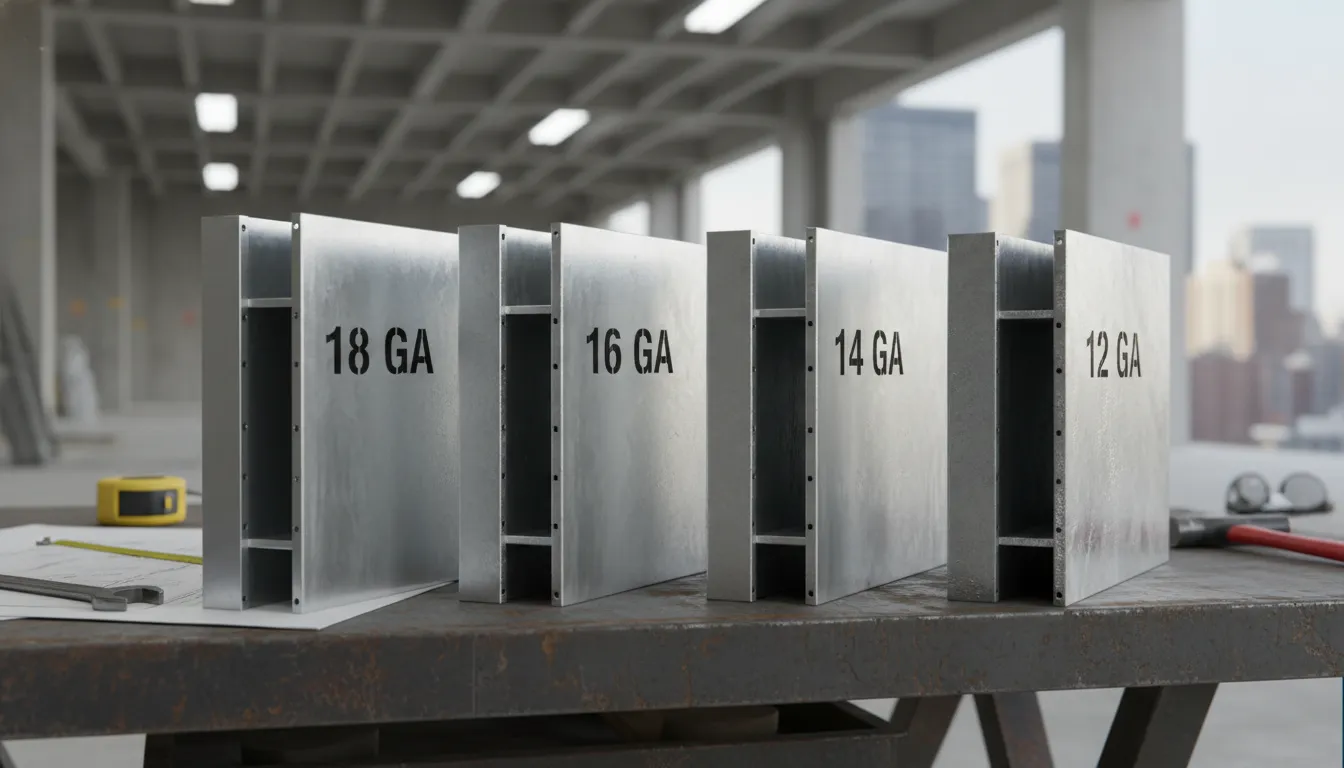
How 12, 14, 16, and 18 gauge steel doors compare
Direct answer: Use 12 gauge for maximum-duty openings. Use 14 gauge for heavy-duty commercial use. Use 16 gauge for balanced interior durability. Use 18 gauge for protected low-abuse openings.
The best gauge depends on the opening. A thicker door is not automatically better for every project. It may be the right choice for a high-impact exterior door, but unnecessary for a protected interior closet. The table below gives a practical comparison for common commercial project decisions.
- 12 gauge: Very heavy duty. Common fit for high-security openings, severe abuse areas, industrial spaces, and high-impact back-of-house areas.
- 14 gauge: Heavy duty. Common fit for exterior doors, vestibules, loading areas, schools, service corridors, and frequent cart traffic.
- 16 gauge: Standard to heavy commercial duty. Common fit for commercial interiors, multifamily common areas, mechanical rooms, offices, and moderate traffic corridors.
- 18 gauge: Light to standard duty. Common fit for low-abuse interior rooms, protected utility openings, and projects where cost and weight matter.
| Gauge | Strength position | Best-fit openings | Cost and handling impact |
|---|---|---|---|
| 12 gauge | Very heavy duty | Security, industrial, severe-abuse, impact-prone areas | Highest weight and cost. Coordinate hardware and frame. |
| 14 gauge | Heavy duty | Exterior doors, loading areas, institutions, service corridors | Higher cost than lighter gauges. Strong value in abuse-prone openings. |
| 16 gauge | Balanced commercial duty | Offices, retail, multifamily common areas, mechanical rooms | Good balance of cost, durability, and availability. |
| 18 gauge | Light to standard duty | Protected rooms, low-traffic interiors, budget-sensitive areas | Lower cost and easier handling. Less dent resistant. |
Universal Fire Doors offers custom steel doors in 12, 14, 16, and 18 gauge specifications. That range gives project teams flexibility when a schedule includes mixed openings. A building may need 14 gauge exterior doors, 16 gauge corridor doors, and 18 gauge low-abuse interior doors on the same project.
Specifying every opening at the same gauge can waste budget or create performance gaps. The better approach is to group openings by exposure, traffic, security, fire rating, and hardware loads. Then the gauge can be assigned with intent.
This is also where a local manufacturer can prevent delays. If a stock distributor only has one common gauge available, the project may compromise. Custom fabrication allows the door package to follow the spec, not the other way around. For related custom steel construction options, compare steel and aluminum applications in the commercial aluminum doors vs. custom steel doors guide.
Which gauge fits your commercial project?
Direct answer: Match gauge to the door's real job. The more abuse, exposure, security pressure, and hardware use the opening faces, the more likely it needs 14 gauge or 12 gauge construction.
Start with the opening's job. A door that protects a street-level mechanical room has a different job than a door between an office suite and a storage closet. The schedule should reflect that difference instead of treating every opening as interchangeable.
High-security and exterior openings
For exterior doors, street-facing doors, rear exits, loading docks, and equipment rooms, 14 gauge or 12 gauge may be appropriate. These openings often face impact, weather exposure, forced-entry risk, and frequent hardware use. The heavier steel can help the door resist dents and deformation.
Institutional and high-traffic interiors
Schools, hospitals, hotels, and multifamily buildings often have heavy daily traffic. Corridor doors, stair doors, service doors, and back-of-house doors may need 14 gauge or 16 gauge construction depending on use. A lighter door can look acceptable at turnover, then show damage quickly once carts, stretchers, bins, and tenant traffic begin.
Moderate-use commercial interiors
Many interior commercial openings work well with 16 gauge doors. This is often a practical balance for office, retail, storage, and mechanical spaces that need commercial durability without the extra cost of a maximum-duty door.
Protected or low-abuse openings
For low-traffic interior openings, 18 gauge may be sufficient when the rating, hardware, and code requirements allow it. This can help control cost and weight. Still, the project team should confirm the expected use, not just the room name on the schedule.
For broader door package planning, review Universal Fire Doors' commercial hollow metal doors page. It explains custom fabrication for commercial openings, including frames, hardware, and fire-rated needs.
How does door gauge affect durability and security?
Direct answer: Door gauge affects dent resistance, deformation resistance, and security strength. Heavier gauges perform best when the frame, anchors, hinges, locks, and hardware reinforcements are specified to match.
Door gauge affects how well the steel skin resists dents, twisting, punctures, and long-term abuse. A thicker skin gives the door more material to absorb impact. That matters in corridors, loading areas, schools, hospitals, and any building where carts or equipment strike doors during normal use.
Durability
A heavier gauge can reduce visible damage and help the door stay flatter over time. That can protect the appearance of the opening, but it also supports function. A warped or damaged door may stop latching cleanly, rub the frame, or create problems during inspection.
Durability is not only about the face sheet. The frame, core, hinge reinforcement, closer reinforcement, lock reinforcement, anchors, and installation must match the opening. A heavy door installed in an underbuilt frame can still perform poorly.
Security
Heavier gauge doors can support higher security goals because they are harder to deform. For security openings, gauge should be coordinated with locksets, exit devices, hinges, glazing, louvers, astragals, and frame anchorage. The door leaf is only one part of the security system.
Lifecycle cost
A thicker door costs more up front, but it can lower replacement and repair costs in high-abuse areas. A lighter door may be the better value in a protected opening. The best specification looks at the total lifecycle, not just the purchase price.
Ask Universal Fire Doors to review the opening schedule before you lock in the gauge mix.
For teams planning related frames, the guide to steel door frames can help explain how frame type and installation affect the final assembly. For hardware planning, the commercial door hardware installation guide explains why hinges, closers, locks, and exit devices must be coordinated with the door package.
How does gauge impact a fire-rated door assembly?
Direct answer: Gauge does not create a fire rating by itself. A rated opening requires a tested and labeled assembly, including the door, frame, hardware, glazing, seals, clearances, labels, and installation.
This distinction is critical. A thick steel door without the correct label and assembly details is not automatically a code-compliant fire door. The project team must specify the required rating, confirm the approved assembly, and make sure every component is compatible.
Universal Fire Doors provides fire-rated assemblies from 20 minutes to 3 hours when specified for the project. In NYC work, that rating must match the building use, wall rating, location, and authority requirements. Stairwells, corridors, mechanical rooms, shafts, and occupancy separations can each have different needs.
Gauge still matters in fire-rated work because rated doors also have to survive daily use. A door in a rated stairwell may see constant tenant traffic. A rated service door may see carts and equipment. In those cases, a heavier gauge can help preserve the assembly's function over time.
Clearances and hardware are just as important. If the door does not close and latch properly, the rating can be compromised in practice. That is why the gauge decision should be made with the frame, hinges, closer, latch, exit device, gasketing, and installer in mind. For fire rating details, see Universal Fire Doors' fire door ratings explained guide and the fire-rated steel doors specification guide.
What is the difference between 16 gauge and 18 gauge steel doors?
Direct answer: A 16 gauge steel door uses thicker steel than an 18 gauge steel door. It usually offers better impact resistance and longer service life, while 18 gauge can reduce cost and weight in low-abuse interiors.
For many commercial interiors, 16 gauge is a strong middle-ground choice. It is often used where the door may see regular traffic, cleaning equipment, tenant movement, or light service use. It can be a smart upgrade when the opening is visible, important, or likely to be touched every day.
An 18 gauge door can be appropriate for lighter-duty interior openings. If the room is protected, traffic is low, and there is no special abuse risk, the lighter gauge may meet the project need while saving budget. This can be useful on large projects with many similar low-risk openings.
The upgrade from 18 gauge to 16 gauge is worth considering when the opening has a closer, exit device, heavy lock use, cart traffic, or public access. It is also worth considering when replacement would be disruptive or expensive later. The material upgrade can be cheaper than a callback, repair, or early replacement.
Project teams should avoid choosing between 16 and 18 gauge by price alone. The better question is simple: what happens at this opening after one year of real use? If the answer includes frequent impact or abuse, 16 gauge often deserves serious consideration.
How to specify the right commercial steel door gauge
Direct answer: Specify gauge after confirming use, abuse level, rating, frame, hardware, security needs, budget, lifecycle cost, lead time, and fabrication requirements.
A clear specification process prevents overbuilding some openings and underbuilding others. Use the steps below before finalizing the door schedule.
- Confirm the opening use. Identify whether the door is exterior, interior, public, staff-only, service, rated, secured, or low-use.
- Define the abuse level. Consider carts, equipment, school traffic, hospital traffic, deliveries, weather, and tenant movement.
- Confirm fire-rating requirements. Determine whether the opening needs a 20-minute, 45-minute, 60-minute, 90-minute, or 3-hour assembly.
- Coordinate the frame and hardware. Match the door gauge with frame gauge, hinges, closers, locks, exit devices, anchors, and reinforcements.
- Review security needs. Decide whether the opening needs heavier steel, reinforced hardware, special glazing, or other protective details.
- Balance budget against lifecycle cost. Use lighter gauges where they fit, but invest in heavier gauges where damage or replacement is likely.
- Confirm lead time and fabrication requirements. Work with a manufacturer that can produce the required gauge, size, rating, and hardware prep.
Universal Fire Doors manufactures and installs custom commercial steel doors from its Brooklyn operation. The company supports exact specifications, no minimum order requirements, and fast 3 to 5 day lead times for many custom door needs.
For a general overview of hollow metal construction, see the Hollow Metal Door 101 guide. It can help project teams connect gauge selection with cores, frames, and hardware choices. If you are also comparing repair and replacement timing, the commercial door replacement guide can help identify when a damaged door should be replaced rather than patched.
Frequently asked questions about commercial steel door gauge
What is the best gauge for a steel door?
The best gauge depends on the opening. High-abuse or high-security openings may need 12 or 14 gauge. Many commercial interiors use 16 gauge. Protected, low-traffic interiors may be suitable for 18 gauge when code and hardware needs allow it.
What is the thickness of a commercial metal door?
Many commercial hollow metal doors are 1-3/4 inch thick, but the steel skin gauge can vary. The schedule should identify both the door thickness and the gauge or duty level needed for the opening.
How does door gauge affect steel door durability?
Lower gauge numbers mean thicker steel. Thicker steel generally resists dents, twisting, and impact better than thinner steel. Durability also depends on core, frame, hardware reinforcement, anchors, and installation quality.
Which steel door gauge is standard for security doors?
Security doors often use heavier gauges such as 14 gauge or 12 gauge, depending on the risk level. The final security performance also depends on the frame, locks, hinges, glazing, and anchorage.
Request the right gauge for your next door package
Universal Fire Doors helps contractors, property managers, and facility teams specify commercial steel doors that fit the opening, code requirement, and project timeline. If your schedule calls for 12, 14, 16, or 18 gauge doors, the team can fabricate the right assembly. They can also coordinate the details that matter.