
Most residential doors in the U.S. use one of two common backset sizes, typically used for interior and exterior doors respectively. Commercial doors generally follow the exterior door standard. Before you order any lock, knob, or lever, measure your door’s backset. That single step prevents the vast majority of wrong-hardware returns. For fire-rated or commercial doors, always cross-reference UL-approved manufacturer templates or consult a specialist like Ufiredoors before ordering.
Table of Contents
- What a door backset is and why getting it wrong costs you
- Standard U.S. backset sizes and where each is used
- How to measure your door backset correctly
- Compatibility checklist: confirm fit before you buy
- Non-standard backsets: vintage, mortise locks, and specialty sizes
- Door prep and installation: bores, faceplates, strikes, and when to re-bore
- When to hire a professional for door hardware installation
- Common mistakes and quick fixes when hardware doesn’t fit
- Quick-reference cheat sheet: backset sizes, bores, and door types
- Key Takeaways
- The measurement nobody takes seriously enough
- Ufiredoors handles the installations that can’t afford a mistake
- Useful sources and manufacturer resources
What a door backset is and why getting it wrong costs you
The backset is the horizontal distance from the flat edge of the door (the side where the latch exits) to the center of the bore hole, which is typically 2-1/8" in diameter on most residential doors. Lowe’s defines it as the measurement that determines where the latch sits inside the door and whether it will engage the strike plate correctly.
People often confuse backset with bore diameter or door thickness. They are three separate measurements, and all three matter.
Here is what goes wrong when the backset is off:
- Latch won’t engage: If the backset is too short, the latch bolt doesn’t reach the strike plate, and the door won’t latch at all.
- Bolt won’t throw fully: A backset that’s too long pushes the bolt toward the stile edge, leaving it partially exposed or unable to extend completely.
- Weakened stile: Boring too close to the door edge removes structural wood or steel, compromising the stile’s integrity and potentially voiding a fire-door rating.
- Hardware won’t seat flush: Faceplates and rose plates are sized for specific backsets. A mismatch leaves visible gaps or prevents the trim from sitting flat.
Standard U.S. backset sizes and where each is used
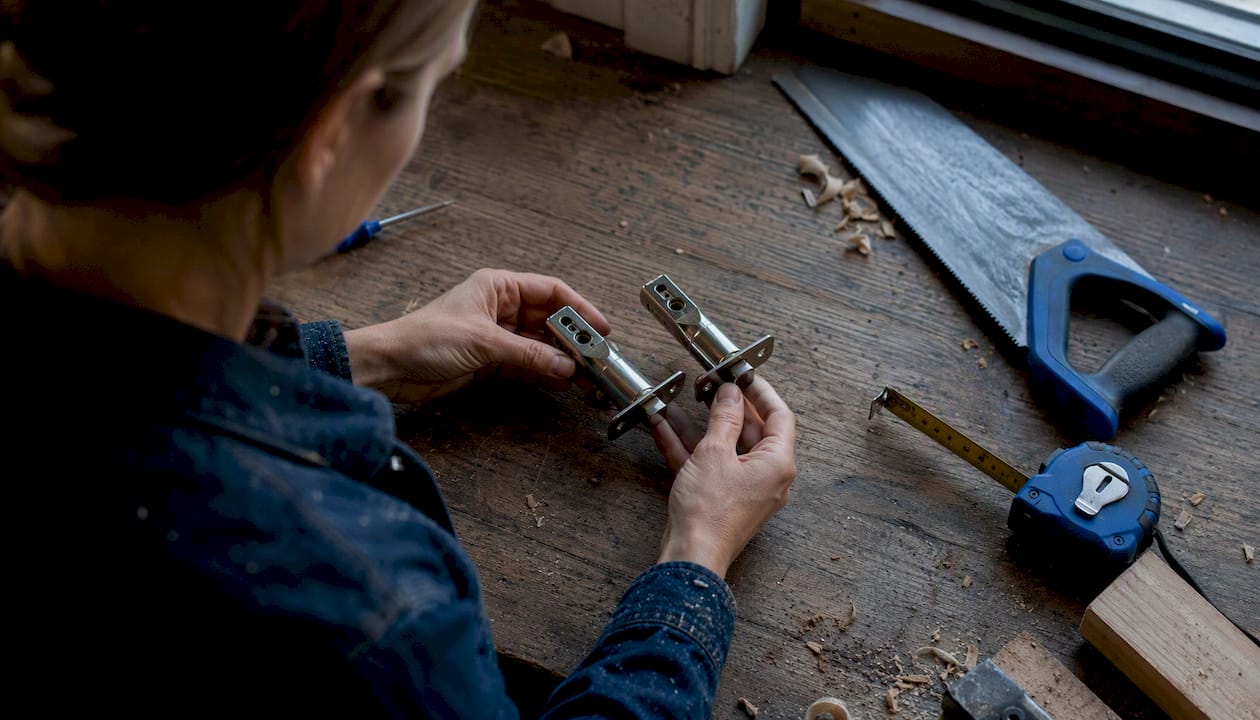
Most residential and light commercial doors use one of two common backset sizes that correspond generally with interior and exterior door uses. Custom doors or millwork may vary in backset dimensions, so always verify measurement before ordering hardware.
How to measure your door backset correctly
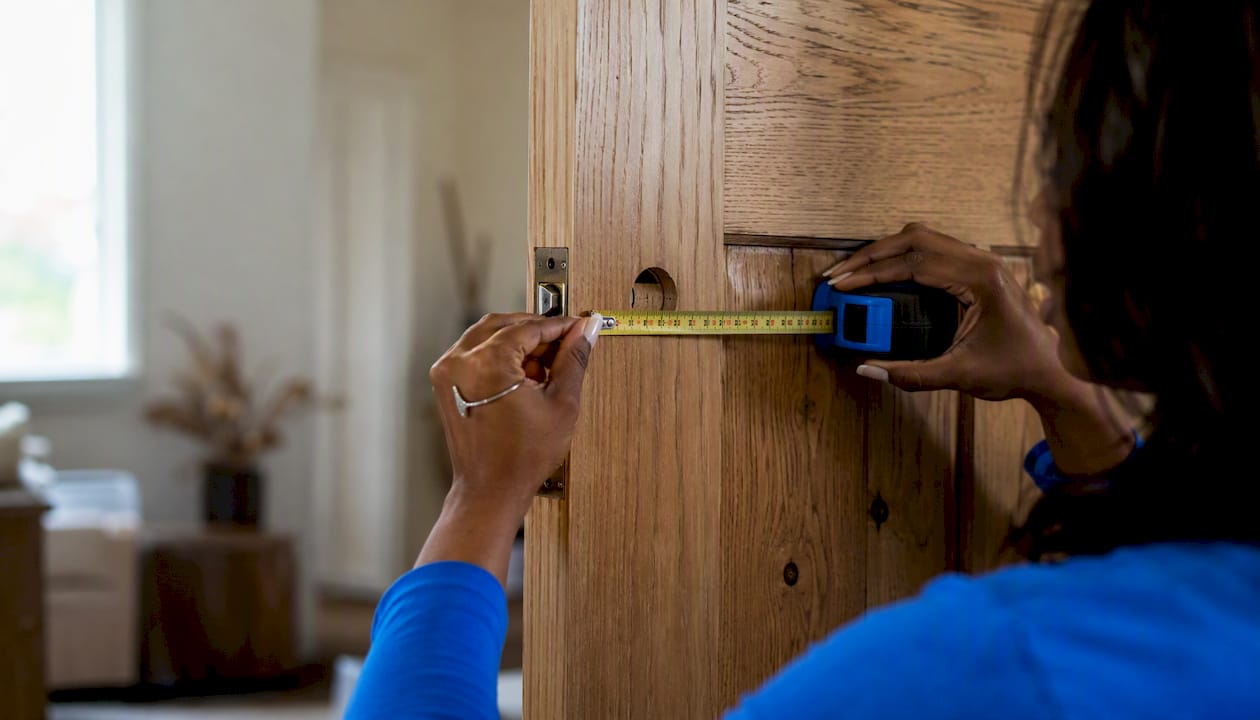
Getting the measurement right takes about two minutes with the right approach. Rushing this step is the single most common reason people order the wrong hardware.
Tools you need: a tape measure, a pencil, a small square (optional), and calipers if you want precision on the bore diameter.
- Open the door fully so you have clear access to the latch edge and the bore hole.
- Locate the center of the bore hole. If hardware is already installed, find the center of the spindle or knob spindle hole. If the door is bare, look for the center of the large circular cutout.
- Measure from the flat door edge (not the stop or the bevel) straight across to the center of the bore hole. That number is your backset.
- Record bore diameter and door thickness while you’re there. Bore diameter is almost always 2-1/8"; door thickness is typically 1-3/8" for interior and 1-3/4" for exterior.
- Double-check by measuring twice from two points on the edge to confirm the bore is centered.
The most common measuring mistake is measuring to the edge of the bore hole instead of its center. That error adds roughly 1" to your reading and sends you to the wrong hardware size every time.
Pro Tip: Measure before removing any existing hardware. With hardware in place, you can measure to the spindle center directly, which is more accurate than estimating the center of a bare hole. Write down backset, bore diameter, and door thickness together — you’ll need all three when ordering.
Compatibility checklist: confirm fit before you buy
Run through this list before placing any order. Skipping even one item is how a $150 lockset ends up back in the box.
Backset: Confirmed as 2-3/8" or 2-3/4" (or non-standard — see below).
Bore diameter: Standard is 2-1/8". Some older doors use a 1-1/2" bore; verify before ordering a modern lockset. Hardware listings specify door-thickness ranges and bore requirements — read them.
Cross-bore diameter: The smaller hole drilled from the edge into the main bore. Usually 1" on residential doors.
Door thickness: 1-3/8" is standard for interior; 1-3/4" for exterior and commercial. Many locksets specify a thickness range on the packaging.
Latch type: Tubular latches fit most residential knobs and levers. Mortise latches are a different animal entirely and are not interchangeable with tubular hardware.
Adjustable backset availability: Many modern tubular locksets include an adjustable latch that slides or twists to lock into either the 2-3/8" or 2-3/4" position. This is a genuine convenience for replacements, but it does not apply to mortise locks or most deadbolts.
Faceplate shape: Rectangular or radius-corner? The faceplate must match the existing mortise in the door edge, or you’ll need to chisel it out.
Strike plate alignment: Measure the distance from the door edge to the strike plate center on the frame. It must match the latch backset.
Handing: Some lever sets are handed (left or right). Confirm before ordering.
Pro Tip: Photograph the existing hardware, the bore hole, and the door edge before you go shopping or contact a supplier. Send those photos with your measurements. Suppliers who see the actual door can flag compatibility issues before you buy, not after.
Non-standard backsets: vintage, mortise locks, and specialty sizes
Not every door fits the 2-3/8" or 2-3/4" mold. Older homes and specialty installations can throw up sizes that stop a standard hardware swap cold.
Non-standard backsets found in vintage homes and commercial buildings include 2", 2-1/2", 3", and up to 5" for grand entry designs. If you pull out a tape and land on one of those numbers, you’re likely dealing with original hardware that was custom-bored decades ago.
Mortise locks are the most common source of confusion here. Unlike a tubular lockset that drops into a round bore, a mortise lock requires a rectangular pocket cut into the door stile. Each manufacturer’s mortise case has its own dimensions, and the backset is fixed by where that pocket sits. Mortise locks require precise pocket dimensions and manufacturer templates — they are rarely interchangeable, and forcing a mismatched case into an existing pocket creates both security and code compliance problems.
A few other constraints worth knowing:
- Stile width limits your options. Narrow stiles below roughly 4"–4.5" may not accommodate a 2-3/4" backset because the bore would weaken or exit the stile entirely. This is a structural constraint, not a hardware one.
- Fire-rated and commercial doors — often have fixed, non-adjustable backset requirements tied to the door schedule. Changing the backset on a listed fire door without recertification can void the rating.
Door prep and installation: bores, faceplates, strikes, and when to re-bore
Standard residential door prep uses a 2-1/8" cross-bore (the large hole through the face) and a ~1" edge bore (the smaller hole from the latch side). Door thickness and bore diameter together determine which hardware packages will physically fit without modification.
When you can swap hardware without re-boring: If the new lockset matches the existing backset, bore diameter, and door thickness, it drops in. An adjustable latch handles the 2-3/8"/2-3/4" range without any drilling.
When re-boring is unavoidable: A fixed deadbolt with a different backset than the existing prep, a stile too narrow for the desired backset, or a bore that’s the wrong diameter all require new holes. Re-boring a wood door is a manageable DIY task with a hole saw kit and a sharp chisel. Re-boring a hollow metal or steel door is a different job — it requires the right bits, a drill press or magnetic drill, and experience with metal fabrication.
Faceplate and strike plate alignment must be rechecked any time the backset changes. The strike plate on the frame is positioned for the original latch location; move the latch and the strike moves too.
Pro Tip: If you’re re-boring a door, mark the new center with a center punch before drilling. Drill from both faces toward the center to prevent tearout on wood doors, and use cutting fluid on metal doors. A misaligned bore is far harder to fix than a misaligned strike.
When to hire a professional for door hardware installation
Some jobs genuinely need a pro. Knowing the line before you start saves time, money, and the risk of a failed inspection.
Clear triggers to call a professional:
- Fire-rated doors. Any hardware change on a fire-rated door must use UL-listed components and may require re-inspection. Commercial fire-door hardware requirements in jurisdictions like New York City are specific about latching, backset, and panic hardware. DIY changes can void the door’s listing.
- Mortise lock replacement or installation. The pocket work alone requires precision routing or chiseling; a mistake removes material that can’t be put back.
- Non-standard backsets requiring re-boring on metal doors. Steel and hollow metal doors need specialized tooling and experience.
- Structural stile constraints. If the stile is too narrow for the hardware you need, the solution may involve a different door, not just different hardware.
- Code-regulated or ADA-compliant installations. Lever height, operating force, and hardware type are all regulated. Getting them wrong triggers violations.
Questions to ask any contractor before hiring:
- Do you work with UL-rated hardware, and can you provide documentation?
- Have you installed mortise locks or fire-door hardware in this door type before?
- What are your lead times, and do you offer emergency service?
- Are you licensed and insured for this work in this jurisdiction?
- What warranty do you provide on labor and hardware?
Pro Tip: Gather your backset measurement, bore diameter, door thickness, and a photo of the existing hardware before you call anyone for an estimate. Contractors who get this information upfront give faster, more accurate quotes — and you avoid a second site visit just to collect measurements.
Common mistakes and quick fixes when hardware doesn’t fit
Most installation problems trace back to one of a handful of errors. Here’s how to diagnose and fix them.
- Measured to the hole edge, not the center. Re-measure to the bore center. The correct backset is almost always 1" shorter than what you recorded.
- Wrong latch length ordered. If the new latch is close but not exact, check whether it’s an adjustable model. Slide or twist it to the correct position. If it’s fixed and wrong, return it and order the right size or an adjustable replacement.
- Bore too close to the stile edge. This is a structural problem. Switching to a smaller backset (if the door allows) or choosing hardware with a narrower rose plate may help. If the stile is already compromised, consult a pro before proceeding.
- Faceplate doesn’t fit the existing mortise. If the new faceplate is smaller, you can fill and repaint the gap. If it’s larger, you’ll need to chisel out the mortise — straightforward on wood, not on metal.
- Strike plate misaligned after a backset change. Reposition the strike plate on the frame to match the new latch location. Fill the old screw holes with wooden dowels and wood glue before re-drilling.
Safety warnings: Never re-bore a fire-rated door without confirming the new prep is compatible with the door’s UL listing. Removing material from a fire door’s stile can compromise its integrity rating. If you’re unsure whether a door is fire-rated, check the door label on the hinge edge before touching anything.
Fixes you can do yourself: Adjusting an adjustable latch, repositioning a strike plate, swapping a tubular lockset on a standard wood door.
Fixes that need a pro: Re-boring metal doors, mortise pocket work, any hardware change on a fire-rated or code-regulated door.
Quick-reference cheat sheet: backset sizes, bores, and door types
Screenshot this table before your next hardware run.
| Backset | Bore Diameter | Door Thickness | Typical Use | Adjustable Latch? |
|---|---|---|---|---|
| 2-3/8" | 2-1/8" | 1-3/8" (interior) | Interior passage, privacy, dummy sets | Yes — most tubular locksets |
| 2-3/4" | 2-1/8" | 1-3/4" (exterior) | Exterior entry, deadbolts, commercial locksets | Yes — most tubular locksets |
| Non-standard (2"–5") | Varies | Varies | Vintage, mortise, custom entry | No — manufacturer-specific |
This table covers the vast majority of U.S. residential and light commercial installations. It does not apply to mortise locks, vintage hardware with custom pocket dimensions, or specialty commercial doors with fixed door-schedule requirements. For those, use the manufacturer’s template and verify against the door schedule before ordering anything.
Key Takeaways
Measure backset, bore diameter, and door thickness before ordering any hardware — those three numbers together determine whether a lockset will fit without modification.
| Point | Details |
|---|---|
| Two standard sizes cover most doors | 2-3/8" suits interior doors; 2-3/4" suits exterior doors, deadbolts, and commercial locksets. |
| Measure to bore center, not edge | Measuring to the hole edge adds roughly 1" and sends you to the wrong hardware size. |
| Adjustable latches save re-boring | Most tubular locksets cover both standard backsets, but this does not apply to mortise locks or fixed deadbolts. |
| Mortise and fire-rated doors need a pro | Non-standard backsets, mortise pockets, and fire-door hardware require professional tools, UL-listed components, and often re-inspection. |
| Ufiredoors handles complex installations | For fire-rated steel doors, commercial hardware, or code-compliance work in New York and the Northeast, Ufiredoors fabricates and installs to UL standards. |
The measurement nobody takes seriously enough
Here’s the thing about backset: it’s a two-minute measurement that most people skip, then spend two hours at the hardware store trying to fix. The industry has done a reasonable job standardizing around 2-3/8" and 2-3/4", and adjustable latches have made the margin for error wider than it used to be. But that convenience has also made people sloppy.
The cases that go sideways aren’t the standard residential swaps. They’re the ones where someone assumes a vintage door matches a modern spec, or decides a mortise lock is “basically the same” as a tubular one, or changes hardware on a fire-rated door without checking the door schedule. Those mistakes don’t just cost money. On a fire-rated door, they can cost a building its certificate of occupancy.
My honest view: the two-standard-sizes world is genuinely simple for most homeowners. Measure once, confirm bore and thickness, buy an adjustable latch if you’re not certain, and you’ll be fine. The moment you’re looking at a mortise lock, a metal door, or anything with a fire label on the hinge edge, the calculus changes completely. That’s not a job for a YouTube tutorial. It’s a job for someone who has done it a hundred times on doors that actually matter.
Ufiredoors handles the installations that can’t afford a mistake
When the door is fire-rated, the hardware is mortise, or the backset doesn’t match anything on a standard shelf, that’s where Ufiredoors comes in. As a New York-based manufacturer and installer with over 20 years of experience, Ufiredoors fabricates and installs fire-rated steel doors built to UL standards, with hardware selected to match the door schedule exactly. No guessing on backset compatibility. No voided ratings from a mismatched latch.
Services include fabrication, installation, emergency repair, and code compliance inspections for commercial, residential, and industrial properties across New York and the Northeast. Before you call, pull your backset measurement, bore diameter, door thickness, and a photo of the existing prep. That information lets the team give you an accurate estimate on the first call. Request a free site estimate and get the right hardware installed right the first time.
Useful sources and manufacturer resources
These resources give you measurement guides, manufacturer templates, and installation specs for standard and specialty hardware:
- How to Determine the Backset of Your Door — Lowe’s: Step-by-step measurement instructions with diagrams; good starting point for homeowners.
- Door Backset — Reeb Learning: Explains stile width constraints and structural limits on backset choices.
- Door Hardware Terminologies — Ufiredoors: Professional reference for bore, backset, cross-bore, faceplate, and related terms.
For mortise or custom hardware, always download the manufacturer’s installation template before ordering. Templates specify the exact pocket dimensions, backset, and spindle location — no template, no guarantee of fit.