
Door hardware terminologies are the standardized vocabulary construction and building management professionals use to specify, procure, and install every component of a door assembly correctly. Misusing even one term, such as confusing “backset” with “bore diameter,” can trigger costly reorders, failed inspections, and code violations. The ISO 21174:2026 standard now provides a global framework organizing door hardware into six defined categories, giving specifiers a consistent reference across jurisdictions. Mastering this vocabulary is not optional for professionals working on commercial projects. It is the foundation of accurate specification, compliant procurement, and successful installation.
What are the core door hardware terminologies and component categories?
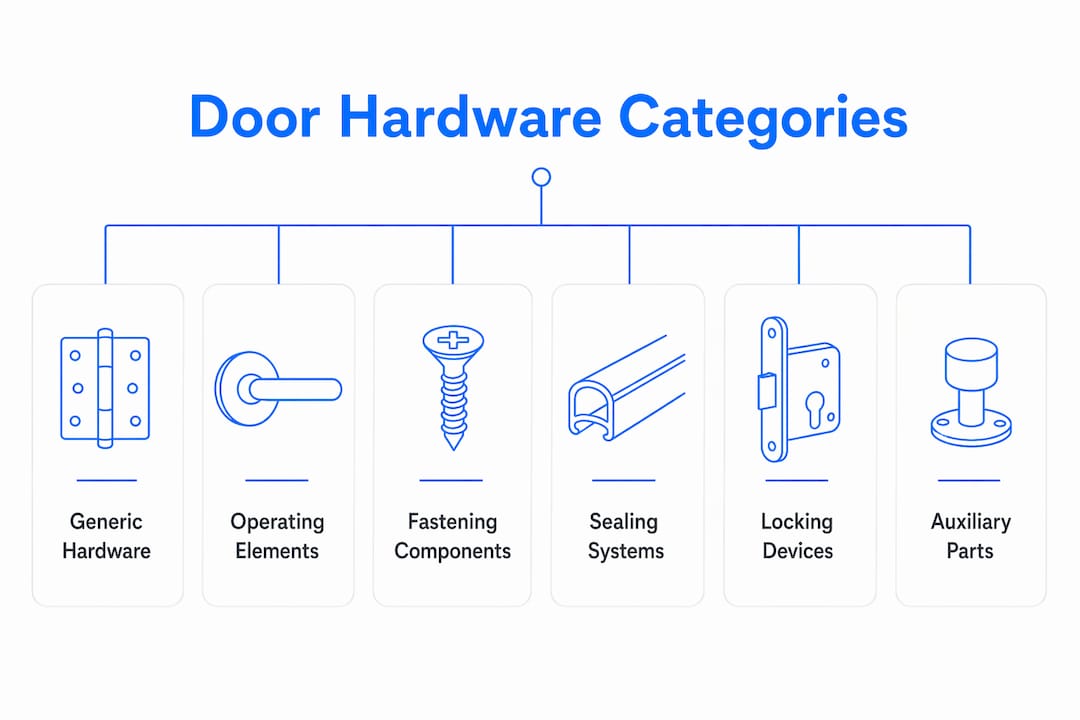
The ISO 21174:2026 standard organizes door hardware into six categories: generic hardware, operating elements, fastening elements, supporting elements, hold-open and controlling elements, and system-specific hardware. This classification gives specifiers a shared mental model that works across manufacturers, project types, and building codes. Understanding where each component fits within this structure prevents specification gaps.
Generic hardware covers the broadest components, including door frames, thresholds, and weatherstripping. These elements define the opening itself before any functional hardware is added. Operating elements are the components a user directly touches: handles, knobs, levers, push plates, and pull bars. These drive most of the aesthetic decisions on a project.
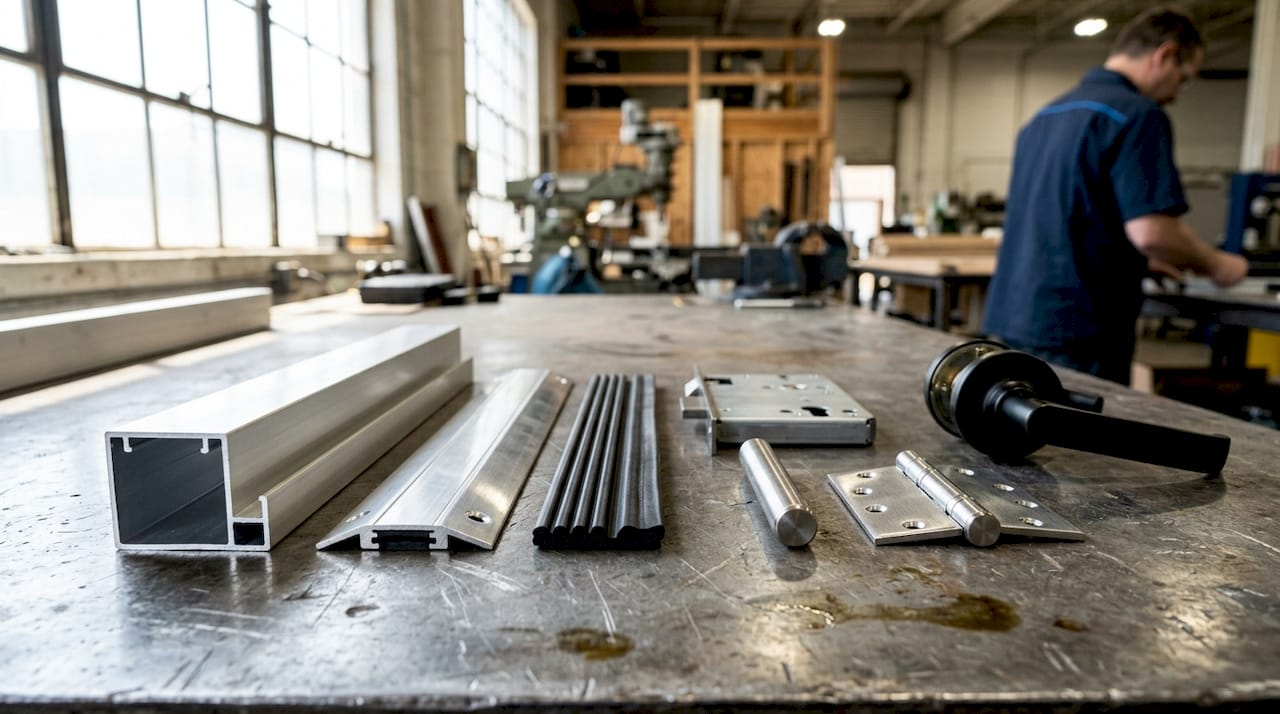
Fastening elements include hinges, pivots, and screws. They hold the door in the frame and bear the full weight of the leaf. Supporting elements cover closers, floor stops, and wall stops, which control door movement and protect surrounding surfaces. Hold-open and controlling elements include electromagnetic hold-open devices and door coordinators used on paired doors. System-specific hardware refers to access control readers, electric strikes, and electrified mortise locks that integrate with building security systems.
Here is a quick reference for the most common components in each functional group:
- Hinges: Ball-bearing hinges are standard for commercial doors. Non-removable pin hinges are required on outward-swinging doors to prevent hinge removal from the unsecured side.
- Locks: Mortise and cylindrical (bored) are the two primary lock body types in commercial construction.
- Exit devices: Also called panic hardware, these allow egress under pressure and are required by code on many commercial doors.
- Door closers: Surface-mounted or concealed, closers control the speed and force of door closure to meet ADA and fire code requirements.
- Seals: Intumescent seals expand under heat to block smoke and flame at the door perimeter on fire-rated assemblies.
Pro Tip: When building a door hardware types list for a project, organize it by ISO category first, then by opening number. This structure maps directly to the hardware schedule and reduces coordination errors between the architect, specifier, and contractor.
What measurement and specification terms do professionals need to know?
Precise measurement terminology is where most specification errors originate. Getting these definitions right before ordering prevents field failures and change orders.
The five terms that drive most installation decisions
Backset: The horizontal distance from the door edge to the center of the lock or handle bore. The standard commercial backset is 2-3/4 inches. Mismatching the backset to the door stile width causes the lock face to sit off-center or the handle to conflict with the frame.
Door handing: The convention for determining which side of a door the hinge is on and which direction it swings. Handing is determined by standing on the secure side of the door and observing the hinge position. Left-hand and right-hand designations follow this rule universally in commercial hardware.
Door thickness: Most commercial steel doors are 1-3/4 inches thick. Hardware is specified to match this dimension. Ordering hardware for a 1-3/8 inch door on a 1-3/4 inch assembly creates a non-functional installation.
Bore diameter: The diameter of the hole drilled through the door face for a cylindrical lock. The standard bore is 2-1/8 inches. Mortise locks do not use a face bore; they require a recessed pocket cut into the door edge instead.
Frame preparation (frame prep): The cutouts, reinforcements, and strike placements machined into the door frame to accept specific hardware. Frame prep must be specified at the factory for steel frames. Field modifications to frame prep on fire-rated assemblies can void the door’s listing.
Pro Tip: Always verify backset, bore diameter, and handing against the hardware schedule before submitting a purchase order. These three variables account for the majority of hardware return and reorder situations on commercial projects.
The table below summarizes the key measurement terms and their standard commercial values:
| Term | Standard Commercial Value | Consequence of Error |
|---|---|---|
| Backset | 2-3/4 inches | Lock misalignment, handle conflict with frame |
| Door thickness | 1-3/4 inches | Hardware incompatibility, non-functional installation |
| Bore diameter | 2-1/8 inches | Lock body does not seat correctly |
| Frame prep | Factory specified | Field modification voids fire rating |
| Door handing | Secure-side convention | Wrong-handed hardware ordered and delivered |
Hardware schedules are the documents that consolidate all of these measurements into a single reference per opening. The schedule is legally binding in many jurisdictions and governs procurement when it conflicts with architectural drawings.
How do lock types and hardware functions differ in commercial settings?
Lock terminology is the most misused area of the door hardware glossary. Professionals who conflate lock types with lock functions order the wrong product for the application.
Lock types describe the physical construction of the lock body. A mortise lock requires a recessed pocket cut into the door edge. Mortise locks are preferred in high-traffic commercial doors because they offer superior durability and support multiple functions within a single body. A cylindrical lock (also called a bored lock) is installed through a hole drilled in the door face. It is lighter duty and faster to install, making it common in lower-traffic interior applications.
Lock functions describe how the lock operates, regardless of its physical type. The most common commercial functions include:
- Passage: No locking mechanism. The latch retracts freely from both sides. Used on closets and non-secure interior doors.
- Privacy: Locking from the inside only, with an emergency release on the outside. Used in restrooms and hotel rooms.
- Entry: Key-controlled from the outside, lever or thumb-turn from the inside. The standard function for most commercial entry doors.
- Storeroom: Always locked from the outside. Requires a key to enter at all times. Used in stock rooms and server rooms.
- Classroom: Locked from the outside by key, always free from the inside. Meets security requirements for educational facilities.
Exit devices (panic hardware) are a separate category entirely. They allow the door to open under body pressure from the inside without requiring knowledge of a locking mechanism. Exit devices are required by the International Building Code on doors serving high-occupancy spaces. Specifying the correct exit device trim, such as a lever trim versus a pull trim, determines whether the outside of the door is key-controlled or free-access.
For fire-rated door hardware, every lock and exit device must carry a UL listing that matches the door’s fire rating. Substituting an unlisted component, even temporarily, violates NFPA 80 and voids the assembly’s certification.
What are common specification pitfalls in door hardware compliance?
Specification errors in door hardware are rarely random. They cluster around a few predictable failure points that professionals encounter repeatedly across commercial projects.
Incorrect handing is the most frequent ordering mistake. Door handing errors occur when the specifier or contractor applies the handing convention from the wrong side of the door. The result is hardware that physically cannot be installed as ordered. Confirming handing on every opening during the submittal review stage eliminates this problem.
Missing fire-rated hardware specifications create serious liability. When a hardware schedule lists a generic closer or hinge without specifying a fire-rated version, the installer may substitute a non-listed product. Field modifications such as drilling additional holes for non-listed hardware void the fire door’s certification under NFPA 80. Only listed and approved hardware may be installed on fire-rated assemblies.
Ignoring finish durability is a costly long-term error. Hardware finishes are protective layers, not decorative choices. Specifying a standard satin chrome finish on an exterior coastal door, where salt air accelerates corrosion, leads to premature failure within a few years. The finish must match the environmental conditions of the opening.
“Unauthorized modifications to fire doors nullify their fire rating. Every component on a fire-rated assembly must be listed and approved. The hardware schedule is the legal document that defines what is permitted. Deviating from it, even for a single fastener, puts the entire assembly’s certification at risk and exposes the building owner to code violations under NFPA 80.”
The Door and Hardware Institute (DHI), the Steel Door Institute (SDI), and NFPA each publish standards that govern compliant specification. Referencing these bodies in the hardware schedule, alongside the 2026 compliance requirements, gives the project team a clear audit trail for inspections and certificate of occupancy reviews.
Pro Tip: Treat the hardware schedule as a living document. Update it every time a substitution is approved during construction. An outdated schedule creates discrepancies between what was specified and what was installed, which becomes a serious problem during fire door inspections.
Key Takeaways
Mastering door hardware terminology requires knowing the ISO 21174:2026 categories, precise measurement conventions, lock function distinctions, and NFPA 80 compliance rules as an integrated system, not as isolated facts.
| Point | Details |
|---|---|
| ISO 21174:2026 framework | Organizes all door hardware into six categories for consistent specification across projects. |
| Backset and handing accuracy | Verify both against the hardware schedule before ordering to prevent costly reorders. |
| Lock type vs. lock function | These are distinct concepts; confusing them leads to wrong products for the application. |
| NFPA 80 and fire-rated assemblies | Only listed hardware may be installed on fire-rated doors; field modifications void certification. |
| Hardware schedule authority | The schedule governs procurement and is legally binding when it conflicts with drawings. |
Why terminology mastery changes how you specify hardware
After years of working with commercial door assemblies, the pattern I see most often is this: professionals who treat hardware as a list of parts consistently run into coordination failures. Professionals who treat it as a system rarely do.
The hardware schedule is the clearest example. Most teams treat it as a procurement checklist. The better approach is to treat it as the single source of truth for the entire opening, from the frame prep to the finish code. When the schedule is built with precise terminology, every trade, from the steel fabricator to the access control installer, works from the same language. When it is built loosely, every trade interprets it differently.
The other thing I have seen underestimated repeatedly is finish selection. Specifiers often defer to the architect’s aesthetic preference without checking the environmental rating of the finish. A beautiful satin brass lever on a high-humidity corridor door will fail within two years. The fix costs more than the original hardware. Finish is a performance decision first.
The professionals who avoid these problems are the ones who invest time in the commercial hardware installation details early, before submittals go out. That is where terminology precision pays off most.
— Esteban
Ufiredoors: built for professionals who need compliant door assemblies
Ufiredoors manufactures and installs fire-rated steel doors built to UL-approved standards from its New York facility, with lead times of 3–5 days on standard assemblies. Every door ships with hardware specifications matched to the opening’s fire rating, frame prep, and code requirements, so your hardware schedule stays accurate from fabrication through installation.
For commercial projects requiring steel stiffened door assemblies with free site estimates, Ufiredoors provides complete door solutions from specification through ongoing maintenance. With over 20 years of experience serving commercial, residential, and industrial properties across New York, the team understands exactly what compliant hardware specification requires. Contact Ufiredoors to get a site estimate and confirm your assembly meets current fire and safety codes.
FAQ
What is the ISO 21174:2026 standard for door hardware?
ISO 21174:2026 is an international standard that defines a global vocabulary for door hardware, organizing components into six categories: generic hardware, operating elements, fastening elements, supporting elements, hold-open and controlling elements, and system-specific hardware. It gives specifiers a consistent reference across manufacturers and jurisdictions.
What does “door handing” mean in hardware terminology?
Door handing identifies the hinge side and swing direction of a door, determined by standing on the secure side of the opening. Misapplying this convention is one of the most common causes of wrong-handed hardware orders in commercial projects.
What is the difference between a mortise lock and a cylindrical lock?
A mortise lock fits into a recessed pocket cut into the door edge and is preferred for high-traffic commercial doors due to its durability. A cylindrical lock is installed through a bored hole in the door face and is better suited for lighter-duty interior applications.
Why do field modifications void fire door ratings?
Under NFPA 80, only listed and approved hardware may be installed on fire-rated door assemblies. Drilling additional holes or adding non-listed components breaks the certification of the assembly, exposing the building to code violations and failed inspections.
What is a hardware schedule and why does it matter?
A hardware schedule is a document listing every hardware component for each door opening in a project. It is legally binding in many jurisdictions and governs procurement decisions when it conflicts with architectural drawings, making it the authoritative reference for compliance and installation.