
Door security best practices are the layered combination of reinforced structures, quality locks, visible deterrents, and consistent maintenance that prevents unauthorized entry into commercial and residential properties. For property managers and business owners in urban settings, a single weak point in this system is enough to compromise an entire building. The WIDE principle combining window locks, indoor lights on timers, door deadlocks, and external sensor lights makes properties 49 times more protected than those with no security measures in place. That number alone makes the case for treating door security as a system, not a checklist.
1. What are the critical physical hardening methods for door security?
Physical hardening is the foundation of any entry door security strategy. Without it, even the best locks and cameras offer limited protection.
Door frame reinforcement is the most overlooked upgrade in commercial properties. Standard strike plates with short screws are weak. Replacing them with security-grade strike plates secured by 2.5–3 inch hardened screws that reach the wall studs dramatically increases frame strength. A kick-in attack transfers force directly to the frame, and a reinforced frame absorbs that force instead of failing.
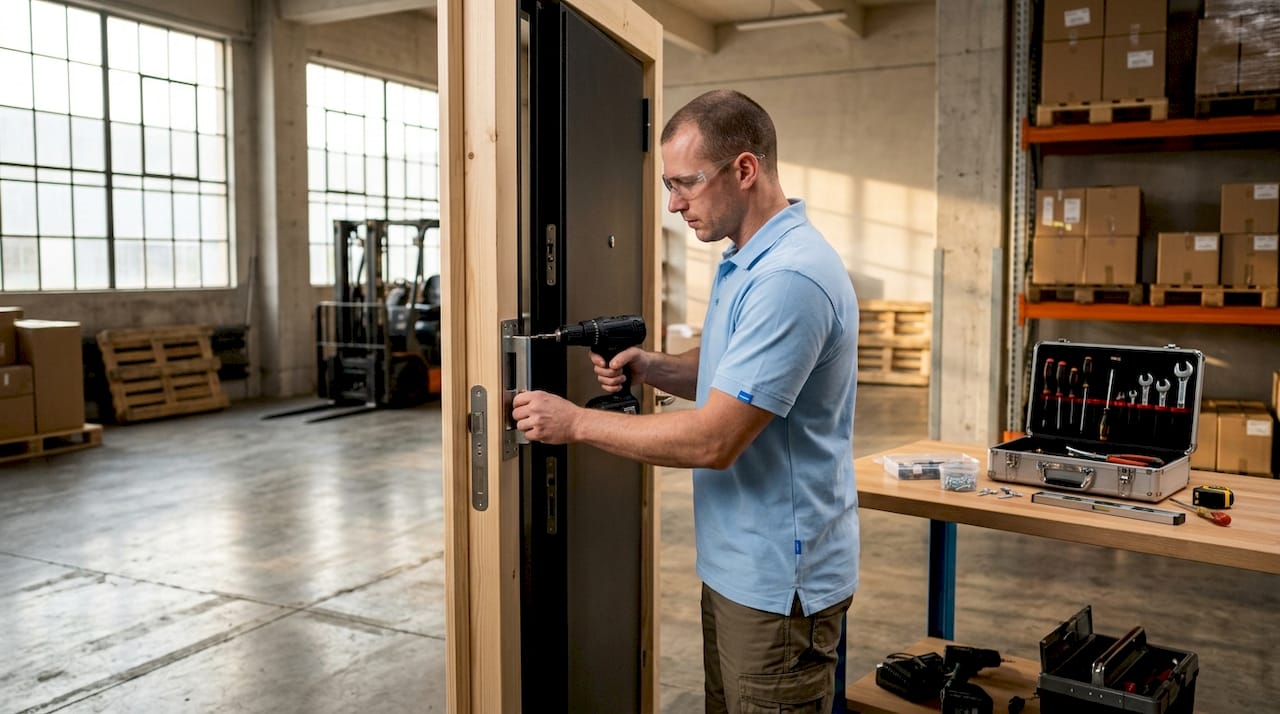
Hinge protection is equally critical. Exposed hinges on outward-swinging doors are a leverage point for intruders. Installing hinge bolts or security hinges with non-removable pins eliminates this vulnerability. For steel doors, welded hinges remove the risk entirely.
Weatherstripping and gap control address a vulnerability most property managers miss. The gap between a door and its frame is a primary prying point. Self-adhesive weatherstripping seals that gap, removes the leverage point, and improves insulation as a bonus.
Pro Tip: Schedule a physical inspection of every entry door frame twice per year. Look for loose screws, visible gaps, and paint cracks around the frame. These are early signs of structural weakness before a failure occurs.
| Hardening Method | What It Addresses | Recommended Standard |
|---|---|---|
| Security strike plate | Frame kick-in resistance | 2.5–3 inch hardened screws into studs |
| Hinge bolts | Hinge leverage attacks | Non-removable pin or welded hinge |
| Weatherstripping | Frame gap prying | Self-adhesive foam or rubber seal |
| Door reinforcement kit | Full frame and door edge | Steel wrap around door edge and frame |
2. Which locking systems and hardware upgrades offer the best protection?
The lock is the most visible part of door security, but it is rarely the strongest. The best locks for doors combine mechanical strength with certification standards that verify performance under attack.
Deadbolt locks remain the standard for commercial entry points. Single-cylinder deadbolts use a key on the exterior and a thumb turn inside. Double-cylinder deadbolts require a key on both sides, which adds security on glass-panel doors but requires a key for emergency exit. Property managers must weigh that tradeoff against fire code requirements before specifying double-cylinder hardware.
Anti-snap cylinders are non-negotiable for uPVC doors and commercial glass doors. Standard euro cylinder locks are vulnerable to snapping, a technique where an attacker breaks the outer section of the cylinder to access the locking mechanism. A 3-star anti-snap cylinder uses a sacrificial cut point that keeps the internal mechanism locked even if the outer section breaks off.
Multi-point locking systems distribute force across three or more points along the door edge instead of concentrating it at one bolt. This makes forced entry significantly harder and is the preferred configuration for high-traffic commercial entries.
Smart locks add a digital layer to mechanical security. Features include biometric access, app-controlled entry, temporary access codes for contractors, and real-time entry logs. Smart locks eliminate common human errors like forgetting to lock a door and enable remote monitoring, which is a direct operational advantage for property managers overseeing multiple buildings.
Pro Tip: Always verify lock certification before purchasing. Look for UL 437, ASTM F476, or BS 3621:2007 ratings. These standards confirm the lock has been tested against picking, drilling, and forced entry.
3. How can visibility and deterrence enhance door security?
Deterrence works before an intruder ever touches a door. 83% of burglars check for visible alarm systems or surveillance cameras before attempting a break-in. That statistic means visible security measures stop most threats before they become incidents.
“The most effective security measure is the one that prevents the attempt entirely. Visible cameras and alarm panels do exactly that for the majority of would-be intruders.”
Video doorbells and external cameras should cover all entry points, including side and rear doors that receive less foot traffic. Cameras with motion-activated recording and cloud storage provide evidence if an incident does occur. Position cameras at a height that captures faces clearly, typically 7–9 feet above ground level.
External lighting on motion sensors removes the cover of darkness that opportunistic intruders rely on. Pair sensor lights with cameras to ensure footage is usable at night. Well-lit entries also signal active management of a property, which itself is a deterrent.
Window covering and access control at entry points prevent intruders from surveying the interior before attempting entry. For commercial properties, frosted or tinted glass on entry doors limits visibility without blocking natural light. Combining physical hardening with visible deterrents creates a layered system where each element reinforces the others.
4. What installation and maintenance practices are essential for sustained security?
Poor installation is the most common cause of security failure. A correctly specified door fitted improperly offers less protection than a basic door installed with precision. Misaligned doors create gaps, stress hardware unevenly, and cause locks to bind or fail prematurely.
Proper installation requires:
- Verify the door frame is plumb and square before hanging the door leaf.
- Use manufacturer-specified fasteners for all hardware, not generic hardware store substitutes.
- Test the lock engagement at multiple points along the door edge after installation.
- Confirm the strike plate aligns precisely with the deadbolt throw at full extension.
- Check for visible light gaps around the entire door perimeter after installation is complete.
Maintenance is what preserves the security investment over time. Hinges loosen, screws back out, and weatherstripping compresses and loses its seal. A door that passed inspection at installation can develop critical vulnerabilities within 12 months without upkeep. Ufiredoors recommends scheduling door inspections twice per year for all commercial entry points, with additional checks after any forced entry attempt or significant weather event.
Pro Tip: Keep a maintenance log for every door in your property. Record inspection dates, hardware replacements, and any alignment adjustments. This log becomes evidence of due diligence if a security incident leads to an insurance or liability claim.
5. How to choose door security solutions based on property type and risk
Security doors must be treated as complete systems where the door leaf, hardware, frame, and fittings work together to meet specific threat requirements. Choosing a door based on appearance or price alone produces a system with mismatched components and unpredictable performance under attack.
A risk assessment is the starting point. Property managers should identify the specific threats their building faces before specifying any door or hardware. Forced entry, ballistic threats, blast resistance, and surreptitious entry each require different door specifications and certification standards.
For urban commercial properties, the primary threats are forced entry and opportunistic break-ins. Steel stiffened doors with multi-point locking systems and UL-certified hardware address these threats directly. Ufiredoors manufactures steel stiffened doors locally using UL-approved materials, which means the door, frame, and hardware are specified as a matched system rather than assembled from separate vendors.
For residential properties in high-density urban buildings, composite or solid-core wood doors with ANSI/BHMA Grade 1 hardware provide strong protection without the weight and cost of full steel construction. The right commercial exterior door depends on occupancy type, foot traffic volume, and local building code requirements.
Certification standards to know:
- UL 10C covers positive pressure fire tests for steel doors.
- ASTM F476 covers forced entry resistance for swinging door assemblies.
- BS 3621:2007 is the British standard for key-operated locks, referenced in international security specifications.
- NPSA guidance classifies doors by threat type, from basic forced entry to ballistic and blast resistance.
A door security system is only as strong as its weakest component. A comprehensive risk assessment before purchase prevents the common mistake of specifying a high-grade door with a low-grade frame or vice versa.
Key takeaways
Effective door security requires layered physical hardening, certified locking hardware, visible deterrents, and consistent maintenance working together as a single system.
| Point | Details |
|---|---|
| Layer your security | Combine reinforced frames, quality locks, and visible deterrents for maximum protection. |
| Upgrade strike plates | Use 2.5–3 inch hardened screws into wall studs to resist kick-in attacks. |
| Certify your locks | Specify UL 437, ASTM F476, or BS 3621:2007 rated hardware for verified performance. |
| Inspect twice yearly | Regular maintenance prevents hardware failures that undermine even well-installed doors. |
| Match door to threat | Conduct a risk assessment before specifying doors to avoid mismatched system components. |
What I’ve learned from years of watching door security fail
The most common failure I see in urban properties is not a bad lock or a weak door. It is a well-specified door that was installed carelessly and never inspected again. Property managers invest in the hardware and then assume the job is done. It is not.
The second failure is treating door security as a one-time decision. Urban risk environments change. A building that was low-risk three years ago may now face different threats because of changes in the surrounding neighborhood, tenant mix, or building use. Security specifications need to be revisited, not just maintained.
The WIDE principle is the clearest framework I have encountered for explaining layered security to clients who are not security professionals. It is simple, memorable, and it works. When property managers apply it consistently across all entry points, including improving door security at secondary and service entries that often get ignored, the results are measurable. The properties that take this seriously have fewer incidents, lower insurance claims, and tenants who stay longer because they feel safe.
The uncomfortable truth is that most door security failures are preventable. They happen because of skipped inspections, deferred maintenance, and hardware that was never upgraded from the builder-grade original. The fix is not expensive. It is consistent.
— Esteban
Ufiredoors steel stiffened doors for urban property security
Ufiredoors builds and installs steel stiffened doors designed specifically for the security demands of urban commercial and residential properties. Every door is fabricated locally in New York using UL-approved materials, with matched frames and hardware specified as a complete system. That means no mismatched components and no gaps in your security specification. Ufiredoors provides free site estimates, fast lead times, and emergency repair services for properties that cannot afford downtime. If your current entry doors are overdue for an upgrade or inspection, contact Ufiredoors to schedule a consultation and get a free estimate on a door system built to protect your property.
FAQ
What are the most effective door security best practices for commercial properties?
The most effective practices combine reinforced steel frames, multi-point locking systems with UL-certified hardware, and visible deterrents like cameras and sensor lighting. Regular inspections twice per year maintain the integrity of the full system.
What is the best lock for a commercial entry door?
A deadbolt with a UL 437 or ASTM F476 rating paired with a multi-point locking system provides the strongest protection. For uPVC or glass doors, a 3-star anti-snap cylinder is required to prevent snapping attacks.
How often should door hardware be inspected and maintained?
Property managers should inspect all entry door hardware, frames, and weatherstripping at least twice per year. Additional inspections are recommended after any forced entry attempt or severe weather event.
Why does door installation quality affect security?
Poor installation is the leading cause of door security failure. Misaligned doors create gaps, stress hardware unevenly, and cause locks to bind or fail. Even a high-grade door provides limited protection if it is not fitted correctly.
What certification standards should I look for when selecting security doors?
Look for doors and hardware certified to UL 10C for fire resistance, ASTM F476 for forced entry resistance, and locks rated to UL 437 or BS 3621:2007. These standards confirm performance has been independently tested against real attack methods.