
For fire-rated commercial doors, the only acceptable door weatherproofing options are UL-listed perimeter gasketing, UL-listed automatic door bottoms or drop seals, listed thresholds where required by the assembly, and smoke seals listed to UL 1784 where an S-label or smoke barrier applies. Anything else voids the door label and sets you up for an AHJ citation.
Before any product ships to your site, do these three things:
- Pull the door label and confirm the gasketing model appears in the manufacturer’s listing or hardware submittal.
- Remove any consumer weatherstrip already installed on fire-rated openings.
- Set up a written inspection record file. NFPA 80 requires annual inspection of all fire door assemblies and documented records available to the AHJ.
Table of Contents
- Why do NFPA 80 and UL listings control your weatherproofing choices?
- What are the compliant weatherproofing components for fire-rated doors?
- How should you inspect and budget for gasket replacement?
- What should your specs and installer requirements include?
- Common installation mistakes that void fire ratings
- Ufiredoors handles listed installation and AHJ documentation in NYC
- Key Takeaways
- The part most specs still get wrong
- Useful sources and standards
Why do NFPA 80 and UL listings control your weatherproofing choices?
Most facility managers discover this the hard way: a perimeter seal that looks right, fits snugly, and costs half the price of the listed version will still fail inspection. The reason is structural, not cosmetic.
NFPA 80 mandates a formal inspection of every fire door assembly annually, with written records kept on file for the authority having jurisdiction. That inspection covers gasketing condition, listing status, and continuity of the perimeter seal. No documentation, no compliance.
The UL listing side is equally strict. Two separate standards govern fire door gasketing:
- UL 10C tests positive-pressure fire endurance. Gasketing listed to UL 10C is what keeps a fire door assembly rated at 20 minutes, 45 minutes, 90 minutes, or 3 hours.
- UL 1784 tests air leakage for smoke and draft control. The IBC caps air leakage at 3.0 cfm per square foot at 0.10 inch water column for smoke doors, which is why continuous smoke seals and door bottoms are required on S-label assemblies.
“Fire-rated gasketing must be listed for use on the specific door assembly. Substituting a non-listed seal voids the door label regardless of perceived quality.”
— I Dig Hardware / Lori Greene
The door, frame, gasketing, threshold, and hardware are evaluated as one listed assembly. Swap one component for an unlisted substitute and the whole assembly loses its rating.
What are the compliant weatherproofing components for fire-rated doors?
Here is a practical catalog of the components you will specify, what each does, and when a listing is required.
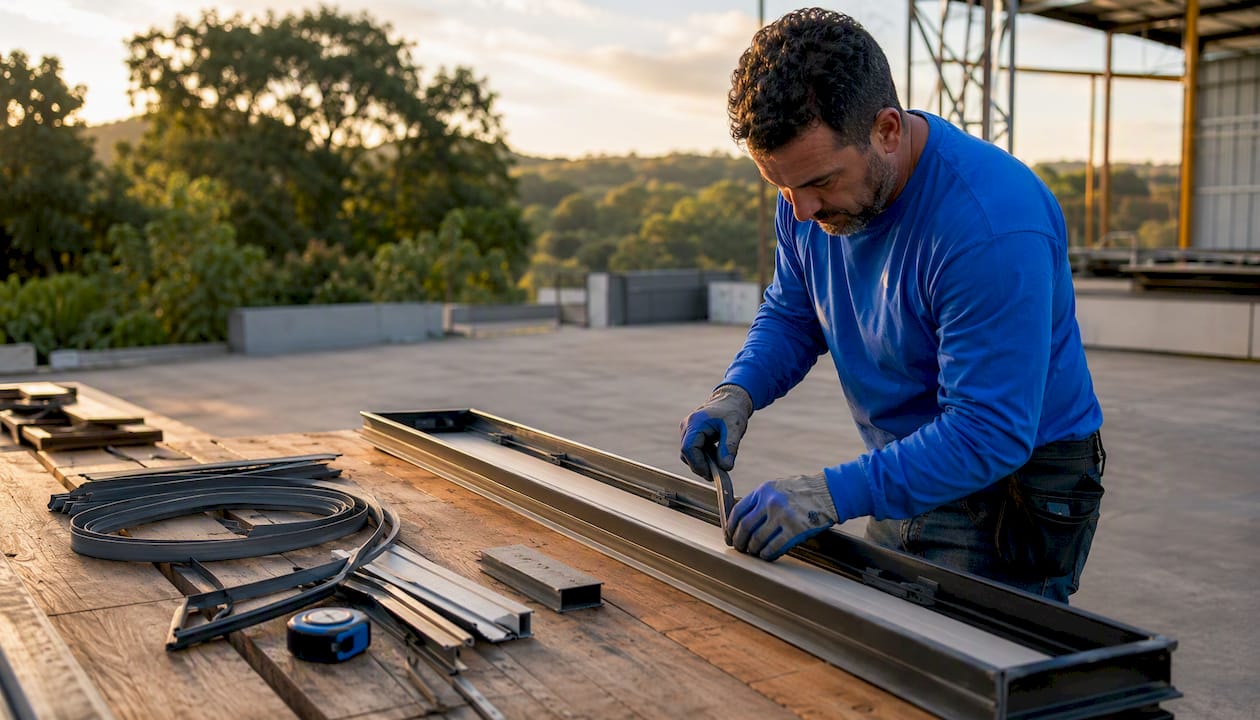
| Component | Primary goal | Listing required? |
|---|---|---|
| Perimeter intumescent gasketing | Fire containment at head/jamb under positive pressure | Yes — UL 10C listed for the assembly |
| Smoke/draft perimeter seal | Limit air leakage at perimeter | Yes — UL 1784 listed for S-label doors |
| Automatic door bottom (drop seal) | Close the gap at the floor when door closes | Yes — listed for use on labeled door |
| Surface-mounted sweep | Secondary bottom seal | Only if listed for the specific assembly |
| Threshold/sill gasket | Seal at floor level, support door bottom | Listed when part of the tested assembly |
Material selection matters too. Silicone is the preferred material for fire and smoke listings because it handles high temperatures and retains compression memory over time. EPDM suits exterior openings where UV exposure and weather resistance are priorities. Neoprene works for interior acoustic applications. Match the material to both the environment and the listing — a silicone-based intumescent seal on an exterior stairwell door, for example, handles temperature swings better than neoprene would.
Compatibility by door material follows a similar logic. Steel and hollow-metal doors typically accept kerfed or surface-applied listed kits. Wood fire doors often require factory-routed intumescent channels or listed retrofit kits designed for wood substrates. Fiberglass-reinforced plastic doors need moisture-tolerant retainers and corrosion-resistant fasteners to hold the seal in place over time.
One detail that catches contractors off guard: UL 1784 testing sometimes uses an artificial bottom seal during the test procedure. If the listing was obtained with that artificial seal, the installed door may not need a field-applied bottom. If the test was run without it, the same bottom seal must be present in the field assembly. Always read the listing document, not just the door label.
Pro Tip: Cross-check the hardware submittal and the door listing document side by side. Physical fit and similar appearance are not substitutes for a matching model number in the listing.
Smoke seals listed to UL 1784 are required on S-label doors, smoke partitions, corridor doors, and elevator lobby doors per IBC Chapter 7. If the door serves a smoke barrier, a listed smoke seal is not optional.
How should you inspect and budget for gasket replacement?
NFPA 80 sets no fixed replacement interval for fire door gasketing. The standard requires that listed gasketing remain functional at each annual inspection. Treat it as a consumable, not a set-and-forget component.
Your annual inspection checklist should cover:
- Continuous head and jamb seal with no gaps, tears, or compression failure
- Meeting stile seal intact on pairs
- Door bottom or automatic drop seal engaging the floor without dragging
- No paint on intumescent or silicone seals
- No daylight visible at the perimeter when the door is closed
- Product model and listing data recorded in the inspection file
For budgeting, plan shorter replacement cycles on high-traffic openings — main corridor doors, stairwell entries, and exterior vestibule doors wear seals faster than a low-traffic mechanical room door. A stairwell door in a quiet office building might go several years between replacements; a hospital corridor door used dozens of times per day may need attention annually. The fire door maintenance requirements for each opening type should drive your capital plan, not a blanket schedule.
Pro Tip: Mask all gasketing before corridor repainting. Paint on silicone or intumescent seals destroys compression memory and can void the listing — painted seals must be replaced, not cleaned.
What should your specs and installer requirements include?
A bid document that does not specify listing requirements will get you unlisted product. Here is what to require:
Spec language: Require UL-listed gasketing, thresholds, and door bottoms compatible with the door label and hourly rating. Require the installer to include product model numbers and listing documentation in the submittal package, stamped for AHJ review. Reference NFPA 80 annual inspection compliance as a project deliverable.
Questions to ask every bidder:
- Can you provide the UL assembly listing that shows this gasket model on this door rating?
- Are the automatic door bottoms listed for use on labeled doors?
- Who supplies the threshold, and is it listed as part of the assembly?
- Will you provide a completed submittal package ready for the AHJ?
Red flags to reject immediately:
- Consumer weatherstrip or home-center product names on the invoice
- Painted intumescent seals on existing doors being “reused”
- Installer unable or unwilling to provide listing documentation
- Retrofit claims backed by appearance only, with no matching listing
Specify installer qualifications explicitly: NFPA 80 familiarity, a documented track record on fire-rated openings, and a warranty that covers both materials and labor. Universal Fireproof Door Co., Inc. is a local example of a manufacturer-installer with 20-plus years of experience on exactly these assemblies in New York and the Northeast.
Pro Tip: Ask for the UL-approved installation documentation before work begins, not after. Getting it retroactively is slower and sometimes impossible if the installer has moved on.
Common installation mistakes that void fire ratings
Non-listed perimeter weatherstrip is the most common inspection failure on fire-rated steel doors. It passes visual QA, it seals the gap, and it still voids the assembly.
Other failures that show up regularly on failed fire door inspections:
- Painting over silicone or intumescent gasketing during corridor repaints
- Notching or cutting a continuous perimeter seal to route conduit or fit hardware
- Incorrect bottom clearance after new flooring raises the finished floor height
- Missing listing documentation in the inspection file
A typical corrective sequence after a failed inspection: the installer pulls the non-listed weatherstrip, sources the listed perimeter seal kit matching the door’s assembly, installs it per the manufacturer’s instructions, updates the hardware submittal with the correct model and listing number, and schedules a re-inspection with the AHJ. The whole process takes days when the right product is in stock. It takes weeks when it is not.
Ufiredoors handles listed installation and AHJ documentation in NYC
Ufiredoors manufactures and installs fire-rated steel doors and commercial hollow metal doors locally in New York, using UL-approved materials and listed perimeter gasketing, thresholds, and automatic door bottoms. Every project includes a complete submittal package ready for AHJ review, so you are not chasing paperwork after installation.
Universal Fireproof Door Co., Inc. has handled fire door installations and NFPA 80 annual inspection services across NYC and the Northeast for over 20 years. Fast lead times, emergency repair response, and documented compliance from fabrication through final inspection.
To get started, photograph the door label, gather your current hardware submittal and maintenance records, and request a free on-site estimate. Ufiredoors will confirm listing compatibility, identify any non-compliant components, and provide a full replacement or retrofit plan with AHJ-ready documentation.
Key Takeaways
For fire-rated commercial doors, only UL-listed gasketing, door bottoms, thresholds, and smoke seals maintain the assembly’s fire rating and satisfy NFPA 80 annual inspection requirements.
| Point | Details |
|---|---|
| Listing is mandatory | Only gasketing listed for the specific door assembly is permitted; unlisted substitutes void the rating. |
| Annual inspection required | NFPA 80 requires documented annual inspection of all fire door assemblies, with records available to the AHJ. |
| No fixed replacement cycle | Treat gasketing as a consumable; high-traffic doors need more frequent replacement than low-traffic ones. |
| Never paint seals | Paint on silicone or intumescent gasketing damages compression and voids the listing; mask or replace after painting. |
| Ufiredoors for NYC projects | Ufiredoors manufactures and installs listed fire door assemblies with complete AHJ submittal packages in New York and the Northeast. |
The part most specs still get wrong
The gap between what a spec says and what actually gets installed on fire-rated openings is wider than most facility managers realize. Specs routinely call for “weatherproof door seals” without specifying a listing standard, and installers fill that gap with whatever is available locally, often a product from a building supply house with no UL 10C or UL 1784 listing in sight.
The fix is not complicated, but it requires one deliberate step: tie every seal and gasket line item in your spec to a listing requirement and demand the submittal documentation before installation begins, not at closeout. An inspector does not care how the seal looks or how well it compresses. They check the listing. If it is not there, the door fails.
The other thing worth saying plainly: the door, frame, gasketing, threshold, and hardware are one system. Upgrading the seal without verifying the rest of the assembly is like replacing one link in a chain and calling it repaired. Specify the whole assembly, document the whole assembly, and inspect the whole assembly annually.
Useful sources and standards
- NFPA 80 Inspection Checklist for Swinging Fire Doors — the official NFPA periodic inspection checklist for fire door assemblies
- IBC Chapter 7: Fire and Smoke Protection Features — model code requirements for smoke and draft control doors
- I Dig Hardware: Smoke Door Requirements of the IBC — plain-language breakdown of UL 1784 and smoke door gasketing requirements
- I Dig Hardware: Thresholds and Gasketing for Fire Doors and Smoke Doors — listing requirements, artificial bottom seal nuance, and assembly compliance
- SDI Technical Data: Hourly Ratings and Assembly Requirements — Steel Door Institute guidance on ratings and how they affect gasketing and hardware choices
- Ufiredoors: Fire Door Gasketing Requirements for NYC Buildings — local specification guidance for perimeter and smoke seals in New York projects