
Fire-resistant materials are structural components engineered to withstand fire exposure for a defined period without losing their load-bearing capacity, integrity, or insulating performance. Construction professionals and property developers who understand this distinction make better specification decisions, pass inspections faster, and protect occupants more effectively. This guide covers fire resistance materials explained from classification systems through material types to practical selection criteria, grounding every point in current standards including EN 13501-2:2023 and ASTM E84.
What do fire resistance ratings and classifications actually mean?
Fire resistance ratings measure how long a building element maintains its performance under standardized fire conditions. Two separate testing frameworks govern this, and confusing them leads to specification errors.

ASTM E84 and EN 13501-1 evaluate flame spread and smoke production on material surfaces. These are reaction-to-fire tests. They tell you how a material behaves when fire reaches it, not how long a structural assembly holds up under sustained fire exposure.
EN 13501-2:2023 covers fire resistance of entire building elements such as walls, floors, and ceilings. It uses a four-letter classification system that construction professionals need to read correctly:
| Code | Meaning | Example application |
|---|---|---|
| R | Loadbearing capacity | Structural columns and beams |
| E | Integrity (no flame or hot gas passage) | Partition walls, fire doors |
| I | Insulation (limits heat transfer) | Floor assemblies, ceilings |
| S | Smoke control | Corridor walls, stairwell enclosures |
Each code is followed by a time period in minutes, such as REI 60 or EI 30. A wall rated REI 90 maintains loadbearing capacity, integrity, and insulation for 90 minutes under the test fire curve. That 90-minute window is the time occupants have to evacuate and firefighters have to work safely.
ASTM E84 classifies materials into Class A, B, and C based on flame spread and smoke developed indices. Class A carries the best surface fire performance. The critical misunderstanding: Class A materials can still burn. Class A is a surface behavior rating, not a structural fire resistance rating. Specifying Class A gypsum board satisfies a surface finish requirement. It does not replace a rated wall assembly.
Pro Tip: Always verify whether a specification calls for a reaction-to-fire rating (ASTM E84, EN 13501-1) or a fire resistance rating (EN 13501-2:2023). They answer different questions and cannot substitute for each other.
How do fire-resistant materials differ from flame retardants?
The terminology gap between flame retardants and fire-resistant materials causes real compliance failures on job sites. They are not interchangeable.
Flame retardants are chemical additives designed to inhibit combustion at the material level. Common types include phosphorus compounds and mineral hydroxides. They work through three mechanisms: gas phase quenching, char formation, and cooling. A flame retardant treatment applied to a wood substrate slows ignition. It does not transform that wood into a fire-resistant structural element.
Fire-resistant materials are passive protection components. Concrete, fire-rated gypsum board, and fire-rated steel door assemblies resist fire through their physical composition and tested assembly configuration. They do not rely on a chemical reaction triggered by heat. Their performance is validated through standardized fire tests, not additive chemistry.
| Category | Mechanism | Building code role |
|---|---|---|
| Flame retardants | Chemical inhibition of combustion | Surface treatment, reaction-to-fire compliance |
| Fire-resistant materials | Structural passive resistance | Fire resistance rating compliance |
| “Fireproof” materials | Does not exist | Misleading marketing term |
No material is truly fireproof. Fire resistance is the practical standard: it measures how long a material or assembly maintains its performance under fire exposure. Every material has a thermal failure point. The goal is to delay that failure long enough to protect life and allow evacuation.
Pro Tip: When reviewing product submittals, reject any material marketed as “fireproof.” Request the tested fire resistance duration and the applicable standard instead. That number is the only claim that holds up in a code review.
What are the main types of fire-resistant materials used in construction?
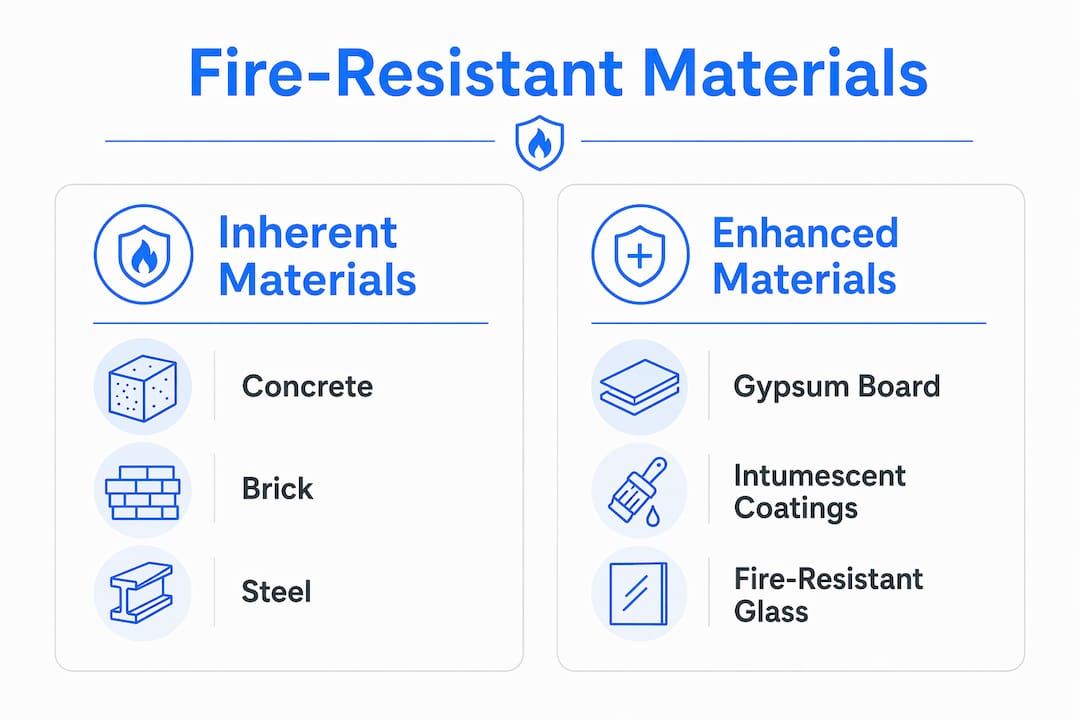
Concrete, brick, steel, gypsum board, intumescent coatings, and fire-resistant glass are the core materials in any fireproof materials overview for commercial and industrial construction. Each serves a different structural role.
Concrete and masonry
Concrete and brick are inherently non-combustible and thermally stable under prolonged heat. Concrete walls and floors regularly achieve REI 120 or higher in tested assemblies. Brick cavity walls provide both structural fire resistance and thermal insulation. These materials are the backbone of fire-compartmentalization strategies in multi-story buildings.
Gypsum board
Gypsum board contains chemically bound water in its core. When exposed to heat, that water releases as steam, absorbing energy and slowing temperature rise on the protected side. A single layer of 5/8-inch Type X gypsum board adds significant fire resistance to a steel stud partition. Stacked assemblies with multiple layers can achieve 1-hour, 2-hour, or higher ratings depending on the tested configuration.
Steel and intumescent coatings
Bare structural steel loses strength rapidly above 1,100°F. Steel is non-combustible but not inherently fire-resistant at structural load levels. Intumescent coatings applied to steel expand when exposed to heat, forming an insulating foam layer that protects the substrate and slows temperature rise. They are lightweight, easy to apply, and widely used for both new construction and retrofits. Spray-applied fireproofing (SFRM) is the alternative for large structural steel members in commercial buildings.
Fire-resistant glass
Fire-resistant glass assemblies use multiple laminated layers or special tempered compositions to maintain integrity under fire exposure. Rated glazing appears in fire-rated door lites, sidelights, and partition systems. The glass itself must be part of a tested and listed assembly to carry a fire resistance rating.
| Material | Key property | Typical fire resistance |
|---|---|---|
| Concrete | Non-combustible, thermally stable | REI 60–REI 180 (assembly dependent) |
| Gypsum board (Type X) | Releases steam under heat | 1–2 hour rated assemblies |
| Intumescent coating | Expands to insulate substrate | 30–120 minutes (coating thickness dependent) |
| Fire-resistant glass | Maintains integrity under fire | 20–120 minutes (listed assembly) |
| Brick/masonry | Non-combustible, dense | REI 60–REI 240 |
Materials must be thermally stable, non-combustible, and produce low smoke and toxic gas emissions to comply with fire safety standards. Low smoke toxicity matters as much as structural performance because smoke inhalation causes the majority of fire fatalities in buildings.
Pro Tip: Intumescent coatings require a specific dry film thickness to achieve their rated performance. Always verify the applied thickness with a wet film gauge during installation. Under-application voids the rating.
How should you select and apply fire-resistant materials on a project?
Fire-resistant materials should be selected by assessing the required fire resistance duration, local codes, occupancy type, and environmental conditions. A systematic approach prevents costly substitutions during inspections.
Determine the required fire resistance rating. Start with the building’s occupancy classification and construction type under the applicable building code. IBC Table 601 assigns minimum fire resistance ratings to structural elements by construction type. This number drives every material decision downstream.
Map the application. Walls, floors, ceilings, columns, beams, and fire-rated partitions each have distinct tested assembly configurations. A 2-hour floor-ceiling assembly uses different materials and thicknesses than a 2-hour exterior wall. Match the tested assembly to the application, not just the rating number.
Verify the listing. Every fire-rated assembly must reference a tested and listed configuration from a recognized testing laboratory such as UL or Intertek. The listing number ties the assembly to a specific set of materials, dimensions, and installation requirements. Substituting an unlisted component breaks the rating.
Account for environmental conditions. Exterior applications require materials that maintain fire resistance under moisture, UV exposure, and thermal cycling. Intumescent coatings used outdoors need a topcoat rated for exterior exposure. Gypsum board used in wet areas requires moisture-resistant Type X products.
Plan for inspection and maintenance. Regular inspection and maintenance of fire-resistant materials are critical for maintaining fire safety over a building’s lifetime. Intumescent coatings can be damaged by impact or renovation work. Gypsum assemblies lose their rating when penetrations are left unsealed. Schedule periodic reviews of all fire-rated assemblies as part of the building’s maintenance program.
Understanding fire rating hours for each structural element type prevents under-specification. A corridor wall rated EI 30 when the code requires EI 60 is a failed inspection, not a minor discrepancy.
Key Takeaways
Fire-resistant materials are structural components rated by tested performance duration, not by a “fireproof” label, and correct specification requires matching the right material, assembly, and standard to each building element.
| Point | Details |
|---|---|
| Ratings measure time, not immunity | Every fire resistance rating specifies minutes of performance, not permanent protection. |
| Two separate standards apply | ASTM E84 covers surface behavior; EN 13501-2:2023 covers structural fire resistance of assemblies. |
| Flame retardants are not substitutes | Chemical additives slow ignition but do not replace tested fire-resistant structural assemblies. |
| Assembly listing is mandatory | Substituting any unlisted component in a rated assembly voids the fire resistance rating. |
| Maintenance preserves ratings | Damaged coatings and unsealed penetrations eliminate fire resistance performance over time. |
Why terminology precision is the real fire safety problem
After working with construction teams across commercial, residential, and industrial projects, the single most consistent failure point is not material quality. It is terminology confusion at the specification stage.
Architects write “Class A” on a finish schedule and assume it covers fire resistance. Contractors submit a flame-retardant-treated product as a substitute for a rated assembly. Developers approve a budget that cuts intumescent coating thickness to save money per square foot. Each of these decisions looks reasonable in isolation. Each one can result in a failed inspection, a costly remediation, or worse.
The clarity between flame retardants and fire-resistant materials is not a semantic debate. It is a compliance requirement. When a project team conflates the two, the building either fails its fire resistance test or gets approved with a gap that only surfaces during an actual fire event.
The other issue I see consistently is the cost-versus-performance trade-off applied in the wrong direction. Effective fire-resistant materials maintain thermal stability under prolonged heat without cracking or deforming. That long-term durability is the criterion that matters, not the unit cost at procurement. A gypsum assembly that costs 15% less but requires replacement after five years because of moisture damage is not a savings. It is a liability.
The Extended Application Principles under EN 15725:2023 are worth tracking in 2026. They allow manufacturers to apply test results across product families, which reduces the testing burden and opens the door to faster material innovation. For developers and contractors, this means more listed options will become available without waiting years for individual product testing cycles. Staying current with these standards is not optional. It is how you avoid specifying a product that was compliant two years ago but no longer meets the current classification requirements.
Fire safety design works best when it is integrated from the schematic phase, not retrofitted during construction documents. The professionals who get this right treat fire resistance as a structural performance criterion, not a code checkbox.
— Esteban
Ufiredoors builds fire-rated steel doors that meet your project specs
Fire-resistant assemblies only perform as designed when every component in the system is listed, installed correctly, and built to the required rating. The door opening is the most common weak point in a fire-rated assembly, and it is the one element most often specified late in the project cycle.
Ufiredoors manufactures and installs fire-rated steel doors for commercial, residential, and industrial properties across New York. Every door is built locally using UL-approved materials, fabricated to your project’s specific fire resistance rating, and installed within 3–5 days. Ufiredoors also offers steel stiffened door manufacturing with free site estimates for projects requiring structural fire protection at openings. Contact Ufiredoors to confirm your door assembly meets the rated assembly listing your project requires.
FAQ
What is a fire resistance rating?
A fire resistance rating is the measured time, in minutes, that a building element maintains its structural performance under standardized fire test conditions. Ratings are expressed using codes like R, E, I, and S under EN 13501-2:2023, or as 1-hour, 2-hour designations under IBC-referenced UL listings.
What is the difference between Class A and a fire resistance rating?
Class A is an ASTM E84 surface burn classification based on flame spread and smoke developed indices. A fire resistance rating measures how long a full assembly withstands fire exposure. Class A materials can still burn and do not carry a structural fire resistance rating on their own.
Are flame retardant treatments the same as fire-resistant materials?
No. Flame retardants are chemical additives that slow ignition at the material surface. Fire-resistant materials are structural components tested as complete assemblies. Substituting a flame retardant treatment for a rated assembly does not satisfy fire resistance code requirements.
How long do fire-resistant materials last in a building?
Fire-resistant materials maintain their rated performance as long as the assembly remains undamaged and intact. Penetrations, impact damage, moisture intrusion, and renovation work can all compromise the rating. Regular inspection and maintenance are required to preserve fire resistance over the building’s lifetime.
What fire resistance rating do fire doors need?
Fire door ratings range from 20 minutes to 90 minutes depending on the wall assembly they are installed in and the occupancy requirements of the building. A door in a 2-hour fire-rated wall typically requires a 90-minute rated door assembly per IBC requirements.