
A fire resistance rating is the measured duration a building assembly can withstand standardized fire exposure before failing defined criteria for structural stability, integrity, and insulation. The industry term is “fire resistance rating,” and it applies to complete assemblies, not individual materials. Property managers, facility managers, building owners, and contractors rely on this rating to select code-compliant materials, pass inspections, and protect occupants. Common rating increments in North America include 30 minutes and 1–4 hours, with tests governed by ASTM E119 and UL 263. Understanding what is fire resistance rating means understanding a time-based performance standard, not a guarantee of fireproof construction.
What is fire resistance rating and how is it measured?
A fire resistance rating is determined by exposing a complete building assembly to a standardized furnace test and measuring how long it performs before any single criterion fails. The rating reflects test performance time, not the duration a real fire would last in your building. That distinction matters when you are specifying materials for a code-required rated wall or floor assembly.
ASTM E119 and UL 263 both use a prescribed time-temperature curve to simulate fire conditions inside a furnace. The curve ramps up quickly, reaching roughly 1,000°F within the first few minutes and continuing to climb. The assembly being tested must meet three performance criteria simultaneously throughout the test.
The three criteria are:
- Structural stability. The assembly must not collapse or deflect beyond allowable limits under load during the test period.
- Integrity. No flames or hot gases can pass through the assembly to the unexposed side.
- Insulation. The temperature on the unexposed side must not rise beyond a defined limit, typically an average increase of 250°F above ambient.
The rating clock stops the moment any one of these three criteria fails. Almost passing is not sufficient. An assembly that holds structural stability for 59 minutes but allows heat transfer at minute 58 earns a 45-minute rating, not a 60-minute rating.
Pro Tip: Always verify that the assembly you specify matches the exact tested configuration in the UL or ASTM directory. Substituting one component, even a fastener type, can invalidate the rating.
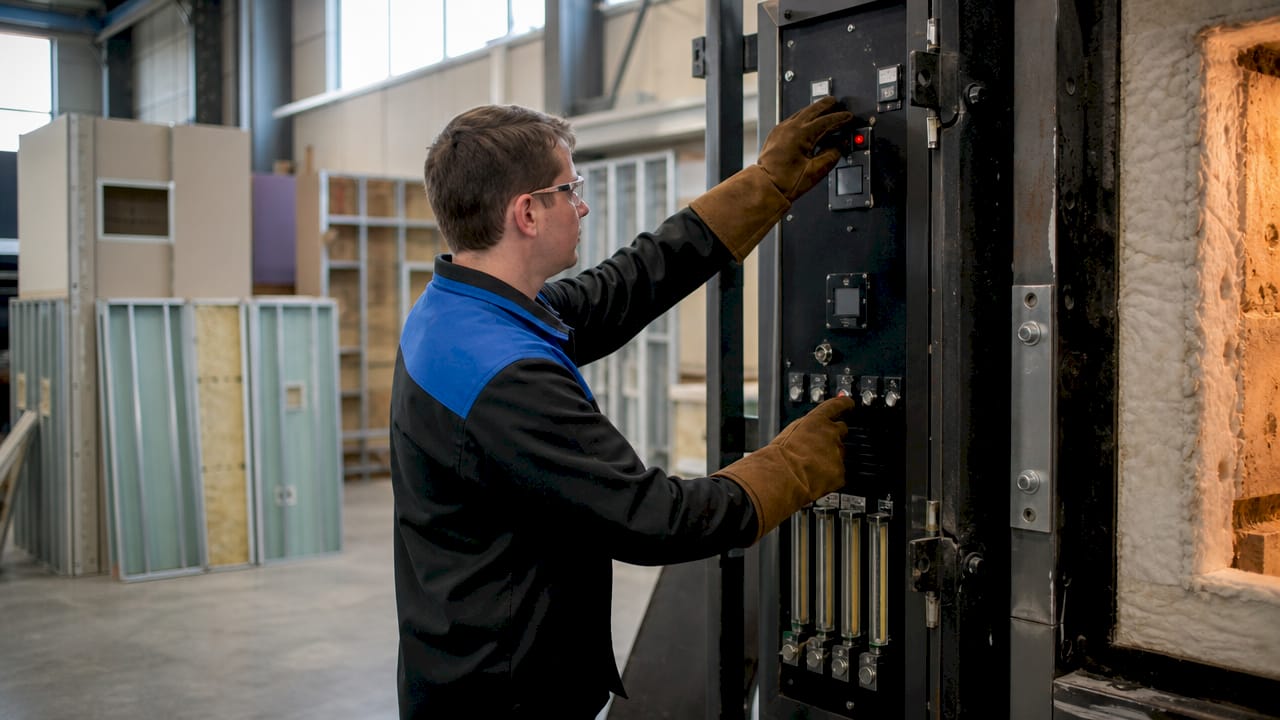
A hose-stream test follows the furnace exposure for walls and partitions. A high-pressure water jet simulates the thermal shock and mechanical force of firefighting operations. Assemblies that survive the furnace but crack or collapse under the hose stream do not earn the full rating. This step is one of the most overlooked details in fire resistance compliance, and it disqualifies more assemblies than most contractors expect.
Fire resistance rating vs. fireproof: clearing up the confusion
“Fireproof” is not a recognized building code classification. No building material or assembly is truly fireproof. A fire resistance rating is a time-based measure of performance under controlled test conditions, and every rated assembly will eventually fail if exposed long enough.
The confusion between fire resistance and fireproof leads to real specification errors. Contractors sometimes assume a highly rated assembly eliminates fire risk entirely. It does not. The rating buys time for evacuation and firefighting response, which is exactly what building codes intend.
A second common confusion involves reaction-to-fire testing. Reaction-to-fire tests, such as ASTM E84 (the Steiner Tunnel test), measure how a material’s surface contributes to flame spread and smoke development. These tests are not substitutes for assembly-level fire resistance ratings. A material can have a Class A flame spread index and still provide no meaningful fire resistance when used in a wall assembly.
Key distinctions every building manager should know:
- Fire resistance rating measures how long a complete assembly resists fire penetration and structural failure.
- Reaction-to-fire rating measures how a material’s surface behaves when exposed to flame, specifically flame spread and smoke.
- Fireproof is a marketing term with no code definition. Avoid it in specifications and contracts.
- Component vs. assembly rating: A single sheet of Type X gypsum board has no standalone fire resistance rating. The rated assembly is the specific combination of studs, board layers, fasteners, and insulation tested together.
That last point catches many building owners off guard. Specifying “fire-rated drywall” does not create a rated assembly. The complete tested assembly must be replicated exactly as documented in the listing.
How do fire resistance standards compare globally?
North American and international standards share the same core concept: time-based performance under a standardized fire curve. The protocols and classification systems differ in ways that matter when you are working on projects with international specifications or importing assemblies.
| Standard | Region | Test Method | Classification System |
|---|---|---|---|
| ASTM E119 | United States | Furnace time-temperature curve | Hours and fractions (e.g., 1-hour, 2-hour) |
| UL 263 | United States | Equivalent to ASTM E119 | UL listing by duration |
| ISO 834-1 | International | Standardized time-temperature curve | Duration in minutes |
| EN 13501-2 | Europe | Based on ISO 834 | R (stability), E (integrity), I (insulation) criteria |
The European system under EN 13501-2 is worth understanding because it separates the three performance criteria into individual classifications. An assembly rated “REI 60” meets all three criteria for 60 minutes. An assembly rated “RE 60” meets stability and integrity for 60 minutes but does not meet the insulation criterion. This granularity is more transparent than the North American approach, which bundles all criteria into a single duration label.
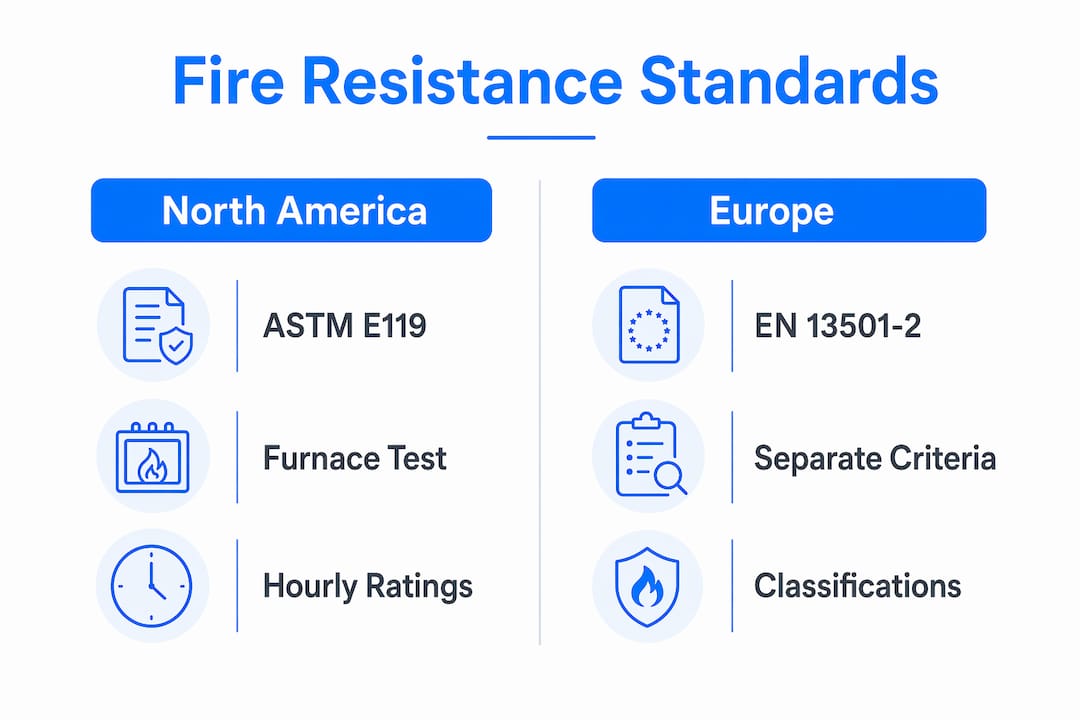
ISO 834-1 defines the international standardized fire-resistance test with prescribed time-temperature curves. The classifications represent test performance time, not guaranteed real-world fire durations. That caveat applies equally to ASTM E119 and UL 263.
Pro Tip: When reviewing international product data sheets, always confirm which standard the rating was tested under. An “EI 60” European rating and a “1-hour” ASTM rating are similar in concept but tested under different protocols and may not be directly interchangeable for U.S. code compliance.
One limitation shared by all standards is that laboratory furnace conditions do not perfectly replicate real fires. Real fires vary in fuel load, ventilation, and temperature distribution. Ratings provide a reliable comparative baseline, but they are not a simulation of every possible fire scenario your building might face.
Practical implications for building design, management, and compliance
Fire resistance ratings directly shape which materials and assemblies you can legally use in a building. Building codes, including the International Building Code (IBC), specify minimum ratings for walls, floors, ceilings, columns, and beams based on occupancy type and construction classification. Getting this wrong during design or renovation creates liability and can trigger costly remediation.
The most common compliance mistake is specifying a material rather than a tested assembly. Building codes require the tested assembly configuration to be replicated on site. Any deviation, including a different stud spacing, a different insulation type, or a different fastener pattern, can void the rating.
Practical steps for property and facility managers:
- Verify listings before specifying. Cross-reference every assembly against the UL Fire Resistance Directory or the GA-600 Fire Resistance Design Manual published by the Gypsum Association.
- Document tested configurations. Keep records of the exact assembly listing numbers used in each rated wall, floor, or ceiling. Inspectors and insurers will ask for this.
- Inspect after any renovation. Penetrations for pipes, conduits, and cables through rated assemblies must be sealed with listed firestop systems. Unsealed penetrations eliminate the rating.
- Understand door and partition ratings separately. Fire door assemblies carry their own ratings, expressed in minutes (20, 45, 60, 90), and must be coordinated with the wall assembly rating they are installed in.
- Schedule periodic inspections. Rated assemblies can be compromised over time by building modifications, water damage, or deferred maintenance.
Fire-rated partitions are a specific area where managers often underestimate complexity. A fire-rated partition must maintain its rating at every penetration, joint, and connection point. The wall rating is only as strong as its weakest detail.
The importance of fire ratings extends beyond code compliance. Insurance underwriters use rated assembly documentation to assess risk and set premiums. A building with properly documented and maintained rated assemblies presents a lower risk profile than one with undocumented or compromised assemblies.
Key Takeaways
A fire resistance rating is a time-based performance standard for complete building assemblies, tested under ASTM E119 or UL 263, and it governs material selection, code compliance, and occupant safety across every building type.
| Point | Details |
|---|---|
| Ratings measure assembly performance | The rating applies to the full tested assembly, not individual materials or components. |
| Three criteria must all pass | Structural stability, integrity, and insulation must each hold for the full rated duration. |
| Hose-stream test is mandatory | Walls and partitions must survive post-furnace water impact to earn the full rating. |
| “Fireproof” has no code definition | Specify rated assemblies by duration and listing number, never by the term fireproof. |
| Global standards differ in classification | European EN 13501-2 separates R, E, and I criteria; U.S. standards bundle them into one duration label. |
Why assembly ratings are the detail most managers get wrong
Working with fire-rated construction for over two decades, the single most consistent error I see from property and facility managers is treating fire resistance as a material property rather than a system property. A manager will specify “5/8-inch Type X gypsum board” and assume the wall is rated. It is not. The rating belongs to the assembly: the specific combination of framing, board layers, fasteners, and any insulation, tested together as a unit.
The second pattern I see is over-reliance on the furnace duration alone. Managers hear “2-hour wall” and assume the building has two hours of protection. What they miss is that the rating was earned under controlled laboratory conditions with a specific fuel load and temperature curve. Real fires do not follow a laboratory script. The rating gives you a reliable comparative benchmark and a code-compliant baseline. It does not promise two hours of protection in every fire scenario.
The practical takeaway is this: integrate fire resistance documentation into your building records the same way you track mechanical systems. Know which assemblies are rated, what their listing numbers are, and when they were last inspected. That discipline is what separates a building that passes inspection from one that creates liability when something goes wrong.
— Esteban
Ufiredoors: fire-rated steel doors built for compliance
Property and facility managers who understand fire resistance ratings know that the door assembly is often the most inspected and most vulnerable point in a rated wall. Ufiredoors manufactures and installs UL-listed fire-rated steel doors built locally in New York using UL-approved materials, with lead times of 3–5 days. Every door ships as a complete, code-compliant assembly.
Ufiredoors has served commercial, residential, and industrial properties for over 20 years, covering everything from fabrication to installation and ongoing maintenance. Contractors and building managers working under tight inspection timelines rely on Ufiredoors for fast turnaround without sacrificing compliance. Explore steel stiffened door options and request a free site estimate to match the right assembly to your rated wall requirements.
FAQ
What does a fire resistance rating actually measure?
A fire resistance rating measures how long a complete building assembly can withstand standardized fire exposure before failing any one of three criteria: structural stability, integrity, and insulation. The rating reflects test performance time under ASTM E119 or UL 263 conditions, not real-world fire duration.
Is a fire resistance rating the same as a fire door rating?
No. A fire resistance rating applies to wall, floor, and ceiling assemblies tested under ASTM E119 or UL 263. A fire door rating is expressed in minutes (20, 45, 60, 90) and is tested under a separate standard. Both ratings must be coordinated when a door is installed in a rated wall.
Can a single material have a fire resistance rating?
No. Fire resistance ratings apply to complete tested assemblies, not individual materials. A sheet of Type X gypsum board has no standalone rating. The rating belongs to the specific combination of framing, board, fasteners, and insulation tested together as a system.
What happens if one criterion fails during testing?
The test ends immediately and the clock stops. The assembly earns a rating equal to the duration it held all three criteria simultaneously. Passing two out of three criteria for the full duration does not earn the full rating.
How do U.S. fire resistance standards differ from European ones?
U.S. standards under ASTM E119 and UL 263 express ratings as a single duration (e.g., 1-hour, 2-hour) that bundles all three performance criteria. The European system under EN 13501-2 classifies each criterion separately using R (stability), E (integrity), and I (insulation) designations, giving specifiers more detail about exactly how an assembly performs.