
Essential fire safety terms every property manager must know
Property managers who understand fire safety vocabulary can spot compliance gaps, communicate clearly with inspectors, and avoid costly violations. The terminology is not complicated once you strip away the jargon. Here are the core terms you need to know.
- Fire Risk Assessment (FRA): A systematic review of your building to identify fire hazards, evaluate who is at risk, and document what protective measures are in place. Think of it as your baseline audit before anything else.
- Authority Having Jurisdiction (AHJ): The local agency, usually the fire marshal’s office, that enforces fire codes and reviews your inspection certifications. Every filing you submit goes to the AHJ.
- Responsible Person: The individual legally accountable for fire safety compliance at a property. In most management agreements, this is the property manager acting on behalf of the building owner.
- Means of Escape: All corridors, stairwells, exit doors, and pathways that occupants use to evacuate. These must stay clear and unobstructed at all times.
- Emergency Lighting: Battery-backed lighting that activates automatically when power fails. It illuminates exit routes so occupants can evacuate safely in the dark.
- Fire Alarm System: A network of detectors, pull stations, notification devices, and a control panel designed to detect smoke or heat and alert occupants.
- Fire Sprinkler System: An automatic suppression system with water-filled pipes and heat-activated heads. When a head activates, it discharges water directly over the fire source.
- Fire Extinguisher: A portable device for suppressing small, contained fires. Extinguishers are rated by fire class (A, B, C, D, K) and must be matched to the hazards present in each area.
- Evacuation Plan: A documented procedure showing exit routes, assembly points, and roles during a fire emergency. It must be communicated to all residents and staff.
- Impairment: Any condition that takes a fire protection system offline or reduces its effectiveness, whether planned for maintenance or unplanned due to failure.
Understanding these terms lets you hold a productive conversation with your fire protection contractor, respond accurately to AHJ inquiries, and catch problems before they become citations.
Fire compliance roles and responsibilities for property managers
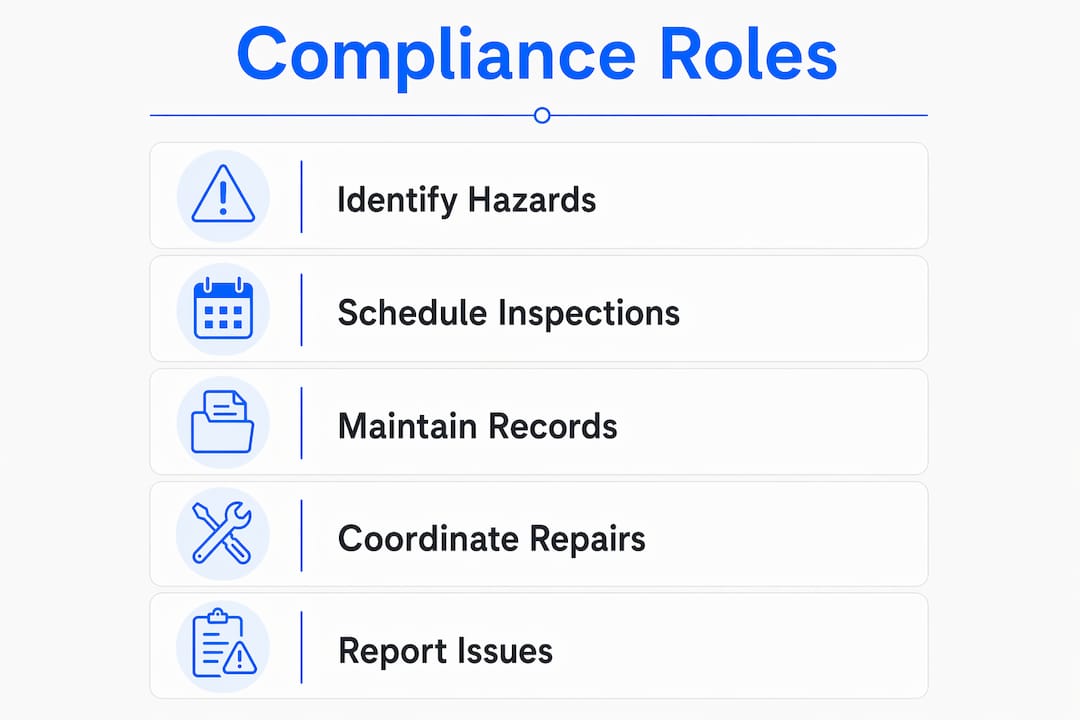
Legal liability for fire safety violations stays with the property owner, but operational responsibility, including inspection scheduling and record-keeping, typically falls on the property manager through the management agreement. That distinction matters in practice. If a sprinkler inspection lapses, the fire marshal cites the building, the owner faces the fine, and the manager answers for why the inspection was missed.
What property managers are directly responsible for:
- Scheduling all required fire safety inspections across every system in the portfolio
- Maintaining inspection records and keeping them available for AHJ review per IFC requirements
- Filing inspection certifications with the local AHJ on time
- Notifying tenants before any inspection that requires unit access
- Coordinating with licensed fire protection contractors for all testing and servicing
- Documenting deficiencies and tracking corrective work orders to completion
- Communicating fire safety procedures and evacuation plans to residents and staff
Supporting roles you coordinate with:
- Fire protection contractors: Licensed professionals who perform the actual inspections, testing, and repairs. You schedule them; they certify the work.
- Tenants: Responsible for not blocking egress paths, not tampering with devices, and following evacuation procedures.
- Local fire department: Conducts periodic inspections of the property and responds to impairment notifications.
The paper trail of inspection records is often as important as the physical maintenance itself for legal and insurance purposes. An inspection that happened but was never documented is treated as an inspection that never happened, by auditors and insurers alike.
Best practices to maintain fire safety compliance and protect liability
Build a centralized compliance calendar. Map every fire protection system across your entire portfolio, pull the current certification expiration date from the most recent inspection report for each one, and schedule the next inspection 30–60 days before expiration. That buffer gives you time to correct any deficiencies the inspector finds before the certification actually lapses.
Key practices that close the most common compliance gaps:
- Run monthly visual checks on fire extinguishers and emergency lighting yourself; do not wait for the annual contractor visit
- Build 30-day tenant notice windows into your calendar for any inspection requiring inside-unit access
- Keep a current certification certificate on file for every system, with the expiration date visible
- Log every deficiency with the date found, corrective action taken, and work order number
- Treat any system impairment as urgent: notify your fire protection contractor immediately and report alarm impairments to the AHJ within 8 hours as required by NFPA 72
Pro Tip: Stagger inspection weeks across your portfolio so you are not absorbing every inspection in the same month. For a 12-building portfolio, scheduling two buildings per month creates a predictable workload for your staff and a consistent rhythm for your contractor, and it keeps AHJ paperwork moving steadily rather than in a single annual rush.
Maintaining a central compliance file with current certificates, a three-year deficiency correction log, and AHJ correspondence keeps you audit-ready at any point in the year. Insurers request the same documentation during underwriting, so a clean file protects you on two fronts.
What every major fire safety system actually does

Understanding what each system does, not just that it exists, helps you catch problems during your own walkthroughs and ask better questions of your contractors.
Fire sprinkler systems
Sprinklers suppress fires automatically before the fire department arrives. Each head activates independently when heat reaches its rated temperature, so only the heads nearest the fire discharge activate. The inspection cycle under NFPA 25 runs quarterly for visual checks, annually for flow testing, and every five years for internal pipe inspection. During your own walkthroughs, look for storage stacked within 18 inches of sprinkler heads. Obstructed heads are the leading cause of sprinkler failure during an actual fire.
Fire alarm systems
The alarm system detects smoke or heat, notifies occupants through horns and strobes, and transmits a signal to the monitoring company. Monthly functional tests cover pull stations, notification appliances, and control panel diagnostics per NFPA 72. Full system inspections, including battery backup and sensitivity testing, happen annually. Skipping monthly tests is a common cause of alarm failures during fire events.
Fire extinguishers
Extinguishers handle small, contained fires before they spread. Monthly visual checks confirm the pressure gauge reads in the green zone, the pull pin is intact, and the unit is accessible and mounted correctly. Annual professional inspections are required under NFPA 10, and internal exams are required every six years. Per the Arvada Fire Protection District’s apartment management guidelines, commercial extinguishers must be positioned so no point in the building is more than 75 feet from one, measured by path of travel.
Emergency lighting and exit signs
Emergency lighting requires monthly 30-second tests and annual 90-minute battery drain tests per NFPA 101. The 90-minute test simulates a full power outage to confirm the battery can sustain lighting long enough for full evacuation. Non-functional emergency lighting shows up in a large share of commercial fire inspections, and it is one of the easiest deficiencies to prevent with a consistent monthly test routine.
Pro Tip: Assign monthly emergency lighting and extinguisher checks to your maintenance staff as a standing work order, not a verbal reminder. A timestamped digital work order creates the documentation trail that protects you if a citation or insurance dispute arises later.
For fire doors specifically, annual inspections are required under NFPA 80. Fire doors are a critical part of compartmentation, the strategy of containing a fire to one area while occupants evacuate. A propped-open fire door or a broken door closer can allow fire and smoke to spread through a building in minutes. Ufiredoors provides fire door maintenance and testing services for commercial and residential properties, including inspection, repair, and replacement to keep your doors code-compliant.
Key regulatory standards and inspection frequencies for fire safety
The NFPA standards that govern fire safety inspections are not suggestions. AHJs enforce them, and insurers reference them during underwriting. Here is how the major codes map to your daily compliance responsibilities.
| System | Inspection frequency | Governing standard |
|---|---|---|
| Fire sprinkler visual | Quarterly | NFPA 25 |
| Fire sprinkler annual test | Annually | NFPA 25 |
| Fire sprinkler internal pipe | Every 5 years | NFPA 25 |
| Fire alarm functional test | Annually | NFPA 72 |
| Fire alarm monthly test | Monthly | NFPA 72 |
| Fire extinguisher visual | Monthly | NFPA 10 |
| Fire extinguisher service | Annually | NFPA 10 |
| Emergency lighting test | Monthly (30 sec) | NFPA 101 |
| Emergency lighting battery | Annually (90 min) | NFPA 101 |
| Fire door inspection | Annually | NFPA 80 |
Documentation requirements for each system include the inspection report, any confidence test reports, AHJ filings, and a deficiency correction history. Deficiency records should include the date found, the corrective action taken, the work order number, and any AHJ response documents. Keep these records for at least three years.
Pro Tip: Schedule inspections before their expiration dates, not on them. A 30-day buffer between the inspection date and the certification expiration gives you time to correct deficiencies and still file a clean certification with the AHJ before the deadline passes.
For property managers overseeing construction or renovation projects alongside occupied buildings, a construction safety management framework that integrates NFPA and IFC requirements helps keep fire compliance from slipping during active work phases.
Common fire hazards in properties and how the terms connect
Knowing the terminology helps you identify hazards during your own walkthroughs, not just during formal inspections. Most fire hazards in managed properties fall into a few predictable categories.
Egress obstructions are the most cited hazard in residential buildings. Boxes, furniture, or trash stored in corridors, stairwells, or near exit doors directly violate the Means of Escape requirement. When you walk a building and see a blocked hallway, you are looking at a potential citation and a genuine life-safety risk.
Electrical hazards include overloaded circuits, damaged wiring, and extension cords used as permanent wiring. These are common in older buildings and in units where tenants run high-draw appliances. Your Fire Risk Assessment should flag electrical panel age and condition as a standing item.
Improper storage near ignition sources covers combustibles stored in boiler rooms, mechanical rooms, and near electrical panels. NFPA standards require these spaces to have self-closing doors and be kept free of combustible storage. A propped-open boiler room door is both a fire hazard and a fire door deficiency.
Deferred maintenance on fire protection systems is where terminology gaps hurt property managers most. A manager who does not know what an impairment is may not report a failed sprinkler zone to the AHJ within the required window. A manager unfamiliar with NFPA 101 may not realize that a single burned-out emergency light fixture is a citable deficiency. The commercial roof inspection checklist framework used in property management also applies here: systematic, documented walkthroughs catch hazards before inspectors do.
How to respond during a fire emergency
When a fire alarm activates, your building’s response depends on the procedures you established before the emergency, not during it. Property managers do not fight fires. Your job is to have the systems, documentation, and trained people in place so that evacuation happens correctly.
The core evacuation terminology you and your staff must know:
- Assembly Point: The designated outdoor location where all occupants gather after evacuating. It must be far enough from the building that it does not interfere with fire department access.
- Area of Refuge: A protected space, typically a fire-rated stairwell landing, where occupants who cannot use stairs wait for assisted evacuation.
- Assisted Rescue Procedures: Documented steps for helping occupants with mobility limitations evacuate safely, including who is responsible and how they communicate with the fire department.
- Evacuation Warden: A staff member assigned to sweep a floor or zone, confirm all occupants have left, and report to the incident commander.
The Arvada Fire Protection District’s apartment management manual recommends that evacuation plans be communicated to residents when they first move in and reviewed with them annually. Staff training should happen at least semi-annually. After each drill, debrief with staff to identify what worked and what did not, and keep a written record of the drill including the date, participants, and findings.
When a system impairment occurs between inspections, treat it as an emergency. Call your fire protection contractor, notify the monitoring company if the alarm is affected, and document the event with a timestamp. NFPA 101 requires a fire watch after four hours of alarm downtime or ten hours of sprinkler downtime within a 24-hour period.
Legal consequences of non-compliance with fire safety regulations
Fire code violations carry real financial and legal consequences. Many fire code violations stem from missed routine inspections that a scheduled checklist would have caught.
Beyond fines, the consequences compound quickly. A building with open code violations can face occupancy restrictions, which means vacancy and lost revenue. Insurance carriers can deny claims if they find that required inspections were not performed or documented. In cases where a fire causes injury or death and inspections were lapsed, property managers and owners face civil liability and, in serious cases, criminal exposure.
The documentation gap is where most legal exposure originates. Many fire safety disputes during insurance claims involve missing or incomplete inspection records. An inspection that was performed but not documented gives you no legal protection. Courts and insurers treat undocumented inspections as inspections that never occurred.
Staying current on commercial fire door regulations is one area where property managers frequently fall behind, particularly as NFPA 80 requirements have been updated. Fire door deficiencies account for a meaningful share of citations in commercial buildings, and they are among the most straightforward to correct with a scheduled annual inspection and prompt repair.
How to communicate fire safety terms to tenants and staff
Clear communication about fire safety is not just good practice. Fire departments actively encourage property managers to shift from a compliance-only mindset to a resident safety culture by communicating fire safety plans, evacuation routes, and emergency procedures clearly and regularly.
For tenants:
- Distribute the evacuation plan when a tenant moves in, and review it with them again annually
- Post floor plans showing exits, primary and secondary evacuation routes, assembly points, and extinguisher locations in common areas
- Use plain language in all written communications. Replace “means of egress” with “exit path.” Replace “AHJ notification” with “we are required to report this to the fire marshal.”
- Send written notice before any inspection requiring unit access, at least 30 days in advance
For staff:
- Train maintenance staff on what an impairment is and what to do when they find one: stop work, notify the manager, call the contractor
- Assign specific evacuation warden roles to staff members and train them at least twice a year
- Make sure every staff member knows the location of every fire extinguisher, pull station, and emergency lighting unit in their area
The goal is a building where residents and staff know what to do before the alarm sounds, not after. That preparation is what the evacuation plan, the fire safety plan, and the annual training drills are designed to build.
Why fire-rated doors are a critical part of your compliance plan
Fire-rated doors are the physical barrier between a contained fire and a building-wide emergency. A door that fails to close, latch, or hold its rating during a fire event can allow smoke and flames to spread through corridors in minutes, turning a manageable incident into a catastrophe.
Ufiredoors manufactures and installs fire-rated steel doors built with UL-approved materials, fabricated locally in New York, and available with lead times of 3–5 days for standard configurations. Whether you need new installations to meet code, repairs on doors with broken closers or damaged seals, or emergency replacements after an inspection citation, Ufiredoors provides complete door solutions from fabrication through installation and ongoing maintenance.
Get a free site estimate for your property today.
Key Takeaways
Property managers who combine clear terminology, scheduled inspections, and complete documentation meet fire safety regulations and protect their buildings from liability exposure.
| Point | Details |
|---|---|
| Know the core terms | Terms like AHJ, FRA, Means of Escape, and Impairment are the vocabulary of compliance conversations with inspectors and contractors. |
| Schedule inspections 30–60 days early | Booking before expiration leaves time to correct deficiencies before certifications lapse. |
| Document everything | 51% of fire safety insurance disputes involve missing or incomplete inspection records. |
| Monthly checks prevent most citations | Many alarm failures during fire events trace to skipped monthly functional tests. |
| Fire doors require annual inspection | NFPA 80 mandates annual fire door inspections; deficiencies are among the most common and most correctable citations. |