
Fire door damage assessment is the systematic inspection of a fire door assembly to identify defects that compromise its ability to contain fire, smoke, and toxic gases. The 2026 NFPA 80 standard defines 13 critical visual and functional inspection criteria that every qualified inspector must verify annually. Knowing how to assess fire door damage correctly protects occupants, satisfies code requirements, and creates a defensible record for building owners. This guide walks property managers, building inspectors, and safety compliance officers through every step, from tools and preparation to documentation and repair prioritization.
What tools and preparation does fire door damage assessment require?
Accurate fire door condition assessment starts before you touch the door. Arriving unprepared wastes time and produces results that cannot hold up under regulatory scrutiny.
Required inspection tools
Every inspection kit should include the following:
- Feeler gauges (calibrated): measure door-to-frame gaps against NFPA 80 tolerances
- Tape measure or digital calipers: verify door leaf dimensions and hardware placement
- Force meter or door closer gauge: test closing force and speed
- Flashlight or inspection light: illuminate seals, hinges, and label areas
- Camera or smartphone: photograph every deficiency with a timestamp
- Inspection checklist software or printed forms: record findings in real time
Calibration certificates are required for measuring tools like feeler gauges and force meters to maintain chain-of-custody. Without them, your measurements may not hold up in a compliance dispute.
Preparation steps

Confirm the door is accessible and not propped open or blocked by furniture. Notify building occupants before testing self-closing mechanisms, especially in occupied corridors. Review any prior inspection records to identify recurring defects before you start.
Pro Tip: Photograph the certification label before touching anything else. If the label is later damaged during inspection, you still have a timestamped record of its condition.
| Preparation Step | Why It Matters |
|---|---|
| Gather calibrated tools | Uncalibrated instruments produce legally indefensible data |
| Review prior inspection records | Recurring defects signal systemic problems, not isolated damage |
| Notify occupants | Prevents interference during functional closing tests |
| Confirm door accessibility | Blocked doors cannot be tested from both sides as NFPA 80 requires |
How to inspect fire door components step by step
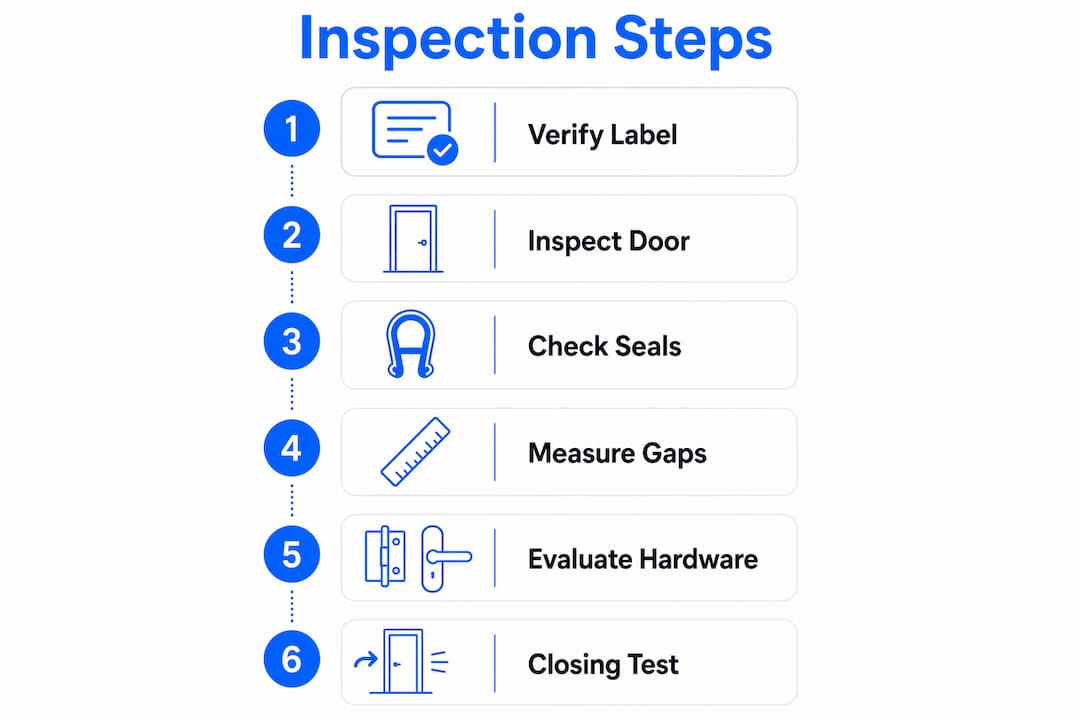
A systematic approach prevents missed defects. Work through the door assembly from top to bottom, covering labels, the door leaf, frame, seals, hardware, and functional performance.
Step 1: Verify the certification label
The certification label confirms the door carries a valid fire rating. Locate it on the door edge or frame. The label must be legible, permanently attached, and free of paint or damage. A missing or obscured label is an automatic failure under NFPA 80 inspection criteria, which expanded from 11 to 13 criteria in 2026 to include signage integrity.
Step 2: Inspect the door leaf and frame
Examine both faces of the door leaf for cracks, holes, warping, or delamination. Run your hand along the surface to feel for bulges or soft spots that are not visible under normal lighting. Check the frame for cracks, loose anchors, and any gaps between the frame and the wall. A warped door leaf will not seat properly against the frame, creating a gap that smoke and fire can penetrate.
Step 3: Check intumescent and smoke seals
Intumescent seals expand when exposed to heat, sealing the gap between the door and frame. Painted-over seals form a hard shell that prevents this expansion, making the door ineffective as a fire barrier. Run your finger along every seal. Confirm each seal is continuous, undamaged, and free of paint, debris, or compression damage. Replace any seal that shows cracking, missing sections, or paint coverage.
Pro Tip: Press gently on the intumescent seal. It should feel slightly soft and compressible. A seal that feels rock-hard is almost certainly painted over and must be replaced before the door can pass inspection.
Step 4: Measure door-to-frame gaps
Use a calibrated feeler gauge to measure the gap at the top, latch side, and hinge side of the door. The maximum allowable gap is 3mm on the sides and top, and 8mm at the bottom unless the door’s fire rating specifies a tighter tolerance. Excessive gaps are the single most common cause of fire door failure. Record every measurement, not just the ones that exceed tolerance.
| Door Location | Maximum Allowable Gap |
|---|---|
| Top of door | 3mm |
| Latch side | 3mm |
| Hinge side | 3mm |
| Bottom of door | 8mm (unless rating specifies tighter) |
Step 5: Evaluate hardware
Inspect all hinges for fire-rated markings, proper installation, and missing screws. All hinges must be fire-rated, properly installed with no missing screws, and the door must hang level to prevent closing failures. Check the door closer for smooth operation, oil leaks, and correct spring tension. Verify that the latch bolt engages fully with the strike plate. Test the lock cylinder for smooth operation without binding.
Step 6: Perform the functional closing test
Open the door to its widest position and release it. The door must self-close and fully latch from any open position without manual assistance. Failure to latch is an automatic inspection fail. For rolling steel fire doors, a drop test must be performed by a trained technician to validate closing speed between 6–24 inches per second per NFPA 80 standards. Test the door from multiple open positions, not just fully open.
What are the most common signs of fire door damage?
Knowing the most frequent failure points helps you spot defects that are easy to overlook during a routine walkthrough. These are the issues that cause the most inspection failures.
- Excessive gaps: The gap between the door and frame exceeds 3mm on the sides or top. This is the leading cause of fire door failure and is often caused by hinge sag or frame settlement.
- Painted-over intumescent seals: Building maintenance staff sometimes paint over seals during routine repainting. The seal looks intact but cannot expand during a fire.
- Field modifications: Unauthorized modifications such as added locks, mail slots, or cat flaps void the fire door certification regardless of the door’s physical condition. A door with an unauthorized hole is non-compliant even if every other component passes.
- Hinge sag or missing screws: A single missing hinge screw shifts the door’s weight distribution. Over time, this causes the door to hang unevenly, creating gaps at the top corner opposite the hinge.
- Incomplete latching: The door swings shut but the latch bolt does not fully engage the strike plate. This often results from a misaligned strike plate or a worn latch mechanism, and it is a functional failure regardless of how the door looks.
Key rule: A fire door that passes every visual check but fails the functional closing test is still a failed door. Visual checks and functional tests are both required, and neither substitutes for the other.
Identifying fire door issues accurately also means checking for signs of previous repairs that may not have been performed to code. Filler compounds, mismatched paint, or non-original hardware are all indicators that the door’s certification status needs verification.
How should you document and report fire door damage findings?
A fire door inspection report is a legal document. Vague language creates liability and makes it impossible to verify that deficiencies were corrected at re-inspection.
Every report must include:
- Door identifier: location, floor, door number, and fire rating
- Inspector information: name, credentials, date, and time of inspection
- Visual findings: description of each defect with the specific component affected
- Functional test results: closing speed, latching performance, and gap measurements
- Labeled photographs: one photo per deficiency, with the defect clearly visible
- Deficiency categorization: urgent (safety-critical) or scheduled (cosmetic or minor)
Precise, actionable descriptions paired with labeled images improve compliance and help building owners track repairs effectively. Replace vague terms like “door damaged” with specific language: “3mm crack on the push face of the door leaf, 18 inches from the top, latch side.”
Critical defects such as failed closers or missing seals require urgent repair within days. Minor defects can be scheduled for regular maintenance windows. A tiered response system balances safety urgency with operational budgeting without letting critical failures sit unaddressed.
Pro Tip: Number your photographs to match the deficiency list in your report. An inspector reviewing your work six months later should be able to match every photo to a specific finding without guessing.
Maintain all inspection records for a minimum of three years. NFPA 80 requires documentation to be available for review by the authority having jurisdiction at any time.
Key Takeaways
A fire door that fails any one of the 13 NFPA 80 criteria, whether a gap measurement, a painted seal, or an incomplete latch, is a non-compliant door that requires immediate corrective action.
| Point | Details |
|---|---|
| Use calibrated tools | Feeler gauges and force meters need calibration certificates to produce legally defensible data. |
| Check seals for paint | Painted intumescent seals cannot expand during fire and must be replaced before the door passes. |
| Measure all four gaps | Record gap measurements at the top, both sides, and bottom against NFPA 80 tolerances. |
| Test functional closing | A door that does not self-latch from any open position fails inspection regardless of visual condition. |
| Document with labeled photos | Match numbered photos to each deficiency in the report for clear, trackable compliance records. |
What I’ve learned from years of fire door assessments
By Esteban
The most common mistake I see from inspectors is treating fire door assessment as a visual exercise. You walk up, look at the door, check the label, and move on. That approach misses the failures that actually matter.
Spring fatigue in door closers is invisible until you test the door from a 15-degree open position. A door that closes perfectly from 90 degrees can fail to latch from a narrow angle because the closer lacks the torque to push through the final few degrees of travel. Visual checks alone are insufficient. Functional testing and calibrated measurements reveal hidden failures that no amount of looking will catch.
The second thing I’ve learned is that building managers often push back on repair timelines. They want to batch everything into the next scheduled maintenance window. My position is firm: a failed closer or a missing seal is not a maintenance item. It is a safety failure that needs a repair date measured in days, not months. The tiered defect response approach exists precisely to give managers a framework that protects both occupants and budgets.
Finally, I always verify the certification label last, not first. If I find an unauthorized modification during the inspection, the label status becomes irrelevant. The door is non-compliant regardless. Starting with the label can create a false sense of security that colors the rest of the inspection.
— Esteban
Ufiredoors: fire door products and repair services for compliance officers
When an inspection reveals damage that requires replacement or professional repair, the next step is sourcing a door that meets the exact fire rating, size, and hardware specifications your building requires.
Ufiredoors manufactures and installs fire-rated steel doors built locally in New York using UL-approved materials, with lead times of 3–5 days for most commercial orders. Every door ships with full certification documentation, so your next inspection starts with a clean record. For buildings where inspection findings require same-week action, Ufiredoors offers emergency repair services across commercial, residential, and industrial properties. Property managers can also request free site estimates for steel-stiffened door replacements tailored to their building’s specifications. With over 20 years of experience, Ufiredoors delivers complete door solutions from fabrication through installation and ongoing maintenance.
FAQ
What does NFPA 80 require for annual fire door inspections?
NFPA 80 2026 requires annual inspections covering 13 visual and functional criteria, including gap measurements, seal condition, hardware function, certification labels, and self-closing performance.
What is the maximum gap allowed on a fire door?
The maximum allowable gap is 3mm on the sides and top, and 8mm at the bottom, unless the door’s specific fire rating requires a tighter tolerance.
Does painting over an intumescent seal fail a fire door inspection?
Yes. A painted intumescent seal cannot expand during a fire, which makes the door non-compliant. The seal must be replaced before the door can pass inspection.
Can a fire door be repaired after field modifications?
Unauthorized field modifications void the fire door’s certification. Repair is only compliant if the modification is removed and the door’s original certified condition is fully restored with manufacturer approval.
How often should fire door inspection records be kept?
NFPA 80 requires inspection records to be available for review by the authority having jurisdiction at any time, and industry practice calls for retaining records for a minimum of three years.