
Door security is defined as the combined strength of every component in your door system, including the slab, frame, hinges, locks, and hardware. Improving it means reinforcing all of those parts together, not just swapping out a lock. A layered security approach treats your door as a system where the weakest part determines total protection. Research shows that implementing integrated security measures, covering deadbolts, reinforced frames, sensor lighting, and quality cylinders, can make a home up to 49 times more protected from burglary than one with no upgrades.
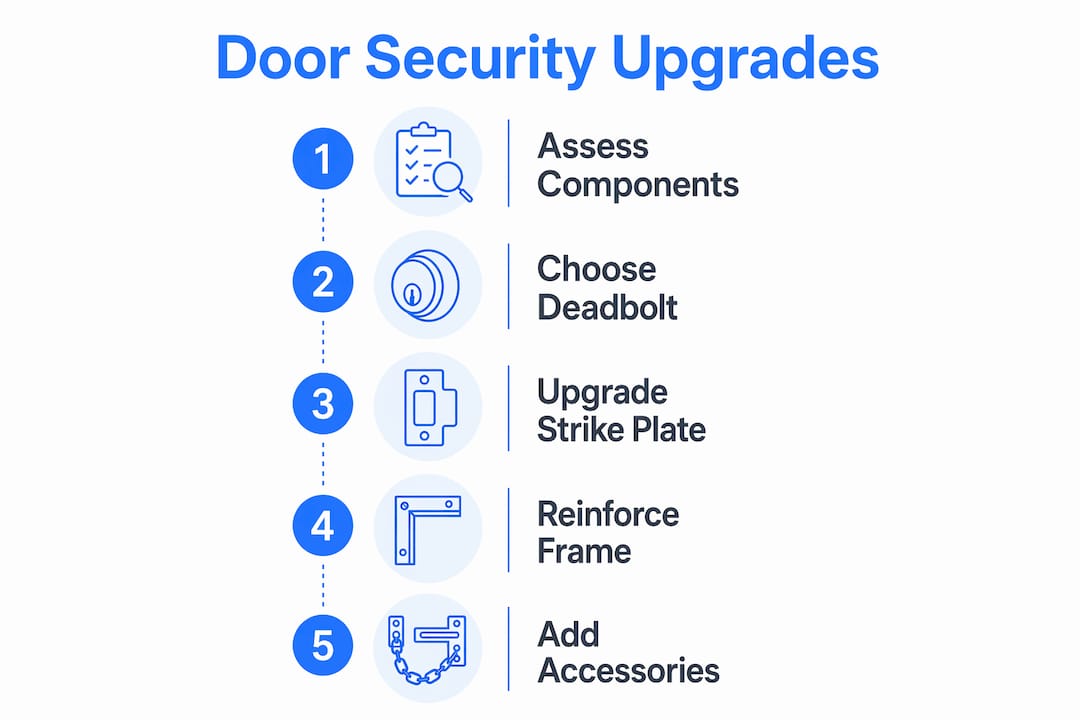
How to improve door security: start with a full component assessment
The first step to securing any entry point is knowing what you are working with. Most property owners focus on the lock and ignore the three components that fail first under forced entry: the slab, the frame, and the hinges.
Door slab: solid core vs. hollow core
The door slab is the panel itself. A hollow core door, common in interior and budget exterior applications, can be kicked through or punched out in seconds. A solid core door, built with a dense wood or composite interior, resists that kind of force. Steel slabs provide the highest resistance. When assessing your current door, knock on it. A hollow sound means hollow construction. Replacing a hollow exterior door with a solid core option is one of the highest-impact upgrades you can make.
Frame integrity and anchoring
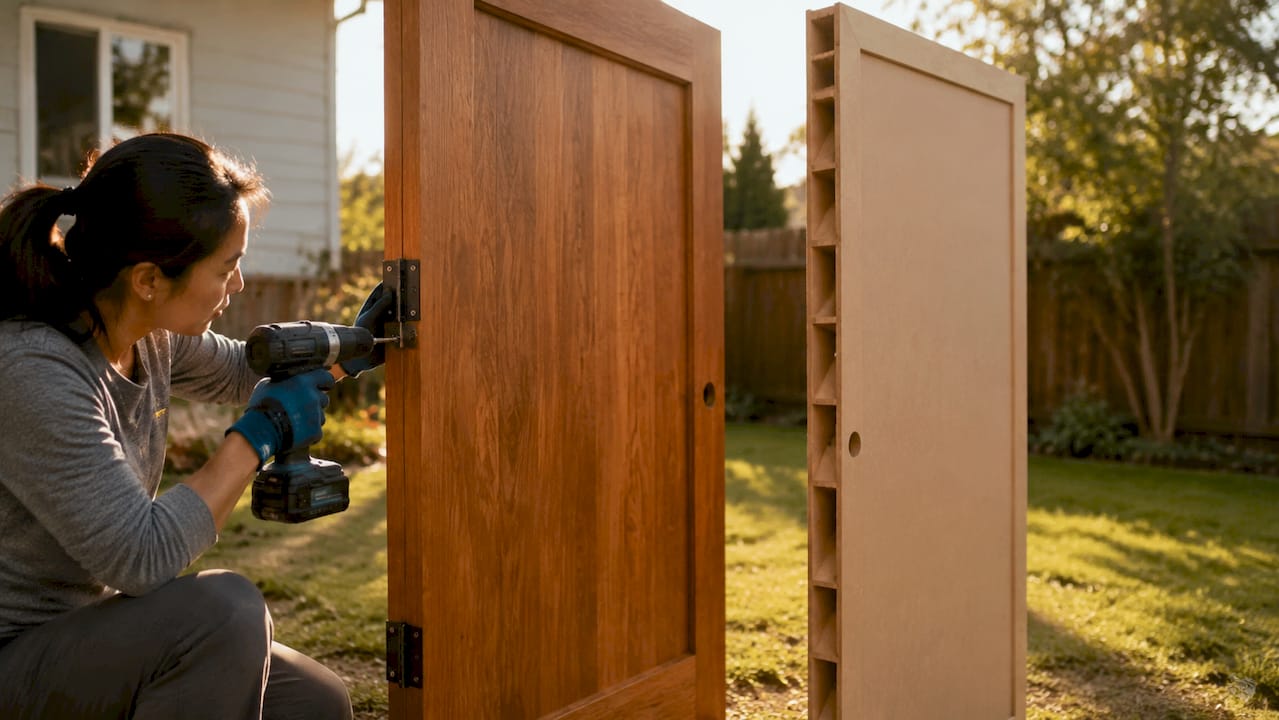
A door frame that is not anchored into structural studs will split under a single hard kick, regardless of how good the lock is. Check your frame for rot, cracks, and loose fasteners. Wood frames are especially vulnerable at the strike plate area. Metal frames, particularly hollow metal frames, offer significantly better resistance when properly installed and anchored.
Hinge condition and placement
Hinges are often overlooked in any door security assessment. Check for loose screws, worn pivot points, and exposed hinge pins. A door with exposed hinges on the exterior side is vulnerable because an intruder can drive out the pins and lift the door off entirely. Use this checklist before any upgrade:
- Slab type: Is it solid core or hollow? Steel or wood?
- Frame condition: Any rot, cracks, or gaps between frame and wall?
- Strike plate screws: Are they short screws into trim, or long screws into studs?
- Hinge placement: Are hinges interior or exterior facing?
- Lock type: Single cylinder deadbolt, knob lock only, or multi-point?
- Door fit: Does the door close firmly with no rattle or gap?
What lock upgrades provide the greatest security improvement?
Locks are the most visible part of door security, but they are only as strong as the hardware around them. Upgrading your lock without reinforcing the frame is like installing a vault door on a cardboard wall.
Choosing the right deadbolt
A Grade 1 ANSI deadbolt is the minimum standard for any exterior door. It offers a 1-inch throw bolt that resists pulling and prying. A double cylinder deadbolt requires a key on both sides, which prevents glass-break entry but creates a fire egress risk. For most residential and commercial properties, a single cylinder Grade 1 deadbolt on a reinforced frame is the correct choice.
Anti-snap and anti-pick cylinders
Standard euro cylinders are vulnerable to a technique called lock snapping, where an intruder breaks the cylinder in half to access the cam. Anti-snap cylinders, such as those meeting the TS007 3-star standard, have a sacrificial break point that leaves the lock mechanism intact. Anti-pick cylinders add security pins that resist manipulation. Pairing an anti-snap cylinder with a protective escutcheon plate prevents both snapping and drilling attacks.
Strike plate upgrades: the highest-value fix
Strike plate screws must be at least 3 inches long to reach the structural studs behind the door frame. Standard strike plates ship with 3/4-inch screws that only grip the door trim. Those fail under a single kick. Replacing them costs under $10 in hardware. That small investment greatly increases resistance to forced entry.
Pro Tip: Upgrading your strike plate and swapping in 3-inch screws is the single best security improvement per dollar spent. Do this before buying any new lock.
Here is a comparison of common lock types by security level:
| Lock Type | Forced Entry Resistance | Best Use Case |
|---|---|---|
| Knob lock only | Low | Interior doors only |
| Single cylinder deadbolt (Grade 1) | High | Standard exterior doors |
| Anti-snap euro cylinder | Very high | Doors with euro profile locks |
| Electronic/passive lock | High + audit trail | Commercial and rental properties |
| Multi-point locking system | Very high | Steel and composite doors |
Follow these steps when installing or upgrading a deadbolt:
- Remove the existing lock and measure the backset distance (typically 2-3/8 or 2-3/4 inches).
- Confirm the door thickness matches the lock’s specification.
- Install the deadbolt body and test the throw bolt for full extension.
- Replace the strike plate with a heavy-duty reinforced model.
- Drive 3-inch screws through the strike plate into the wall stud.
- Test the lock under light shoulder pressure to confirm no flex in the frame.
How to reinforce door frames and hinges against forced entry
Frame and hinge reinforcement is where most property owners leave the biggest security gap. A high-security lock system requires compatible frame strength to function as designed.
Metal door jamb reinforcements
Door jamb reinforcement kits wrap the existing frame in a steel channel, distributing kick force across a wider area. Products like the Door Armor MAX reinforce the full door frame length rather than just the strike plate zone. This prevents the split-frame failure that accounts for the majority of kick-in entries. Pair jamb reinforcement with a strong frame material for maximum effect.
Hinge security for inswing and outswing doors
Exposed hinges on outswing doors are a direct vulnerability. If the hinge pins face outward, an intruder can remove them and pull the door free from the frame. Two solutions exist. First, replace standard hinge pins with non-removable security pins that cannot be driven out. Second, install hinge bolts, which are steel pins that project from the door edge into the frame when the door is closed. Hinge bolts engage frame recesses and anchor the door even if all pins are removed.
For inswing doors, hinges face inward and are not directly accessible from outside. The priority shifts to using long hinge screws, at least 3 inches, that reach the structural stud rather than just the door jamb trim.
Safety note: Never rely on a heavy door slab alone. A solid steel door on a rotted wood frame with short hinge screws provides almost no real protection. Frame and hinge integrity must match the door’s strength.
Key hinge reinforcement actions:
- Replace all hinge screws with 3-inch screws anchored into studs.
- Install non-removable hinge pins on any outswing exterior door.
- Add hinge bolts to outswing doors as a secondary anchor point.
- Inspect hinge leaf condition annually for corrosion or loosening.
What door security accessories further deter intruders?
Secondary accessories extend your door’s defense beyond the primary lock. They add backup locking, controlled entry, and visible deterrents that reduce the likelihood of an attempt in the first place.
Visible deterrents work. Research shows 83% of burglars check for visible security indicators like alarm systems or video doorbells before attempting a break-in. A camera or alarm sign visible from the street changes the risk calculation for a potential intruder before they ever reach your door.
Pro Tip: Mount your security camera at a height that captures face-level footage, not just the top of a head. Placement matters as much as presence.
Here is a comparison of common door security accessories:
| Accessory | Primary Benefit | Limitation |
|---|---|---|
| Door chain or bar | Controlled opening without full exposure | Easily defeated if door frame is weak |
| Floor bolt / barrel bolt | Secondary locking point at door base | Manual operation only |
| Motion sensor lighting | Deters approach, alerts occupants | Requires electrical work ($50–$300 installed) |
| Video doorbell | Visual deterrent, remote monitoring | Requires Wi-Fi and power |
| Door alarm sensor | Audible alert on forced entry | Needs monitoring or response plan |
| Letterbox restrictor | Prevents fishing for keys through mail slot | Specific to letterbox-style mail openings |
Additional accessories worth considering:
- Security chains: Add a door chain or door bar for controlled entry when answering the door.
- Letterbox restrictors: A letterbox vulnerability allows intruders to fish for keys or manipulate locks. A restrictor or external mailbox eliminates this risk.
- Passive electronic locks: These log access events with user identity and timestamps, which is especially useful for rental properties and commercial entries.
How to maintain door security and avoid common mistakes
Security hardware degrades over time. A door that was secure two years ago may not be secure today if it has shifted, swollen, or lost alignment.
Follow this maintenance schedule to keep your door system performing correctly:
- Check door fit every six months. A door that rattles or requires force to close has shifted. Misaligned doors create gaps that weaken lock engagement and can be forced open more easily.
- Test lock operation monthly. The deadbolt should throw fully and retract smoothly. Stiffness or grinding indicates wear or misalignment.
- Inspect weatherstripping annually. Damaged weatherstripping is not just an energy issue. It signals door fit problems that create security vulnerabilities.
- Tighten all hinge and strike plate screws. Screws back out over time, especially in wood frames. Check torque annually.
- Examine the frame for rot or water damage. Wood frames near the threshold are especially prone to moisture damage that weakens structural integrity.
Maintenance is a security feature. A door that does not close firmly can be forced open even with a high-quality lock installed. The most common mistake property owners make is installing new hardware on a door that no longer fits its frame correctly. The second most common mistake is assuming that a heavy door alone provides security. Door weight means nothing without a sound frame, properly anchored hardware, and a well-fitted slab.
Key takeaways
Improving door security requires reinforcing every component together: slab, frame, hinges, locks, and accessories must all meet the same standard or the weakest part defines your total protection.
| Point | Details |
|---|---|
| Assess before upgrading | Check slab type, frame condition, hinge placement, and screw length before buying new hardware. |
| Strike plates first | Replace strike plate screws with 3-inch versions anchored into studs for the highest gain per dollar. |
| Match frame to lock strength | A high-security lock on a weak frame provides no real protection; reinforce both together. |
| Use visible deterrents | Motion lighting and cameras deter 83% of intruders before they reach the door. |
| Maintain regularly | Inspect door fit, lock operation, and hardware torque every six months to prevent degradation. |
What most people get wrong about door security
I have seen hundreds of properties where the owner installed a quality deadbolt and considered the job done. The lock was fine. The frame was splitting at the strike plate. The hinge screws were 3/4-inch stubs gripping nothing but paint and trim. That door would have failed in under five seconds.
The industry term for what most people skip is “door system integrity.” It means every component must be rated and installed to the same standard. A $200 lock on a $0 frame upgrade is a waste of money. A $10 strike plate fix on a solid core door with proper hinge screws is genuinely effective security.
The other thing I see constantly is deferred maintenance. A door that fit perfectly at installation shifts over two to three years as the building settles. The gap between the door edge and the frame grows. The deadbolt no longer throws fully into the strike plate. Nobody notices until there is a problem. Checking your door hardware installation and fit twice a year takes ten minutes and catches these issues before they matter.
My honest recommendation: treat your door like you treat your smoke detector. Do not wait for it to fail. Test it, adjust it, and replace worn parts on a schedule. That habit is worth more than any single hardware upgrade.
— Esteban
Upgrade your door security with Ufiredoors
Ufiredoors manufactures and installs fire-rated steel doors, frames, and commercial door hardware for residential, commercial, and industrial properties across New York. Steel doors eliminate the hollow core vulnerability entirely and pair with reinforced frames and UL-approved hardware for a complete, code-compliant door system. Every installation is handled by experienced technicians who anchor frames into structural studs and verify lock alignment before the job is complete. If your current door is hollow core, misaligned, or working with a compromised frame, a steel stiffened door from Ufiredoors is the most direct path to genuine security. Request a free site estimate and get a professional assessment of your property’s entry points.
FAQ
What is the most effective way to secure a door against kick-ins?
Reinforce the strike plate with 3-inch screws anchored into wall studs and add a metal door jamb reinforcement kit. These two upgrades address the frame failures that cause the majority of kick-in entries.
How do I know if my door frame needs reinforcement?
Check the strike plate screws. If they are shorter than 3 inches or only grip the door trim, the frame is not properly reinforced. Visible cracks near the strike plate area also indicate structural weakness.
Are electronic locks more secure than traditional deadbolts?
Electronic and passive locks offer access control and audit trails that traditional deadbolts cannot match, making them ideal for rental and commercial properties. They do not replace the need for a reinforced frame and solid core door.
What door material provides the best security?
Steel doors provide the highest forced entry resistance. Solid core wood doors are a strong secondary option. Hollow core doors are not suitable for any exterior security application.
How often should I inspect my door security hardware?
Inspect door fit and lock operation every six months. Check hinge and strike plate screw torque annually. Address any rattling, stiffness, or misalignment immediately, as these are active security vulnerabilities.