
Fire door rating testing is the systematic verification that a door assembly performs according to its certified classification under NFPA 80 and UL 10C standards. Building inspectors and safety officers cannot rely on visual appearance alone. The rating lives in the label, the clearances, the hardware, and the integrity of the complete assembly. This guide covers how to test fire door ratings from pre-inspection preparation through field measurement, common failure points, and the hard boundary between what field testing can confirm and what only a laboratory furnace can prove.
How to test fire door ratings: tools and documentation you need first
Accurate fire door rating verification starts before you touch the door. Walking onto a site without the right tools produces incomplete data and exposes you to liability when the authority having jurisdiction (AHJ) reviews your report.
The core measurement tool is a calibrated gap gauge. Fire door gap gauges designed to measure NFPA 80 compliance clearances at the head, jambs, and meeting stiles are non-negotiable for any inspector. Many professionals carry these on a keychain for convenience during multi-door inspections. A standard measuring tape, a flashlight, and a mirror for checking door bottoms and frame backs round out the physical toolkit.
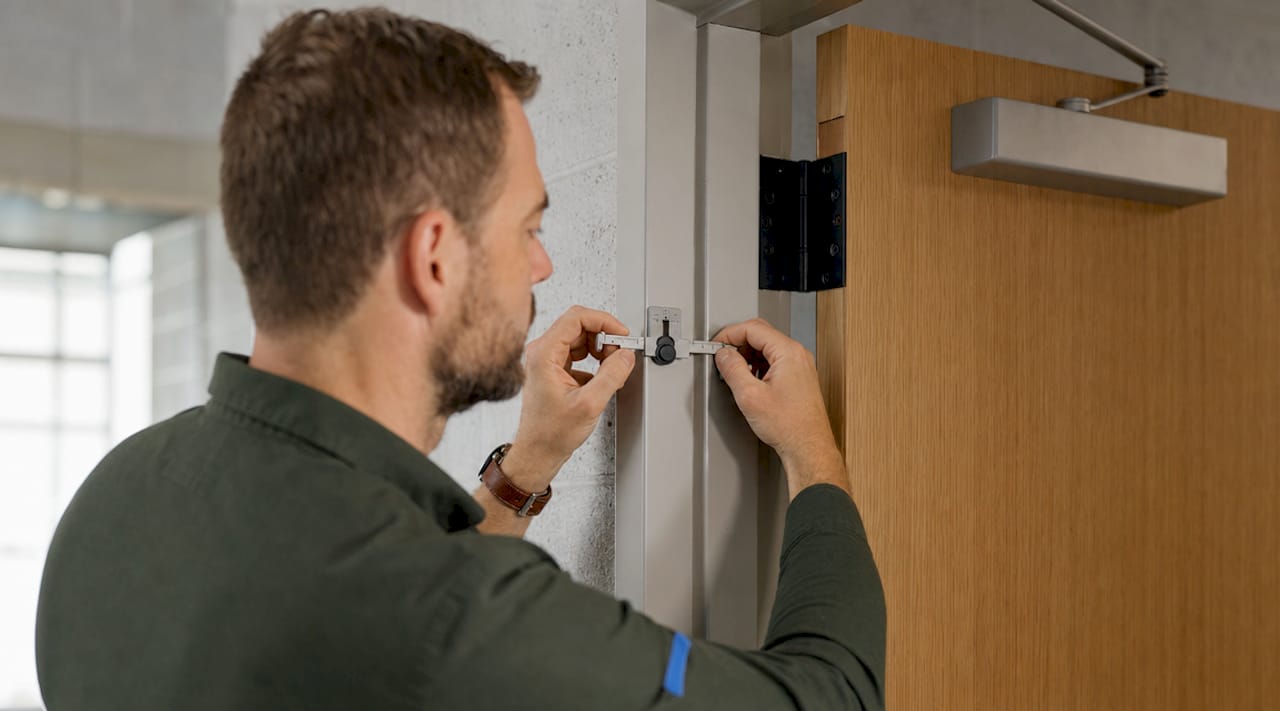
Documentation requirements are equally specific. NFPA 80 mandates that inspection records be available for AHJ review, covering label checks, door and frame condition, clearances, self-closing operation, latching, and hardware completeness. Bring a pre-formatted inspection form that maps to all 13 NFPA 80 criteria. Digital forms on a tablet speed up reporting and reduce transcription errors.
Before entering the building, pull the manufacturer’s listing documentation for each door assembly. This tells you exactly which frame, hardware, glazing, and seals were tested together in the laboratory. Any deviation from that listed configuration is a deficiency, regardless of how minor it appears.
| Tool | Purpose |
|---|---|
| Calibrated gap gauge | Measures clearances at head, jambs, bottom, and meeting stiles |
| Flashlight and inspection mirror | Checks label legibility and frame back conditions |
| Measuring tape | Verifies door and frame dimensions against listing |
| NFPA 80 inspection form | Documents all 13 criteria for AHJ submission |
| Manufacturer listing documentation | Confirms correct assembly configuration |
Pro Tip: Photograph every label before measuring anything else. If a label becomes illegible during the inspection process, your photo serves as documentation of its condition at the time of arrival.
Step-by-step process for inspecting fire door ratings in the field
Field inspection of fire door ratings follows a defined sequence. Skipping steps or reordering them creates gaps in your documentation and increases the chance of missing a deficiency.
Step 1: Verify label presence and legibility. Every fire-rated door and frame must carry a legible label from an accredited testing laboratory such as UL or Intertek. An absent or illegible label means the assembly must be treated as non-rated during the inspection. Check both the door leaf and the frame separately. Labels are typically located on the hinge edge of the door and on the strike side of the frame.
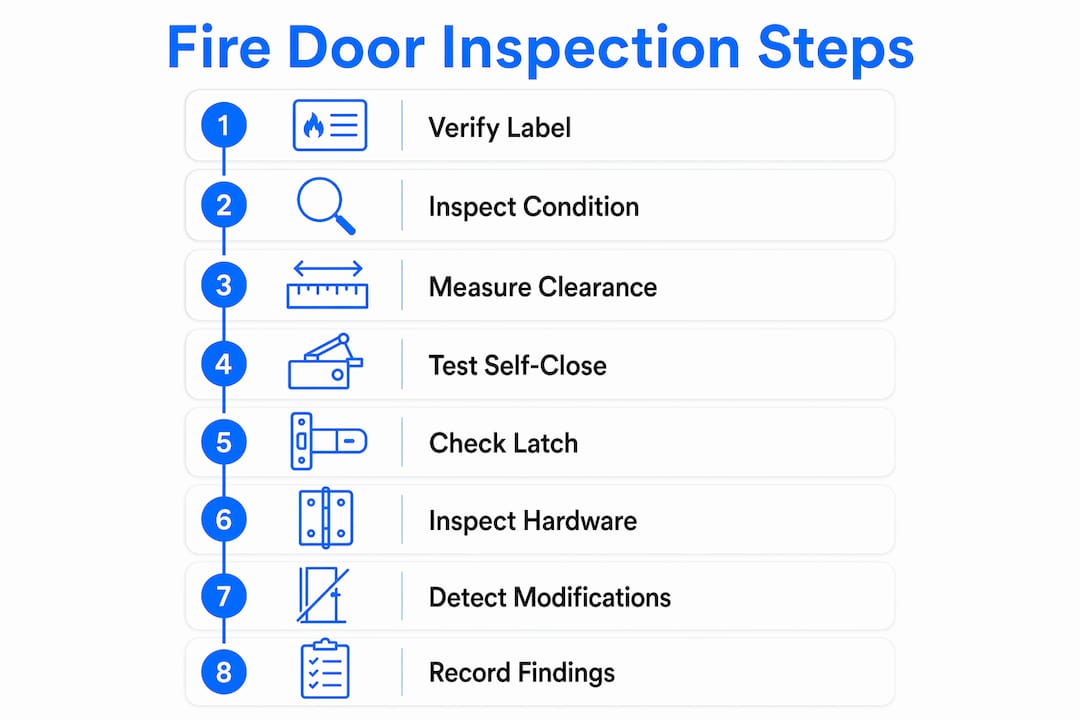
Step 2: Inspect physical condition. Look for holes, cracks, warping, or unauthorized penetrations in the door face and frame. Any hole not part of the original listed assembly voids the rating. Check glazing beads and lite kits to confirm they match the listed configuration.
Step 3: Measure clearances at all four edges. NFPA 80 specifies a maximum bottom clearance of 3/4 inch, with a maximum of 1/8 inch at the top and vertical edges on the pull side. Use your calibrated gap gauge at multiple points along each edge, not just at the center. Uneven readings indicate door sag or frame distortion that a single measurement would miss.
Step 4: Test the self-closing mechanism. Open the door to 90 degrees and release it. The door must close fully and latch without manual assistance. A door that stops short of latching fails this criterion regardless of how small the gap appears.
Step 5: Confirm positive latching. After the self-close test, verify the latch bolt engages the strike plate fully. Push and pull the closed door to check for play. Doors with coordinator hardware require both leaves to close in the correct sequence.
Step 6: Inspect all hardware for listing compliance. Hinges, closers, exit devices, and seals must all match the listed assembly. Substituting an unlisted hinge or an aftermarket closer voids the fire rating even if the door and frame are original. Fire door ratings depend on the performance of the complete assembly, not any single component.
Step 7: Check for field modifications. Look for added holes, removed components, painted-over hardware, or non-original seals. Document every modification with photographs and note the specific NFPA 80 criterion it violates.
Step 8: Record and sign the inspection report. Log all findings against the 13 NFPA 80 criteria. Note pass, fail, or observation for each item. Sign and date the form. The NFPA 80 inspection checklist covers labels, holes, glazing, clearances, closing operation, latching, hardware, field modifications, gasketing, and signage.
Pro Tip: Measure clearances at the top, middle, and bottom of each vertical edge. A door that passes at the center but fails at the top corner is still a failed door. Uneven sag is the most commonly missed deficiency in routine inspections.
Common challenges when testing fire door ratings
Even experienced inspectors encounter recurring problems that slow inspections and complicate compliance reporting. Knowing what to expect reduces time on site and produces cleaner documentation.
Clearance drift is the most frequent failure cause. Clearance increases from door sag or hinge wear undermine intumescent seals and allow smoke bypass before the fire even reaches the door. Sag typically appears at the top latch corner, producing a gap that exceeds 1/8 inch while the bottom of the latch edge remains within tolerance. Adjusting or replacing hinges corrects sag in most cases. Worn pivot hinges on heavy steel doors require replacement rather than adjustment.
Illegible or missing labels create a documentation dead end. Paint, corrosion, or physical damage can render a label unreadable. Contacting the original manufacturer with the door’s serial number or dimensions sometimes produces replacement documentation. When no documentation exists, the door must be treated as non-rated. Ufiredoors offers fire door relabeling services for assemblies that meet current standards but have lost their original labels through legitimate wear.
Hardware substitutions are common in older buildings where maintenance staff replaced original hardware with whatever was available. An unlisted hinge or a residential-grade closer installed on a fire door is a deficiency that requires correction before the assembly can be considered compliant.
Here are the key troubleshooting do’s and don’ts for fire door rating inspections:
- Do measure clearances at multiple points along every edge, not just at the center.
- Do photograph all labels, hardware, and deficiencies before and after measurement.
- Do cross-reference installed hardware against the manufacturer’s listing documentation.
- Do report all deficiencies in writing with specific NFPA 80 criterion references.
- Don’t assume a door passes because it closes and latches. Clearances and label verification are separate criteria.
- Don’t accept verbal confirmation from building staff that hardware was replaced with “equivalent” products. Listing compliance requires documentation.
- Don’t defer deficiencies without a written corrective action timeline agreed upon with the building owner.
Pro Tip: When you find a hardware substitution, ask the building manager for any maintenance records from the past five years. Undocumented replacements are common, and records sometimes reveal whether the substitution was intentional or accidental.
Field testing vs. laboratory testing: what each can actually verify
Field inspections and laboratory fire tests answer fundamentally different questions. Confusing the two leads to overconfidence in field results and misunderstanding of what a fire door rating actually certifies.
Laboratory testing under UL 10C exposes a complete door assembly to a furnace at temperatures exceeding 1,700 degrees Fahrenheit, followed by a hose stream test that subjects the assembly to thermal shock and water pressure. The positive pressure portion of UL 10C is particularly significant for stair doors, where pressure differentials during a fire event push smoke and hot gases toward the door. No field condition replicates this exposure.
Field verification of positive-pressure performance is effectively impossible. The correct proof of compliance is the manufacturer’s UL 10C listing combined with documentation confirming no field alterations have been made to the assembly. This is why the label and the listing documentation carry so much weight during an inspection. They are the only evidence that the assembly in front of you was once tested to the standard it claims to meet.
The table below summarizes what each testing method can and cannot confirm.
| Capability | Laboratory test (UL 10C) | Field inspection (NFPA 80) |
|---|---|---|
| Furnace exposure performance | Yes | No |
| Hose stream resistance | Yes | No |
| Positive pressure performance | Yes | No |
| Label and listing verification | No | Yes |
| Clearance compliance | No | Yes |
| Hardware operation | Partial | Yes |
| Field modification detection | No | Yes |
| Annual compliance documentation | No | Yes |
The practical implication is clear. A fire door’s rating is established once in a laboratory and maintained in the field through correct installation, zero unauthorized modifications, and annual inspections. Compliance relies on listing documentation and annual inspections, not repeated laboratory testing. Your job as an inspector is to confirm the field assembly still matches what was tested.
Key takeaways
Accurate fire door rating verification requires confirming that the installed assembly matches its laboratory-listed configuration, with all clearances within NFPA 80 limits and all hardware documented and functional.
| Point | Details |
|---|---|
| Label verification is the first step | Absent or illegible labels require treating the door as non-rated during inspection. |
| Clearances must be measured at multiple points | Single-point measurements miss uneven sag that causes fire door failure. |
| Field testing cannot replicate lab conditions | UL 10C furnace and hose stream results are proven in the lab, not the field. |
| Hardware must match the listed assembly | Any unlisted substitution voids the fire rating regardless of visual similarity. |
| NFPA 80 documentation is mandatory | Inspection records covering all 13 criteria must be available for AHJ review. |
What I’ve learned after years of fire door inspections
The most consistent finding across hundreds of inspections is not missing labels or broken closers. It is the gap between what building owners believe about their fire doors and what the documentation actually supports. Owners frequently assume that because a door was installed correctly ten years ago, it remains compliant today. That assumption fails the moment an unlisted hinge gets swapped in during a weekend repair.
The second most consistent finding is that inspectors underestimate how much a 1/8 inch clearance violation matters. Excess gaps allow smoke penetration before temperatures ever reach the point where intumescent seals activate. The seal cannot compensate for a gap that exceeds its design tolerance. I have seen doors with perfect labels and functioning closers fail solely because of clearance drift at the top corner, a deficiency that takes about 30 seconds to detect with the right gauge.
My recommendation for any compliance professional is to pursue CFDAI certification through the Door and Hardware Institute. The curriculum forces you to work through the full 13-criterion NFPA 80 checklist in a structured way, and the field practice component exposes you to failure modes that no written guide can fully convey. Pair that with annual fire door inspection protocols and thorough AHJ-ready documentation, and you will catch deficiencies that most routine walkthroughs miss entirely.
Technology is changing the documentation side of this work. Digital inspection platforms that auto-generate NFPA 80-compliant reports from field photos and measurements are now practical for mid-size facilities. The inspection logic does not change, but the paper trail becomes far more defensible when an AHJ questions a finding.
— Esteban
How Ufiredoors supports fire door compliance in New York
Ufiredoors manufactures and installs fire-rated steel doors built locally in New York using UL-approved materials, with lead times of three to five days for most commercial projects. Every assembly ships with full listing documentation, making label verification and compliance recordkeeping straightforward from day one. For facilities facing failed inspections or urgent replacement needs, Ufiredoors provides emergency repair and replacement services designed to restore compliance fast. Safety officers and building inspectors working under AHJ deadlines can request a free site estimate to assess replacement or repair scope. With over 20 years of experience serving commercial, residential, and industrial properties, Ufiredoors delivers door solutions that hold up under both field inspection and laboratory standards.
FAQ
What does NFPA 80 require for annual fire door inspections?
NFPA 80 requires annual inspection of fire door assemblies covering labels, physical condition, clearances, self-closing operation, positive latching, hardware completeness, and unauthorized modifications. All findings must be documented and made available for AHJ review.
What are the maximum clearance tolerances for fire doors under NFPA 80?
The maximum bottom clearance is 3/4 inch. The maximum clearance at the top and vertical edges on the pull side is 1/8 inch. Calibrated gap gauges are the required measurement tool.
Can you test a fire door’s rating in the field?
Field inspections verify label presence, clearances, hardware operation, and assembly integrity, but cannot replicate UL 10C furnace or hose stream conditions. Positive-pressure performance is confirmed through manufacturer listing documentation, not field testing.
What happens if a fire door label is missing or illegible?
A door without a legible label from an accredited laboratory must be treated as non-rated during the inspection. Inspectors should document the condition, photograph the label location, and advise the building owner on relabeling or replacement options.
How often should fire doors be inspected?
NFPA 80 requires annual inspections for fire door assemblies in most occupancy types, with documentation retained for AHJ review. High-traffic doors in healthcare or education facilities may warrant more frequent checks given accelerated wear on closers and hardware.