
In a commercial building, a door closer is not merely a convenience. Its spring power, hydraulic valves, mounting configuration, and condition affect accessibility, reliable latching, and the performance of a fire-rated opening. Universal Fireproof Door, a New York commercial door and hardware contractor, specifies, services, and repairs door closers across the tri-state area. The guidance below reflects the standards the company applies to commercial openings.
Request a free door closer assessment for your building
A hydraulic door closer regulates closing speed and force through internal fluid. Its spring supplies the energy that returns the door to the frame. Correct specification and adjustment balance controlled operation with code requirements.
For interior hinged doors, the U.S. Access Board sets a 5-pound maximum opening force. Fire doors must also self-close and latch under NFPA 80. Universal Fireproof Door applies these requirements when specifying and servicing closers across New York. See the ADA door-opening guidance and NFPA 80 requirements.
Understanding the internal fluid circuit and spring assembly makes it easier to select the right closer. Diagnose inconsistent operation, and adjust sweep, latch, and backcheck valves without compromising the opening.
How a Hydraulic Door Closer Works: Inside the Mechanism
Answer: A hydraulic door closer uses a spring to generate closing force and hydraulic fluid to regulate movement. Universal Fireproof Door evaluates the spring, fluid circuit, seals, and valves together because reliable closing depends on the complete mechanism, not on one adjustment screw.
A hydraulic door closer works by converting the potential energy of a heavy coil spring into controlled closing force. The mechanism relies on an internal oil-filled piston and a valve circuit that govern how fast that stored energy is released. When the door opens, the arm compresses the spring and forces oil through small internal ports. When the door is released, the spring pushes the piston back, driving oil through those same ports to control the speed of the closing swing.
Several components work together to produce that controlled motion:
- The spring stores the energy that closes the door and can be sized to the door weight and width.
- The hydraulic fluid carries resistance, letting the mechanism slow the closing action rather than slamming the door shut.
- The valve circuit splits the closing cycle into sweep speed and latching speed so the door moves quickly over most of its travel, then slows to secure the latch.
- The seals contain the high-pressure oil inside the body, keeping the closer responsive and preventing leaks.
Because closing speed is governed by fluid moving through controlled ports, the same principle applies across nearly every commercial closer. Different grades and sizes change the spring power and the size of the ports, but the underlying hydraulic mechanism remains consistent. This is why most adjustment happens at the valves: changing the opening of a port changes how fast fluid moves and therefore how fast the door closes.
Manufacturers often produce multi-size closers that fit onto a single housing, allowing a technician to adjust the spring power to suit a range of door widths and weights. That flexibility makes a well-chosen hydraulic door closer practical across tenant buildouts and high-traffic corridors because a single unit can be tuned on site rather than swapped for a different frame.
The key takeaway is that the closing behavior of a hydraulic door closer is a product of spring size and fluid control. Both can be adjusted within the design limits of the unit, which is why proper selection matters as much as proper installation.
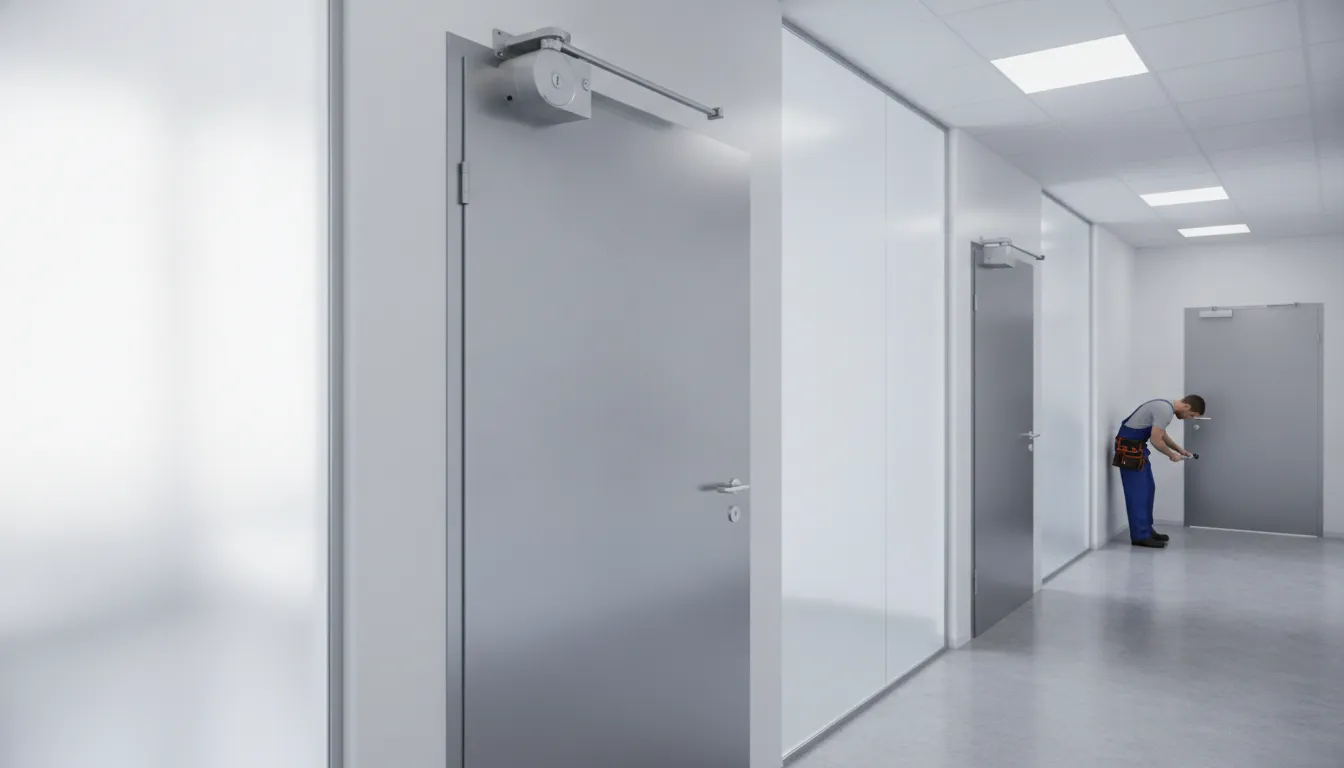
Surface-Mounted vs Concealed Hydraulic Door Closers
Answer: Surface-mounted closers are easier to access and typically suit practical commercial installations. Concealed closers offer a cleaner appearance but require more fabrication planning and can be harder to service. Universal Fireproof Door selects the mounting type around the opening, design intent, maintenance access, and fire-door requirements.
Commercial hydraulic door closers fall into two broad mounting families. Surface-mounted units bolt to the face of the door or frame. Concealed units hide inside the door, the frame head, or the floor. The choice affects appearance, installation cost, and ongoing maintenance access, so it should be made early in the specification process.
Surface-mounted closers are the most common option for commercial openings. They mount visibly on the push face or pull face of the door or on the frame, which keeps them easy to reach, adjust, and service. The visible housing is a trade-off: it is more exposed to impact and vandalism in accessible areas. But it is also the fastest and least expensive to install because it requires essentially no frame preparation.
Concealed closers are hidden within the door or the frame head, with only the arm visible at the edge of the opening. They deliver a clean, finished look preferred in lobbies, glass storefronts, and high-end offices. But they carry a higher cost and require the frame or door to be prepped during fabrication to accept the hardware. Servicing a concealed unit can require partial disassembly to reach the valve ports, which is one reason building owners often pair concealed closers with a scheduled maintenance contract.
Installation templates matter in either case. A template provides the exact location for drilling holes, which is critical for the hydraulic closer to operate within its design parameters once mounted.
| Mounting type. | Visibility. | Install prep. | Best use. | Maintenance trade-off. |
|---|---|---|---|---|
| Surface-mounted. | Visible housing on door or frame. | Minimal; drill and mount in place. | Most commercial openings, fast builds. | Easy access to valves; housing exposed to impact. |
| Concealed in frame. | Hidden in frame head; arm visible. | Frame must be prepped during fabrication. | Lobbies, glass storefronts, clean-look spaces. | Higher cost; may require disassembly to reach ports. |
| Floor-concealed. | Hidden below the floor line. | Floor recess prepared at construction. | High-traffic openings with clear sightlines. | Requires floor access for service. |
For most tenant buildouts and corridor doors, a surface-mounted unit is the pragmatic choice because it is serviceable and lower cost. For a finished lobby or a door where the architect wants minimal visible hardware, a concealed closer is worth the added preparation. To compare the full range of closer types, sizes, and installation options, see types and sizing of commercial door closers. If the opening already has an automatic operator or electrified hardware, coordinate the closer with the integrated hardware plan, as described in the electrified hardware installation service.
What Push and Pull Force Does the ADA Require for Door Closers?
Answer: The U.S. Access Board sets a 5-pound maximum opening force for interior hinged doors. Universal Fireproof Door uses force measurement, hardware inspection, and careful closer adjustment to balance accessibility with the closing and latching performance required at commercial openings.
Accessibility requirements often drive how a hydraulic door closer is specified and adjusted. The U.S. Access Board ADA guidance limits the opening force for interior hinged doors to 5 pounds (22.2 newtons). That limit governs how much push or pull a person must apply to move the door from the closed position. The U.S. Access Board door guidance explains the requirement.
Verifying that a door stays under that limit requires measuring it correctly. Accessibility guidance recommends using a door force gauge. Unlatch the door, then push it open gradually rather than jerking it open. The ADA door adjustment guidance describes this testing approach. A force check after installation or adjustment confirms that the closer is not making the opening hard to use.
Exterior doors are not given a specific force limit in the ADA Standards, but they must not prevent access for people with disabilities. Typical maximum opening force for accessible exterior doors ranges from about 8.5 to 10 pounds, and local or state codes may impose stricter limits.
There are two situations where compliance is more nuanced:
- Fire-rated doors: The force to open a fire door can be higher because it must overcome the friction of the fire door seals. But the opening must still satisfy both NFPA and ADA requirements (opening force for fire doors).
- Delayed-action closers: A delayed-action hydraulic door closer holds the door open for a brief period before it closes. That pause gives people who move slowly or use mobility devices time to pass through.
The practical point is that an adjustable hydraulic door closer is rarely the barrier. The problem is usually a spring set too heavy or a valve turned too far. Measuring the opening force and adjusting the closer keeps the opening compliant without weakening the latch. For buildings that must document accessibility and code compliance across many openings, a fire door compliance program helps keep every closer, hinge, and sign on schedule.
Self-Closing Fire Door Requirements: NFPA 80 and Hydraulic Door Closers
Answer: A fire-rated door must close and latch as part of its listed assembly. NFPA 80 addresses self-closing and automatic-closing requirements. Universal Fireproof Door checks the closer, arm, mounting, and latch together rather than treating a failed closer as an isolated hardware issue.
On fire-rated openings, a hydraulic door closer is not optional hardware. NFPA 80 requires fire doors to be self-closing or automatic-closing so they latch securely in the event of a fire: NFPA 80-2025. The door closer is the standard mechanism used to meet that requirement. A failed or improperly adjusted closer on a fire door is therefore a code violation as much as a physical problem.
Fire-rated assemblies must close completely from a partial-open test. The hydraulic door closer produces that controlled closing cycle, as explained in this fire door closing cycle guide. A door that stops short of the frame or slams may not latch. Correct the opening before relying on it for life safety.
Two installation rules are specific to fire-rated openings:
- Follow the UL-listed instructions: Install the closer according to the door-and-hardware combination’s UL fire-rating instructions. This preserves the fire integrity of the opening. See this fire door closing cycle guide.
- No hold-open bypass on fire doors: Friction hold-open arms and magnetic hold-opens that are not wired to release on fire alarm are not permitted on fire doors. NFPA 80 requires the door to close and latch when the release condition is met.
Regular maintenance of the closer is a critical part of keeping that fire-rated assembly in compliance. A spring that is worn, a valve left too loose, or a leaked unit that cannot close the door all undermine the self-closing function. Property managers who maintain doors under a scheduled inspection catch these issues before an inspector writes up the opening. Annual inspection of fire door hardware and closer condition is part of a fire door inspection program for many commercial buildings in New York.
Get a fire door and closer inspection scheduled
How to Adjust Sweep, Latch, and Backcheck Valves on a Hydraulic Door Closer
Answer: Adjust sweep first, then latch, and set backcheck last. Make small changes while testing the full swing after each one. Universal Fireproof Door also verifies spring power, opening force, complete latching, and the manufacturer’s rotation limits before accepting the adjustment.
Most commercial hydraulic door closers have at least two adjustment valves that control the closing cycle, and many add a third for backcheck. Understanding what each valve does lets a technician tune a door without guesswork. The sweep valve controls the main closing speed from full open down to the latching range. The latch valve controls the final movement into the frame. The backcheck valve adds resistance near full open to stop the door from swinging into a wall or hardware.
Follow this sequence when adjusting a closer:
- Identify the valve ports on the body. They are usually marked for sweep or speed, latch, and backcheck or BC. If markings are unclear, check the manufacturer’s installation sheet for the model.
- Mark the starting position of each valve with tape or a paint pen so you can return to it if an adjustment goes wrong.
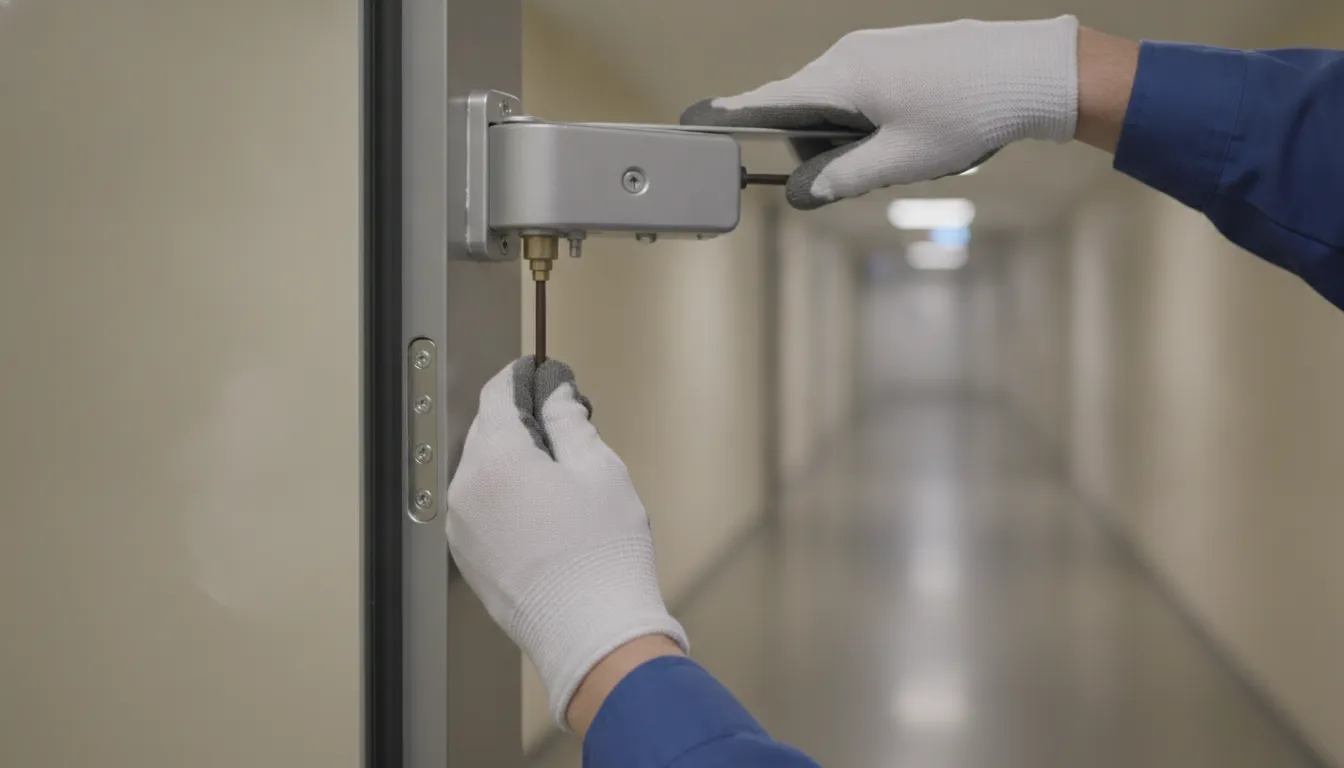
- Adjust the sweep valve first. Turn it in small increments, about one-eighth to one-quarter turn, so the door closes smoothly from open until it reaches the latching range.
- Adjust the latch valve so the door closes fully and secures into the latch. If a door struggles to latch, the latching speed or force usually needs adjustment.
- Set the backcheck so the door cushions near full open and is protected from slamming against a stop or wall. A backcheck set too firm puts excessive stress on the closer and frame components and can cause hardware failure over time.
- Test the full swing after every adjustment and make small corrections rather than large turns. Never crank an adjustment valve beyond its documented rotation limit.
Temperature also matters. Hydraulic fluid becomes thicker in cold weather and thinner in heat, which changes how fast the door closes. A closer may need a seasonal re-adjustment, especially on an unheated vestibule or exterior opening.
The spring power must also suit the door. The spring size of a replacement hydraulic door closer must match the door’s width and weight, or no amount of valve adjustment can produce a reliable close. For a deeper sequence on the backcheck feature specifically, see tuning your hydraulic door closer backcheck. Where a closer is specified on a new build or renovation, pair it with properly set access control and door hardware installation so the opening performs as a complete assembly.
Hydraulic Door Closer Repair: Leaks, Slamming, and When to Replace
Answer: Repair may resolve loose hardware, dry pivots, or incorrect valve settings. Replace a closer when its body leaks, its arm or mounting is damaged, or it still fails after adjustment. Universal Fireproof Door matches replacement hardware to the opening and verifies safe closing and latching afterward.
When a hydraulic door closer fails, the cause is usually visible before the door becomes unsafe. Oil leaking from the body is the clearest sign and almost always means an internal high-pressure seal has failed. Once a seal fails, the closer can no longer reliably contain its fluid, so adjustment will not provide a lasting fix and the unit typically needs replacement. The same leak also stains floors and creates a slip hazard in a busy corridor, so it should be addressed quickly.
Other common failure symptoms include a door that slams, a loose arm, inconsistent closing speed, or a door that stops before it latches. A loose closer arm can cause slamming or a failed latch, so tightening the mounting hardware is often the first repair. If a door simply will not latch, adjusting the latching speed or force is the usual correction rather than replacing the unit.
Deciding between repair and replacement comes down to what is wrong:
- Repair: Tightening loose mounting screws or a loose arm, lubricating pivot points, and correcting valve settings are routine repairs. These steps can restore a closer that is otherwise sound.
- Replace: A leaking body, a damaged arm, a stripped mounting, deep corrosion, or a chronic failure that returns after adjustment usually calls for a new unit. The replacement must match the opening, door weight, door width, fire-door listing, and installation requirements.
Annual servicing is recommended to keep operation reliable and code-compliant in high-traffic commercial environments, and more frequent inspection is wise on fire-rated or heavily used openings. On fire doors, any repair or replacement must also respect the door-and-hardware UL listing. The unit should be calibrated by an authorized technician so safe closing and latching are verified after the work. For routine failures and maintenance, see commercial door closer repair and maintenance. When a closer is beyond repair, a certified technician can spec and install the right unit for the opening, as described on the door closer repair and replacement service page.
Frequently Asked Questions
How do I adjust a hydraulic door closer?
Identify the sweep, latch, and backcheck valves, then make small adjustments while testing the door after each change. Sweep controls the main closing movement, while latch controls the final movement into the frame. Backcheck should limit a forceful opening swing without making the door difficult to use. Mark the starting position and never force a valve. Seasonal temperature changes can alter fluid viscosity and closing speed, so adjustment may be needed as conditions change. See the backcheck adjustment guide for the detailed sequence.
Why is my hydraulic door closer leaking oil?
Oil usually indicates that an internal high-pressure seal has failed. Because the closer can no longer reliably contain its fluid, adjustment is unlikely to provide a lasting repair, and the unit commonly needs replacement. Clean the affected floor promptly because leaked oil can create a slip hazard in a busy corridor. Keep the door in service only if it still closes and latches safely while a qualified technician evaluates it. The door closer maintenance guide explains why a leaking unit usually needs replacement.
How often should I service a commercial hydraulic door closer?
Plan a documented inspection at least annually, and inspect more often on high-traffic openings or where a fire door is not closing consistently. Check for leaks, loose mounting screws or arms, corrosion, abnormal resistance, and complete latching. Service immediately after repeated slamming, a change in closing speed, or impact damage. Annual service is a maintenance recommendation, not a substitute for correcting a failure when it appears. Use the commercial door closer maintenance guidance as a practical inspection reference.
What are the common signs of a failing hydraulic door closer?
Warning signs include oil staining, slamming, a loose arm, inconsistent sweep or latch speed, and a door that stops before fully latching. On a fire door, failure to close completely is a life-safety concern. NFPA 80 requires fire doors to be self-closing or automatic-closing. Have the opening assessed rather than simply increasing spring force or tightening valves. Review the NFPA 80 requirements when evaluating the assembly.
Can a hydraulic door closer be repaired or must it be replaced?
Minor issues such as loose hardware, a dry arm pivot, or incorrect valve settings may be serviceable. A leaking body, damaged arm, stripped mounting, or persistent failure after adjustment generally calls for replacement. The replacement must match the opening, door weight, width, fire-door listing, and installation instructions. An authorized technician should calibrate the unit and verify safe closing and latching after installation.
Schedule Hydraulic Door Closer Repair for Your Building
A professional assessment can help identify whether adjustment, repair, or replacement is the appropriate next step for a commercial door closer. This is especially useful when a door is slamming, failing to latch, leaking fluid, or creating concerns during fire door maintenance.
Schedule door closer repair or replacement
Use the online request form to contact Universal Fireproof Door about service for your commercial building in the NYC tri-state area.