
An industrial door solution is a purpose-built access system engineered to handle the extreme operational demands of commercial and industrial environments, where standard residential doors fail within weeks. These systems cover everything from insulated sectional doors and high-speed roll-ups to fire-rated steel doors and custom hangar configurations. Property managers overseeing warehouses, cold storage facilities, loading docks, and manufacturing plants rely on these systems to maintain security, energy efficiency, and code compliance. Certifications like UL listings and standards such as EN 13241 are not optional extras. They are baseline requirements for any credible industrial door system.
What is an industrial door solution, and how does it differ from standard doors?
An industrial door solution is defined as a heavy-duty access system designed for high-cycle, high-load environments where durability, compliance, and operational continuity are non-negotiable. The gap between industrial and residential performance is not incremental. It is categorical. Warehouse doors may exceed 1,000 cycles daily in active logistics operations, compared to the 2–6 cycles a residential garage door handles. That difference demands specialized materials, motors, and balancing systems that residential-grade products simply cannot provide.
Industrial door systems also carry regulatory weight. A facility door that fails a fire inspection or lacks proper wind-load certification creates liability exposure for the property manager, not just inconvenience. The term “industrial door solution” is the SEO-common phrase, but the recognized industry category is commercial and industrial access systems, which encompasses the full range of hardware, automation, and compliance documentation that comes with a properly specified door.

What are the main types of industrial doors and their advantages?
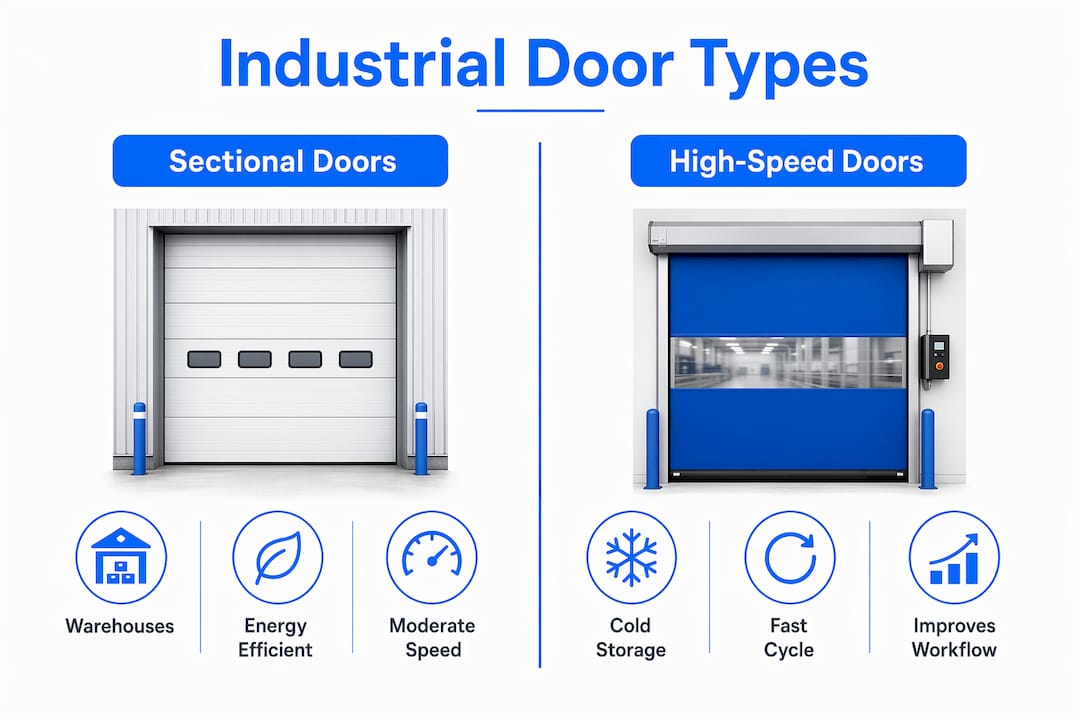
Five primary industrial door types serve the commercial market: sectional doors, high-speed doors, roller shutters, hangar doors, and custom or fire-rated doors. Each suits a distinct set of facility conditions.
Sectional doors
Sectional doors open vertically in horizontal panels that travel along overhead tracks. They are the most common choice for loading docks and warehouses because they preserve floor and ceiling space while delivering strong insulation. Insulated sectional doors reduce facility energy costs by up to 30%, making them the default recommendation for cold storage and climate-controlled distribution centers.
High-speed doors
High-speed doors open at 3–6 meters per second, which is roughly 10–20 times faster than a standard sectional door. That speed matters in food processing plants and pharmaceutical facilities where temperature separation between zones is critical. Every second a door stays open bleeds conditioned air and invites contamination.
Roller shutters and hangar doors
Roller shutters coil into a compact housing above the opening, making them ideal for tight-clearance environments like urban loading bays or retail back-of-house areas. Hangar doors serve openings from 10 to 50-plus meters wide, used in aviation maintenance, shipyards, and large-scale manufacturing. Custom and fire-rated doors fill the compliance-critical gaps, particularly in facilities where building codes require rated assemblies at specific openings.
| Door Type | Best Use Case | Key Advantage | Main Limitation |
|---|---|---|---|
| Sectional | Warehouses, loading docks | Up to 30% energy savings | Requires overhead clearance |
| High-speed | Food processing, pharma | Opens at 3–6 m/s | Higher upfront cost |
| Roller shutter | Urban bays, retail | Compact coil housing | Lower insulation value |
| Hangar | Aviation, shipyards | Spans 10–50+ meters | Complex installation |
| Fire-rated | Code-required openings | UL-listed compliance | Limited design options |
Pro Tip: If your facility runs multiple temperature zones, pair high-speed doors at zone boundaries with sectional doors at exterior loading points. You get speed where it counts and insulation where it matters most.
What are the critical benefits of industrial door systems for commercial facilities?
The benefits of industrial doors extend well beyond keeping a building closed. They directly affect your operating budget, your compliance posture, and your team’s ability to move product efficiently.
Energy savings are measurable. Properly insulated sectional doors cut energy costs by up to 30%, a figure that compounds quickly in facilities running refrigeration or HVAC at scale. A 100,000-square-foot cold storage warehouse paying $40,000 monthly in energy costs could recover $12,000 per month with the right door specification.
Security and compliance are inseparable. Integrating industrial doors with access controls and traffic management systems tightens perimeter security and creates an auditable access record. Fire-rated assemblies that meet UL standards protect occupants and satisfy insurance underwriters who increasingly require documented compliance.
Workflow efficiency is a direct output of door speed. A high-speed door that cycles in under two seconds versus a manual door that takes 15–20 seconds to open and close creates measurable throughput gains in facilities where forklifts cross that threshold dozens of times per shift.
Lifecycle durability separates industrial from residential. Many industrial doors fail quickly if rated only for residential cycles. High-cycle industrial doors use specialized balancing systems and reinforced materials that sustain performance across hundreds of thousands of cycles without degradation.
Pro Tip: Ask your door supplier for the rated cycle count before purchasing. A door rated for 100,000 cycles at 500 daily uses lasts less than a year. A door rated for 1,000,000 cycles at the same usage rate lasts over five years.
How to choose the right industrial door for your facility
Selecting the right industrial door solution requires a structured evaluation, not a catalog browse. Work through these criteria before you contact a supplier.
Assess operational intensity. Count how many times each door opens per day across all shifts. Match that number against the door’s rated cycle count. Matching door choice to operational intensity prevents early failure and avoids the cost of premature replacement.
Evaluate environmental loads. Coastal facilities need corrosion-resistant materials because salt air degrades standard steel within years. Neglecting environmental conditions leads to premature replacements that cost far more than the upfront premium for the right material. Inland warehouses face different wind-load requirements than port facilities.
Verify compliance requirements. Check your local building code and insurance policy for specific door ratings. The 2026 compliance standards for commercial doors include fire ratings, wind resistance, and thermal performance benchmarks that vary by occupancy type and jurisdiction.
Plan your space before ordering. Space planning requires verifying headroom, side clearance, and structural support before specifying a door. Discovering insufficient headroom after delivery forces costly structural modifications. Measure twice, order once.
Calculate total cost of ownership. TCO includes insulation efficiency measured by U-value, maintenance frequency, and downtime risk. A door that costs 20% more upfront but requires half the maintenance and delivers better insulation almost always wins on a five-year cost basis.
Require a service agreement. A door without a maintenance contract is a liability. Confirm the supplier offers certified technician service, emergency response, and parts availability before signing a purchase order.
Pro Tip: Build a one-page door specification sheet for each opening in your facility. Include cycle count, environmental exposure, compliance requirements, and clearance dimensions. This document cuts supplier conversations from hours to minutes and prevents misquotes.
What does professional industrial door installation and maintenance involve?
Professional installation is the difference between a door that performs for 15 years and one that fails its first inspection. Certified installers ensure compliance with EN 13241 and UL standards while eliminating the rework costs that come from DIY or underqualified contractors.
A professional industrial door installation follows a defined sequence: site survey, structural verification, frame fabrication or selection, door assembly, automation integration, and final compliance testing. Skipping the site survey is the most common mistake. It leads to clearance conflicts and structural surprises that delay the project and inflate costs.
Maintenance is where most facilities underinvest. The key service tasks for industrial door systems include:
- Monthly visual inspections of seals, panels, and hardware for wear or damage
- Quarterly lubrication of tracks, rollers, and hinges to prevent friction-related failures
- Annual load testing of springs, cables, and motors against rated specifications
- Immediate response to any unusual noise, speed change, or alignment issue before it becomes a full failure
Springless automation technology removes the spring breakage failure point entirely, which is the single most common cause of emergency door repairs in high-cycle environments. Facilities that upgrade to springless systems report fewer unplanned service calls and more predictable maintenance schedules. That predictability has real budget value for facility directors managing multiple properties.
Facility doors are strategic infrastructure investments where serviceability and lifecycle costs matter more than the purchase price line item. A service contract that costs $2,000 per year per door is cheap insurance against a $15,000 emergency repair and a day of lost operations.
Key takeaways
Industrial door solutions are the highest-leverage infrastructure investment a facility director can make for security, energy efficiency, and compliance across a commercial property.
| Point | Details |
|---|---|
| Definition matters | Industrial door solutions are heavy-duty access systems built for high-cycle, compliance-critical environments. |
| Type drives performance | Match door type to use case: sectional for insulation, high-speed for throughput, fire-rated for code compliance. |
| Energy savings are real | Insulated sectional doors cut energy costs by up to 30% in temperature-controlled facilities. |
| TCO beats sticker price | Evaluate insulation value, maintenance frequency, and downtime risk before comparing purchase prices. |
| Installation requires certification | Certified installers prevent compliance failures and costly post-installation rework. |
Why I stopped recommending the cheapest door that meets spec
I have watched facility managers make the same mistake repeatedly. They get three quotes, pick the lowest number that technically meets the spec, and call it a win. Two years later, they are calling for emergency repairs on a door that was never built for their actual operating intensity.
The uncomfortable truth is that industrial door selection is not a procurement exercise. It is an engineering decision with a 10–15 year cost tail. The door that saves $8,000 upfront but requires quarterly emergency service and leaks conditioned air through worn seals costs far more over its life than the door that was correctly specified from day one.
I have also seen the opposite failure: over-specifying a hangar-grade door for a facility that opens it 20 times a day. That is wasted capital. The goal is precision, not maximum spend.
The technology is genuinely improving. Springless automation systems, better U-value insulation panels, and integrated access control have made modern industrial doors more reliable than anything available a decade ago. The facilities that take advantage of these improvements are the ones that treat their doors as infrastructure, not as a line item to minimize.
If you manage multiple properties, standardize your door specifications by facility type. It simplifies procurement, maintenance contracts, and parts inventory. That standardization alone can cut your annual door-related service costs significantly.
— Esteban
How Ufiredoors can help you specify and install the right door
Ufiredoors builds and installs commercial and industrial door systems from its New York facility, with over 20 years of experience serving property managers and facility directors across the region.
For facilities that need fire-rated compliance, Ufiredoors produces UL-listed fire-rated steel doors built and installed in 3–5 days. For high-security or heavy-use applications, the steel stiffened door line comes with free site estimates and is fabricated locally to exact opening dimensions. Every installation includes compliance documentation and access to emergency repair services. Contact Ufiredoors directly to schedule a site assessment and get a specification recommendation for your facility.
FAQ
What is an industrial door solution?
An industrial door solution is a heavy-duty access system designed for commercial and industrial facilities that require high-cycle durability, security, and code compliance. These systems include sectional doors, high-speed doors, roller shutters, and fire-rated assemblies.
How many cycles per day can industrial doors handle?
Industrial warehouse doors can exceed 1,000 cycles daily in logistics applications, compared to 2–6 cycles for residential doors. High-cycle industrial doors use specialized balancing systems and reinforced materials to sustain that volume.
What certifications should industrial doors carry?
Industrial doors for commercial facilities should meet EN 13241 for performance and safety, and UL standards for fire-rated assemblies. Certified installations reduce compliance risk and satisfy insurance requirements.
How much can insulated industrial doors save on energy costs?
Properly insulated sectional doors reduce facility energy costs by up to 30%, making them the standard recommendation for cold storage warehouses and climate-controlled distribution centers.
How often should industrial doors be serviced?
Industrial doors require monthly visual inspections, quarterly lubrication, and annual load testing of springs, cables, and motors. Facilities with high-cycle operations benefit from a formal service contract with a certified technician.