
Local fire safety codes are legally enforceable standards that govern fire prevention, building safety features, and operational requirements to protect occupants and property from fire hazards. The industry’s primary reference is NFPA 101 Life Safety Code, formally adopted in 43 states and referenced in all 50. Enforcement falls to the Authority Having Jurisdiction (AHJ), typically a local fire marshal or building official who interprets and applies these standards at the property level. For property owners, facility managers, and contractors in the Northeast, understanding how these rules work is not optional. Violations carry fines, forced closures, and liability exposure that no building budget absorbs easily.
How do local fire safety codes vary by building type?
Fire safety requirements are not one-size-fits-all. NFPA 101 defines 13 occupancy classifications, and each classification carries its own specific rules for exits, fire barriers, alarms, and sprinkler systems. The classification your building falls under determines nearly every fire protection decision you make.
The 13 occupancy types include:
- Assembly (theaters, restaurants, houses of worship): high occupant loads require multiple clearly marked exits and full sprinkler coverage.
- Educational (schools, daycare centers): strict corridor fire ratings and fire-rated doors for schools are mandatory.
- Health care (hospitals, nursing homes): horizontal evacuation and compartmentalization requirements are among the most demanding in the code.
- Residential (apartments, hotels): corridor fire ratings, smoke detection, and door self-closing devices are standard requirements.
- Business and mercantile (offices, retail stores): exit travel distances and fire alarm systems are the primary compliance focus.
- Industrial and storage: hazard classification drives sprinkler design density and separation requirements.
Mixed-use buildings present the most complex compliance picture. A building with ground-floor retail and upper-floor apartments must satisfy the requirements of both occupancy types, often simultaneously. The more restrictive rule applies where the two classifications conflict. Contractors working on mixed-use projects in New York City or Boston should confirm occupancy classifications with the AHJ before design begins, not after permits are submitted.
What triggers fire code upgrades during renovations?

Renovation projects carry a compliance risk that many property owners underestimate. Under the International Existing Building Code (IEBC), renovations exceeding 50% of a building’s total floor area typically trigger a requirement to upgrade the entire facility to current fire safety codes. That threshold can turn a targeted interior renovation into a building-wide compliance project.
The practical implications break down this way:
- Below 50% renovation scope: only the altered areas must meet current code; the rest of the building may remain under its original approval.
- At or above 50% renovation scope: the entire building must be evaluated and brought into compliance with current building fire codes.
- New construction: full compliance with current codes is required from the ground up, with no grandfather provisions.
Partial renovations are where costs surprise owners most. A facility manager who approves a floor-by-floor renovation over several years may inadvertently cross the 50% threshold across multiple permit cycles. Some AHJs track cumulative renovation scope, not just individual permits. That means a project that looks small on paper can trigger a full code evaluation.
Pro Tip: Before submitting any renovation permit, ask your AHJ directly whether cumulative renovation work on the property will be counted toward the 50% threshold. Get that answer in writing.
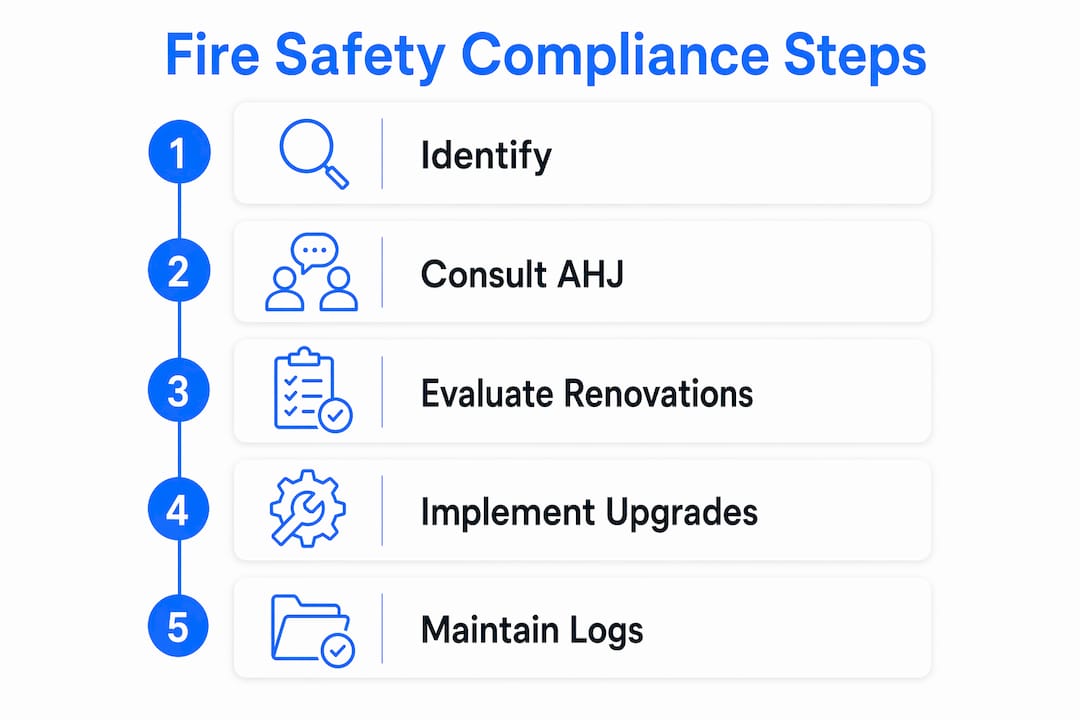
Consulting the AHJ before a project starts is the single most effective way to avoid scope surprises. The 2026 compliance guide for building pros covers door-specific upgrade requirements that frequently arise during renovation reviews.
What are the ongoing compliance responsibilities for occupied buildings?
Fire safety compliance does not end at the certificate of occupancy. NFPA 101 requires ongoing maintenance, testing, and documentation of fire safety systems for the entire lifespan of a building. That obligation falls squarely on building owners and facility managers.
The inspection and testing schedule is specific and non-negotiable:
- Weekly and monthly visual checks: facility staff must verify that exits are unobstructed, fire doors close and latch properly, and extinguishers are in place and undamaged.
- Annual professional inspections: licensed contractors must inspect and test sprinkler systems under NFPA 25 and alarm systems under NFPA 72, with written documentation of results.
- Five-year internal sprinkler inspections: NFPA 25 requires internal pipe inspections on a five-year cycle to check for corrosion and obstruction.
- Documented fire door inspections: fire doors must be inspected annually by a qualified person, with written records retained on site.
Missing or incomplete inspection logs are among the most commonly cited violations during fire marshal inspections. A missing log carries the same enforcement weight as a physical failure. Fire marshals treat absent documentation as evidence that the inspection never happened.
Pro Tip: Keep a single binder or digital folder for each building that holds every inspection report, testing certificate, and corrective action record. Date every entry. Inspectors look for this first.
Ongoing compliance with NFPA 101 requires active management of fire safety components, including exits, barriers, alarms, and sprinklers. Relying on initial construction approvals is a compliance failure waiting to happen. Facility managers who treat fire safety as a one-time construction task consistently produce the most violations during routine inspections.
What role do AHJs play in fire code enforcement?
The Authority Having Jurisdiction is the official who has legal authority to interpret and enforce fire codes at the local level. In most Northeast jurisdictions, the AHJ is the local fire marshal, building commissioner, or a combination of both. Their interpretation of a code provision is final at the local level, subject only to formal appeals.
AHJ authority creates real variability across the region:
- Local amendments: states and municipalities frequently adopt amendments to base codes like NFPA 101. New York City’s fire code, for example, includes requirements that go beyond the base NFPA standard.
- Enforcement discretion: two AHJs in neighboring towns may interpret the same code provision differently, especially for existing buildings or historic structures.
- Project-specific interpretations: AHJs can issue written interpretations that apply to a specific project, providing legal certainty before construction begins.
- Variance and equivalency requests: when strict code compliance is impractical, owners can request a variance. Approval is not guaranteed and requires documented justification.
The most effective approach is to engage the AHJ early, before design is finalized. Bring a clear project description, the relevant code sections you believe apply, and any questions about local amendments. Contact your local AHJ directly for project-specific interpretations, since enforcement varies significantly by location and building specifics.
Two compliance pathways exist under most fire codes. The prescriptive approach follows a checklist of specific requirements. The performance-based approach uses engineering analysis to demonstrate that a design achieves equivalent safety, even if it does not follow the checklist exactly. Performance-based solutions require more documentation and AHJ approval, making them less common but more flexible for complex or historic buildings.
Key Takeaways
Fire safety compliance is a continuous operational obligation, not a one-time construction milestone, and it requires active management of exits, barriers, alarms, and documentation throughout a building’s lifespan.
| Point | Details |
|---|---|
| NFPA 101 governs most buildings | The code’s 13 occupancy classifications determine specific exit, alarm, and sprinkler requirements for your property. |
| The 50% renovation rule matters | Renovations exceeding half a building’s floor area trigger full code upgrades under the IEBC, often increasing project scope significantly. |
| Documentation is as critical as hardware | Missing inspection logs carry the same enforcement weight as physical failures during fire marshal inspections. |
| AHJs have final local authority | Local amendments and enforcement discretion mean you must engage your specific AHJ early, not rely on general code summaries. |
| Compliance is ongoing, not one-time | NFPA 101 requires active maintenance, testing, and recordkeeping for the entire life of the building. |
What I’ve learned after two decades of watching fire code violations unfold
After more than 20 years working with fire-rated door installations across commercial and residential properties in the Northeast, the pattern I see most often is not ignorance of the code. It is the assumption that passing a construction inspection means the work is done.
Building owners frequently misunderstand that fire code compliance is only about construction. The violations that actually trigger enforcement actions are operational: a fire door propped open with a wedge, a corridor stacked with boxes, an alarm test that was never logged. These are management failures, not design failures. And they are entirely preventable.
The other mistake I see regularly is treating the AHJ as an obstacle rather than a resource. In my experience, fire marshals and building officials want projects to succeed. They will tell you exactly what they need if you ask before the permit is submitted. The contractors who get into trouble are the ones who assume they already know the answer.
My honest recommendation: build a relationship with your local fire marshal before you need one. Attend pre-application meetings. Ask for written interpretations on anything ambiguous. And treat your inspection log as a legal document, because during an enforcement action, it is exactly that.
— Esteban
How Ufiredoors helps Northeast properties meet fire door requirements
Fire-rated doors are one of the most inspected and most frequently cited components in any fire safety review. Getting them right requires more than buying a listed product. It requires correct installation, proper hardware, and documentation that satisfies both NFPA 101 and your local AHJ.
Ufiredoors manufactures and installs UL-listed fire-rated steel doors built locally in New York using UL-approved materials. With over 20 years of experience serving commercial, residential, and industrial properties across the Northeast, Ufiredoors delivers complete door solutions from fabrication through installation and ongoing maintenance. Lead times run 3–5 days for standard configurations, and free site estimates are available for renovation and new construction projects. Contact Ufiredoors to confirm your fire door specifications meet current code before your next inspection.
FAQ
What are local fire safety codes based on?
Local fire safety codes are primarily based on NFPA 101 Life Safety Code, which is formally adopted in 43 states and referenced in all 50. Local jurisdictions often add amendments that go beyond the base standard.
How do I check which fire codes apply to my building?
Contact your local Authority Having Jurisdiction, typically the fire marshal or building department, and provide your building’s address and occupancy type. They will confirm which adopted codes and local amendments apply.
Does a renovation always trigger a full fire code upgrade?
Not always. Under the IEBC, renovations must exceed 50% of a building’s total floor area to trigger a full upgrade requirement. Smaller renovations must only bring the altered areas into compliance with current fire safety regulations.
How often do fire safety systems need to be inspected?
NFPA 25 requires annual professional inspections for sprinkler systems, and NFPA 72 requires annual testing for alarm systems. Facility managers must also conduct weekly and monthly visual checks and retain written records of all inspections.
What happens if fire inspection records are missing?
Missing or incomplete inspection logs are treated as violations during fire marshal inspections, carrying the same enforcement consequences as physical system failures. Detailed, dated records must be kept on site for the life of the building.