Third-party door certification agencies verify that a fire door assembly produced on the factory floor matches the exact design that survived a controlled fire test, and they attach a traceable label that inspectors, insurers, and Authorities Having Jurisdiction (AHJs) will actually accept. That single function is what separates a door you can defend in a code audit from one you cannot. If you manage a building with fire-rated assemblies, three things deserve your attention right now: confirm every fire door carries a legible certification label, pull at least one test report from your supplier on file, and schedule your NFPA 80 annual inspection if it is overdue.
Table of Contents
- What role do door certification agencies actually play?
- Why does third-party certification matter to AHJs, insurers, and owners?
- How does the certification process actually work?
- What are the key U.S. test standards and how do they connect to codes?
- Who certifies fire doors in the U.S. and what does accreditation mean?
- What should a certification label show and how do you read it?
- What do FPC audits actually examine?
- How does certification differ from your NFPA 80 inspection obligations?
- What failures do facility managers most often miss?
- How do you verify a door’s certification on site?
- What timelines and costs should you expect?
- Who is qualified to inspect fire doors and what should you require?
- Key Takeaways
- The part most owners get wrong
- Useful sources and references to keep on hand
What role do door certification agencies actually play?
A door certification agency is an independent organization that evaluates whether a manufacturer’s production consistently matches a tested prototype. The operative word is consistently. A one-time prototype test proves a single sample survived a fire exposure under controlled lab conditions. Certification goes further: it lists the tested assembly in a published directory, attaches a label to every conforming unit, and then returns to the factory repeatedly to confirm that what rolls off the line still matches what burned in the test chamber.
The term “listed” has a specific meaning under model codes. A listed product appears in a certification agency’s published directory, meaning the agency has verified conformance to a defined standard and continues to monitor production. An unlisted door may have been tested once, but no ongoing oversight confirms it stays in conformance.
Prototype testing vs. listed certification vs. manufacturer self-declaration:
| Approach | Who Conducts It | Ongoing Oversight | Code Acceptance |
|---|---|---|---|
| Prototype (lab) test only | Accredited test lab | None after test | Limited; AHJ discretion |
| Listed product certification | Third-party certifier | Yes, via FPC audits | Broadly accepted under IBC, NFPA 80 |
| Manufacturer self-declaration | Manufacturer | None independent | Rarely accepted by AHJs |
Two ISO/IEC standards define the competence requirements behind this system. ISO/IEC 17065 governs certification bodies, setting requirements for impartiality, decision-making, and surveillance programs. ISO/IEC 17025 governs the test laboratories that generate the fire-test data. A certifier accredited to 17065 uses labs accredited to 17025, which is why accreditation of the certifier and the lab are both worth confirming before you accept a product listing.
- Listed assemblies appear in a publicly searchable directory maintained by the certifier.
- The listing specifies the exact construction: door thickness, core type, frame profile, hardware, and glazing.
- Any deviation from the listed construction, even a different hinge brand, can void the rating.
Why does third-party certification matter to AHJs, insurers, and owners?
AHJs do not have time to evaluate every door on a job site from first principles. A certification label from an accredited third party gives them objective proof that the assembly met specific safety requirements at the time of testing or evaluation. That proof shortens approval timelines and reduces the risk of a stop-work order or a failed inspection.

Insurers follow similar logic. A property insurer underwriting a commercial building wants documented evidence that life-safety assemblies perform as rated. A certification label backed by a published test report and ongoing factory audit records is the kind of documentation that satisfies underwriters without a lengthy back-and-forth. Missing or illegible labels, by contrast, can trigger coverage disputes after a fire event.
The safety argument is less about paperwork and more about traceability. Consistent manufacturing, confirmed by recurring factory audits, means the door on floor 12 behaves the same way as the door that passed the test. Without that surveillance, a manufacturer could quietly change a core material or a seal specification and no one would know until a fire exposed the gap.
One misperception worth correcting: a certification label is not a lifetime guarantee of performance. It confirms the door was correctly manufactured. What happens after installation, including damage, unauthorized hardware swaps, and gaps that open up over years of use, falls outside the certifier’s scope. Model codes including the IBC, IFC, and NFPA 1 reference NFPA 80 for installation, inspection, and maintenance requirements, and NFPA 80 requires annual inspections regardless of how good the original label looks.
Pro Tip: When an AHJ or insurer requests documentation, have three items ready: the certification label photo (showing the unique ID), the original test report from the certifier’s directory, and the most recent NFPA 80 inspection report. That combination covers manufacture, original performance, and current condition.
- Certification confirms manufacturing conformance at the time of production.
- AHJ acceptance is faster when the certifier mark is from a recognized body.
- Insurers may require documented certification as a condition of coverage for high-occupancy buildings.
- NFPA 80 annual inspections are the owner’s obligation, not the certifier’s.
How does the certification process actually work?
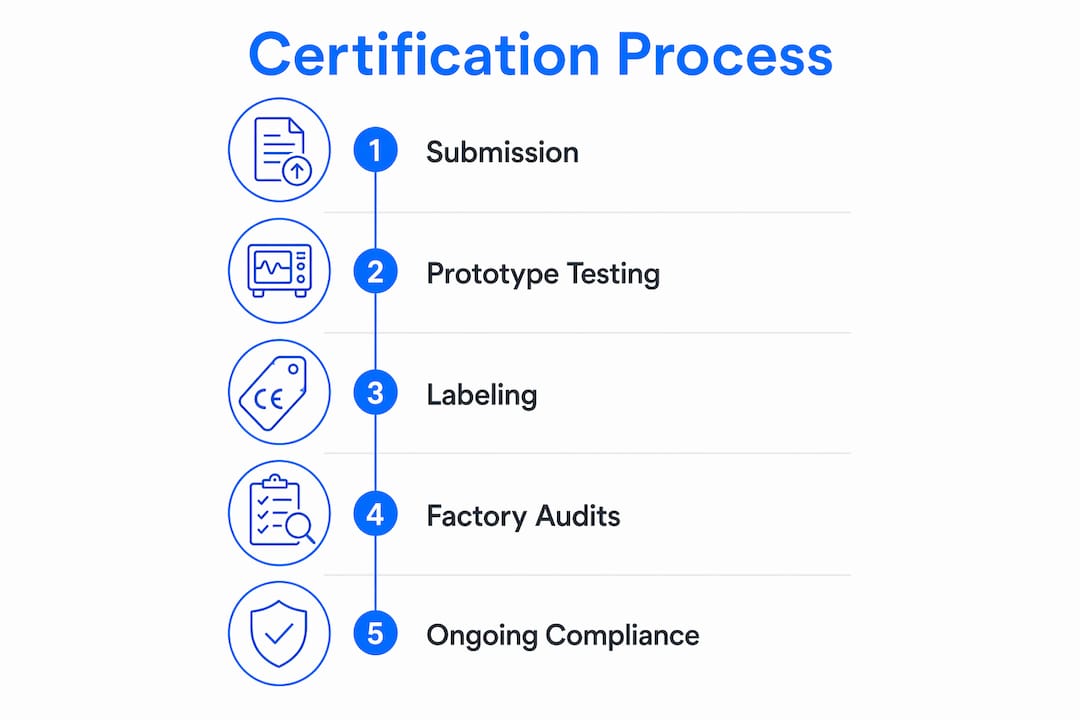
The path from a new door design to a listed product follows a defined sequence, and understanding each step helps facility managers ask better questions of their suppliers.
- Prototype submission. The manufacturer submits a door assembly, including the frame, hardware, glazing, and seals, to an accredited test laboratory.
- Fire test. The lab subjects the assembly to a standardized time-temperature curve under UL 10B, UL 10C, NFPA 252, or ASTM E119, depending on the required rating and applicable code.
- Test report issuance. The lab documents construction details, test conditions, and results. This report becomes the reference document for all future production.
- Certification review. The third-party certifier reviews the test report, confirms the lab’s accreditation, and evaluates the manufacturer’s quality system.
- Listing. The certifier publishes the assembly in its product directory and authorizes the manufacturer to apply certification labels to conforming units.
- Factory Production Control (FPC) audits. Certifier auditors visit the factory on a recurring schedule to compare production samples, materials, and records against the original test assembly.
- Follow-up surveillance. If auditors find a deviation, the certifier can suspend or withdraw the listing until the manufacturer corrects the nonconformity.
What the lab tests is specific: the complete assembly as submitted, including the exact hardware, frame profile, and sealing system. What it does not test is installation quality, field modifications, or hardware substitutions made after delivery. That distinction matters enormously for facility managers who inherit doors from previous tenants or contractors.
Field evaluations and field-applied evaluated labels are used when a door assembly has been modified or lacks its original labeling. These evaluations are conducted by qualified engineers using nondestructive inspection and engineering judgment. They do not replace laboratory listing for new construction, and certification programs will not perform destructive testing in the field to avoid damaging installed assemblies.
Pro Tip: If you receive a door without a label or with a damaged label, do not assume a field evaluation will restore the original listing. A field-applied evaluated label addresses the current condition of that specific assembly. For new procurement, always specify listed assemblies from the start.
What are the key U.S. test standards and how do they connect to codes?
| Standard | What It Tests | Key Feature | Common Code Reference |
|---|---|---|---|
| UL 10B | Fire door assemblies | Neutral pressure at neutral plane | NFPA 80, IBC |
| UL 10C | Fire door assemblies | Positive pressure throughout test | NFPA 80, IBC, IFC |
| NFPA 252 | Fire door assemblies | Hose stream test after fire exposure | NFPA 80, NFPA 1 |
| ASTM E119 | Building assemblies (walls, floors) | Standard time-temperature curve | IBC structural fire ratings |
| NFPA 80 | Installation, inspection, maintenance | Annual inspection mandate | IBC, IFC, NFPA 1 |
The difference between UL 10B and UL 10C is not trivial for procurement decisions. UL 10B tests under neutral pressure conditions, meaning the pressure differential across the door during the test is minimal. UL 10C applies positive pressure throughout the test, simulating the pressurized conditions that occur in a real building fire when HVAC systems and stack effect push hot gases against door assemblies. Most jurisdictions and AHJs now prefer or require UL 10C listings for interior fire doors, so confirming which test standard a door’s label references is worth doing before you accept a shipment.
NFPA 252 includes a hose stream test after the fire exposure, which evaluates whether the assembly holds together under the mechanical stress of firefighting operations. ASTM E119 applies more broadly to building assemblies and is the standard behind fire-resistance ratings for walls and floors, not just door assemblies specifically.
- Fire doors sold in North America generally must be tested and certified by an ISO 17065-accredited agency conforming to tests such as UL 10B/10C or NFPA 252.
- IBC Section 716 governs opening protectives, including fire doors, and directs compliance to NFPA 80.
- NFPA 1 (Fire Code) and IFC both adopt NFPA 80 by reference for inspection and maintenance.
- Smoke-and-draft control assemblies carry additional requirements under UL 1784 for air leakage.
Who certifies fire doors in the U.S. and what does accreditation mean?
Three organizations dominate third-party fire door certification in the United States, and each carries marks that AHJs recognize.
- UL (Underwriters Laboratories): The UL mark is the most widely recognized in North America. UL maintains a publicly searchable product directory (UL Product iQ) where listed assemblies can be verified by model number or label ID. UL’s certification programs operate under ISO/IEC 17065 accreditation.
- Intertek (ETL / Warnock Hersey mark): Intertek’s ETL Listed mark and the legacy Warnock Hersey mark are accepted by most AHJs as equivalent to UL for fire door assemblies. Intertek operates accredited test facilities and conducts FPC audits under the same ISO/IEC framework.
- FM Approvals (FM Global): FM Approvals issues the FM mark, which carries particular weight in industrial and warehouse occupancies where FM Global underwrites property insurance. FM-approved assemblies are tested and audited under FM’s own rigorous standards, which often exceed model code minimums.
Accreditation and certification are not the same thing, and confusing them is a common procurement error. Certification confirms a product passed tests and continues to conform through ongoing surveillance. Accreditation confirms the certifier is competent and impartial enough to run that certification program. The accreditation bodies in the U.S. are ANAB (ANSI National Accreditation Board) and IAS (International Accreditation Service). Both accredit certification bodies to ISO/IEC 17065 and test labs to ISO/IEC 17025.
Accreditation of the certifier is the backstop that makes the certification mark meaningful. A certification mark from a body that has not been independently accredited to ISO/IEC 17065 carries no independent assurance of impartiality or technical competence. Always confirm the certifier’s accreditation status through ANAB or IAS before accepting a product listing as code-compliant.
AHJ preferences vary by jurisdiction. Some local building departments maintain approved-product lists that reference only UL or FM marks. Others accept any mark from an ANAB- or IAS-accredited certifier. Confirming the local AHJ’s preference before specifying a product avoids last-minute substitution requests during construction.
What should a certification label show and how do you read it?
A certification label is a data record, not just a sticker. Every field on it connects to a document you can request.
Required label fields to verify:
- Certifier name and mark (UL, ETL, FM)
- Fire-resistance rating in minutes (e.g., 90-minute, 3-hour)
- Unique label identification number
- Door model or assembly designation
- Applicable test standard (UL 10C, NFPA 252, etc.)
- Manufacturer name and production location
The unique ID is the most operationally useful field. Certification labels carry unique numbers that enable traceability to the original test report and production records, so compatible replacement parts can be sourced without voiding the rating. When a hinge wears out or a closer needs replacement, that ID tells you exactly which hardware was part of the tested assembly, which is the only hardware that preserves the listing.
Steps to use a label ID for verification:
- Locate the unique ID on the label (usually alphanumeric, stamped or printed).
- Search the certifier’s online directory (UL Product iQ, Intertek’s Certification Listings, FM Approvals database).
- Confirm the listed assembly matches the door’s actual construction: thickness, core, frame, hardware.
- Request the original test report from the certifier or manufacturer using the ID.
- Cross-reference hardware specifications in the test report before ordering replacement parts.
Missing labels are a compliance problem, not a cosmetic one. A door without a legible label cannot be verified as a listed assembly during an inspection. Tampered or painted-over labels carry the same implication. When you find either, the immediate step is to contact the manufacturer with the door’s model and serial number to determine whether a replacement label can be issued or whether a field evaluation is required.
What do FPC audits actually examine?
Factory Production Control audits are the mechanism that keeps a listing honest after the prototype test is done. Without them, a manufacturer could change materials, alter construction details, or cut corners on quality control, and no one outside the factory would know.

A rigorous FPC audit examines product drawings, production records, staff training records, incoming material certificates, and sampling of finished units. Auditors compare these against the original test assembly to confirm continued conformity. The audit is not a courtesy visit; it is a structured technical review with defined pass/fail criteria.
| FPC Audit Element | What Auditors Check | Why It Matters |
|---|---|---|
| Product drawings | Current drawings vs. test assembly drawings | Detects unauthorized design changes |
| Incoming materials | Supplier certificates for core, skin, seals | Confirms raw materials match tested spec |
| Production records | Batch records, quality control logs | Verifies process consistency |
| Staff training records | Competence documentation for key personnel | Confirms workers know the spec requirements |
| Finished unit sampling | Physical measurement and construction check | Catches deviations before doors ship |
Frequency varies by certifier and program, but most FPC programs include at least one unannounced audit per year, with additional visits triggered by complaints, design changes, or previous nonconformities. Accredited third-party certification involves repeated testing, factory audits, and quality management system audits to assure that what was tested is what is produced on the factory floor.
As a facility manager or procurement officer, you can request FPC audit summaries from your supplier. A manufacturer who cannot produce recent audit records from their certifier is a procurement risk, regardless of how good the label looks.
Pro Tip: Ask suppliers for the certifier’s most recent FPC audit summary and the current certificate of conformity before placing a large order. If a supplier resists, treat that as a red flag and escalate to the certifier directly to confirm the listing is active.
How does certification differ from your NFPA 80 inspection obligations?
Certification covers what the manufacturer produced. Everything that happens after the door leaves the factory is the building owner’s responsibility. That line is sharper than most owners realize.
NFPA 80 requires annual inspections of fire door assemblies, and model codes including the IBC, IFC, and NFPA 1 adopt NFPA 80 by reference. The annual inspection evaluates whether the installed door still performs as intended, not whether it was correctly manufactured. Those are different questions.
A certified door can fail an NFPA 80 inspection for reasons that have nothing to do with the manufacturer: a gap that has opened beyond tolerance, a self-closer that has lost tension, a latch that no longer engages, or a seal that was damaged during a move-in. Conversely, a door that passes an annual inspection may still have a compromised listing if someone replaced a hinge with an uncertified substitute.
NFPA 80 inspection checklist for building owners:
- Label present, legible, and not painted over
- Door closes and latches fully without manual assistance
- Clearances within tolerance (typically 1/8 inch at the meeting edge, 3/4 inch at the bottom)
- Self-closing device functional and not blocked or removed
- No holes, breaks, or unauthorized penetrations in the door face
- Intumescent seals intact and correctly positioned
- Hardware (hinges, closers, latches, coordinators) is the type specified in the listing
- Frame is plumb, secure, and free of damage
- Vision panels (if present) use listed glazing in listed frames
The NFPA 80 annual inspection must be documented. Inspectors record each door’s condition, the label ID, and any deficiencies found. That record is what an AHJ or insurer will request after an incident.
What failures do facility managers most often miss?
The items that break a fire door’s rating are rarely dramatic. They are the slow accumulations of deferred maintenance and uninformed repairs.
Most common compliance failures found during inspections:
- Missing or illegible certification labels (often painted over during building renovations)
- Hardware substitutions: replacing a listed closer or hinge with a generic equivalent that was not part of the tested assembly
- Gaps and clearances out of tolerance, particularly at the bottom of the door after floor finishes are added or changed
- Damaged or missing intumescent seals, especially at the frame perimeter
- Incorrect intumescent placement after a repair (wrong product, wrong location)
- Altered frames: welded patches, enlarged openings, or added penetrations not covered by the original listing
- Blocked or removed self-closing devices (propped doors are a chronic problem in high-traffic corridors)
- Unauthorized glazing additions or replacements using non-listed glass or frames
Any modification to a listed assembly that is not explicitly covered by the original test report or an approved field evaluation voids the certification. That includes seemingly minor changes like adding a door viewer, installing a new lockset model, or applying surface-mounted hardware.
Red-flag checklist for urgent remediation:
- Label missing entirely: initiate a field evaluation or replacement immediately.
- Hardware brand differs from the listing: document and replace with listed hardware before the next inspection.
- Gap at bottom exceeds 3/4 inch: adjust or replace the door; do not shim the frame.
- Self-closer removed or disabled: restore immediately; a propped fire door is a life-safety violation.
- Frame visibly out of plumb or damaged: assess whether repair or full replacement is required using a damage assessment guide.
How do you verify a door’s certification on site?
Verification is a short process when you know what to look for. Run through this sequence during any inspection, acceptance walkthrough, or procurement review.
- Read the label. Confirm the certifier mark, rating in minutes, unique ID, and applicable test standard. Photograph it.
- Search the certifier’s directory. Use the label ID or model number to pull the current listing from UL Product iQ, Intertek’s database, or FM Approvals. Confirm the listing is active, not suspended or withdrawn.
- Compare construction to the listing. Check door thickness, core type (if visible), frame profile, and hardware against the listed assembly description. Any mismatch is a nonconformity.
- Pull the test report. Request the original fire test report from the manufacturer or directly from the certifier using the label ID. Confirm the test standard matches what the label states.
- Verify hardware compatibility. Cross-reference every piece of hardware (hinges, closer, latch, coordinator, seals) against the hardware schedule in the test report.
- Check installation against manufacturer instructions. Clearances, anchor spacing, and frame installation must match the manufacturer’s listed installation instructions, not generic carpentry practice.
- Document everything. Record label IDs, listing status, hardware verification, and any deficiencies in a written report for your AHJ and insurer files.
Questions to ask suppliers before accepting delivery:
- Can you provide the current certificate of conformity from the certifier?
- What is the certifier’s name and the listing number for this assembly?
- When was the most recent FPC audit, and can you share the summary?
- Which hardware is included in the listed assembly, and what are the approved substitutes?
- What installation instructions apply to this listing?
When building code compliance is at stake during a renovation, having these documents in hand before work begins prevents costly remediation after the fact.
What timelines and costs should you expect?
Prototype testing for a new door assembly typically takes 8–16 weeks from submission to a completed test report, depending on the lab’s queue and the complexity of the assembly. Certification review and listing add another 4–8 weeks after the test report is finalized. FPC program setup, including the initial factory audit, usually occurs within 3–6 months of listing.
Field evaluations for existing installed assemblies move faster: a qualified engineer can typically complete a site visit and issue an evaluated label within a few weeks of engagement, though scheduling depends on geography and the certifier’s capacity.
Main cost drivers for certification and verification:
- Test scope: A single door size and rating is less expensive than a family of sizes tested under one program. Each additional configuration adds cost.
- Number of configurations: Manufacturers testing multiple core types, glazing options, or hardware packages multiply the test cost accordingly.
- Factory locations: Multiple production facilities require separate FPC audits, each with its own travel and audit fees.
- Surveillance frequency: Programs with quarterly audits cost more than annual-only programs, but they provide stronger assurance.
- Expedited services: Rush testing or priority listing review carries premium fees at most labs and certifiers.
- Field evaluation complexity: A single modified door is less expensive than a portfolio of unlabeled assemblies across a large campus.
For procurement budgeting, the practical guidance is to require certified assemblies from the start and build the cost of ongoing FPC surveillance into supplier contracts. Retrofitting compliance after the fact, through field evaluations and hardware replacements, consistently costs more than specifying correctly at the outset. Reviewing industry standards for doors before finalizing a specification helps avoid costly mid-project substitutions.
Who is qualified to inspect fire doors and what should you require?
Not every contractor who installs doors is qualified to inspect them for fire-rating compliance. The distinction matters when an AHJ reviews your inspection report.
Qualifications to require from inspectors:
- Documented training in fire door inspection, specifically covering NFPA 80 requirements
- Familiarity with the certification process and the ability to read and interpret certification labels and test reports
- Experience with field evaluations if the scope includes unlabeled or modified assemblies
- Credentials from a recognized program (DHI’s Certified Door Inspector designation is one example of a structured qualification)
Qualifications to require from installers:
- Demonstrated experience installing listed fire door assemblies, not just general commercial doors
- Familiarity with manufacturer installation instructions for the specific listed assembly being installed
- Ability to document hardware compatibility against the listing before installation begins
Questions to ask before hiring:
- Can you provide references for NFPA 80 inspection work on similar occupancies?
- What certification or training do your inspectors hold specific to fire doors?
- How do you document hardware compatibility during an inspection?
- What is your process when you find a door that lacks a label or has been modified?
- Will your inspection report include label IDs, listing verification, and a deficiency log acceptable to an AHJ?
A general contractor or joiner without fire-door-specific training is not an adequate substitute for a qualified inspector, regardless of their general construction experience. An inspection report that does not reference NFPA 80 criteria and label IDs will not satisfy most AHJs or insurers. For school facilities, the stakes are particularly high; fire-rated doors for schools carry occupancy-specific requirements that generalist inspectors frequently miss.
Key Takeaways
Third-party certification agencies protect life-safety ratings across a door’s entire lifecycle, from factory floor to annual inspection, and building owners who treat the label as a one-time checkbox expose themselves to code violations, insurance gaps, and unverified fire performance.
| Point | Details |
|---|---|
| Certification vs. prototype testing | Listed certification includes ongoing FPC audits; a one-time prototype test does not guarantee consistent production. |
| Label ID is operational data | Use the unique label ID to pull test reports, verify hardware compatibility, and source listed replacement parts. |
| NFPA 80 inspections are owner-driven | Annual inspections under NFPA 80 are the building owner’s obligation, separate from the certifier’s manufacturing surveillance. |
| FPC audits are requestable | Ask suppliers for the most recent FPC audit summary and active certificate of conformity before accepting delivery. |
| Hardware substitutions void ratings | Any hardware not covered by the original listing or an approved field evaluation breaks the fire rating, regardless of how minor the change appears. |
Action plan:
- Walk every fire door in your facility. Photograph labels, note missing or illegible ones, and log hardware that looks non-original.
- Pull test reports for each door model using label IDs. Verify active listing status in the certifier’s directory. Request FPC audit summaries from suppliers for recent doors.
- Schedule a qualified NFPA 80 annual inspection if one is not already on the calendar. Remediate red-flag items (missing labels, disabled closers, out-of-tolerance gaps) before the inspection date. Document everything for your AHJ and insurer files.
The part most owners get wrong
The certification label is treated as a procurement checkbox in most facilities. Owners specify “UL-listed” in the contract, the door arrives with a label, and the file gets closed. What gets missed is the operational half of the system.
Certification agencies do their job at the factory. The label they attach is accurate at the moment of production. But a fire door in a busy commercial corridor absorbs years of abuse: propped open, repaired with whatever hardware the maintenance crew had on hand, painted over during renovations, and never formally inspected until an AHJ shows up. By that point, the label may be the only thing that still matches the original listing.
The FPC audit system exists precisely because manufacturing consistency is not guaranteed without oversight. A supplier who cannot produce recent audit records is telling you something important about how seriously they take that consistency. Traceability via unique label IDs is the fastest way to verify whether a replacement part is compatible, and most facility managers never use it because they do not know it exists.
The practical shift is small: treat the label ID the way you treat a serial number on critical equipment. Log it, verify it against the directory, and use it every time a hardware question comes up. That habit, combined with documented annual inspections, is what keeps a fire door compliant across its entire service life, not just on delivery day.
Useful sources and references to keep on hand
The following primary sources and standards are the authoritative references for fire door certification in the United States. Keep these accessible when working with AHJs, certifiers, or suppliers.
- NFPA 80 (Standard for Fire Doors and Other Opening Protectives): The governing standard for installation, inspection, and maintenance of fire door assemblies in the U.S. Annual inspection requirements and inspection criteria are defined here. Request the current edition from NFPA.
- UL 10B and UL 10C: UL’s fire test standards for door assemblies under neutral-pressure and positive-pressure conditions respectively. Confirm which standard applies to your doors by reading the label and the test report.
- NFPA 252 (Standard Methods of Fire Tests of Door Assemblies): Includes a hose stream test component. Referenced by NFPA 80 and NFPA 1.
- ASTM E119: Standard fire-resistance test for building assemblies. Applies to wall and floor assemblies; less commonly the primary standard for door assemblies but referenced in some IBC contexts.
- IBC (International Building Code): Section 716 governs opening protectives. Adopts NFPA 80 by reference for fire door requirements. Maintained by ICC.
- ANAB (ANSI National Accreditation Board): Accredits certification bodies to ISO/IEC 17065 and test labs to ISO/IEC 17025. Use ANAB’s directory to confirm a certifier’s accreditation status before accepting a product listing.
- DHI (Door and Hardware Institute): Offers training and the Certified Door Inspector (CDI) credential. A useful reference when specifying inspector qualifications.
Documents to request from suppliers for every certified door order:
- Current certificate of conformity (issued by the certifier, not the manufacturer)
- Original fire test report referenced by the label
- Most recent FPC audit summary from the certifier
- Manufacturer’s listed installation instructions for the specific assembly
- Hardware schedule from the test report, showing all listed components
When you are ready to procure fire-rated steel doors that arrive with full certification documentation and are built to UL-approved standards, Ufiredoors supplies, installs, and maintains listed assemblies for commercial, residential, and industrial properties across New York, with lead times that do not force you to compromise on compliance.