
A door closer is a mechanical or hydraulic device that automatically pulls a door shut after it has been opened, without any action required from the person passing through. These devices are standard hardware on fire-rated doors, commercial entrances, and ADA-compliant openings across the United States. They operate under ANSI/BHMA A156.4 standards, which govern durability, closing force, and cycle ratings. Understanding how door closers work, which types exist, and what installation requires helps you make the right choice for any residential or commercial opening.
What is a door closer and how does it work?
A door closer works by storing energy when the door opens and releasing that energy in a controlled way to bring the door back to the closed position. The two most common door closer mechanisms are rack and pinion and cam action. Rack and pinion designs use a gear-driven piston inside a hydraulic cylinder. Cam action designs use a rotating cam to drive the piston, which reduces opening resistance compared to rack and pinion models. That difference matters in high-traffic settings where users push through dozens of doors each day.
Hydraulic fluid controls the closing speed in most commercial closers. As the door swings shut, fluid passes through internal valves that regulate how fast or slow the door moves. Pneumatic closers use compressed air instead of fluid, though hydraulic models dominate commercial installations because of their consistency across temperature ranges.
Three valves appear on most adjustable closers:
- Sweep speed valve: Controls how fast the door moves from fully open to about 10–15 degrees from the frame.
- Latch speed valve: Controls the final few degrees of travel, allowing the latch to engage cleanly without bouncing.
- Backcheck valve: Cushions the door during a hard push to prevent damage to the frame and hardware. The backcheck valve does not affect closing speed. It only limits how far and how fast the door can be pushed open.
Pro Tip: Adjusting latch speed and backcheck valves correctly extends the life of your closer significantly. Proper valve adjustment prevents premature wear caused by repeated slamming or over-extension of the arm.
What are the main types of door closers?
Surface-mounted closers are the most common type. They attach directly to the face of the door or the frame and are visible from both sides of the opening. They are durable, easy to service, and available in grades rated under ANSI/BHMA A156.4 for cycle durability.

Grade 1 closers are rated for up to 2,000,000 cycles, making them the standard choice for high-traffic commercial doors. Grade 2 closers handle 1,000,000 cycles, suited for moderate-traffic openings. Grade 3 closers are rated for 500,000 cycles and work in light residential or low-traffic settings. Choosing the wrong grade for a high-traffic door leads to early failure and repeated replacement costs.
| Closer type | Typical application | Visibility | Durability |
|---|---|---|---|
| Surface-mounted | Commercial, fire-rated doors | Visible | Grade 1–3 available |
| Concealed in door | Upscale residential, hotels | Hidden | Moderate |
| Concealed in frame | High-end commercial, hospitals | Hidden | High |
| Overhead (floor spring) | Heavy glass doors, storefronts | Minimal | Very high |
Concealed closers fit inside the door or frame, making them nearly invisible. Architects specify them for lobbies, hotels, and healthcare facilities where aesthetics matter. They cost more and require more precise installation, but they protect the mechanism from vandalism and weather.
Overhead floor springs sit beneath the floor and handle very heavy doors, including frameless glass entrances. They are the correct choice for storefronts and public buildings with wide, heavy door panels.
For fire-rated doors specifically, surface-mounted Grade 1 closers are the standard. Fire door assemblies require closers that reliably return the door to the fully latched position every single time, without exception.
What are the benefits of installing a door closer?
Door closers deliver four concrete benefits that go well beyond basic convenience.
Fire and smoke control. Door closers are mandatory on fire-rated doors to prevent fire and smoke from spreading through a building after an emergency. A door left open, even briefly, can allow smoke to travel through corridors and stairwells within minutes. A closer eliminates that risk by ensuring the door returns to the latched position automatically.
Security. A door closer guarantees the door closes and latches after every use, reducing the chance of unauthorized access through a door left ajar. This is especially critical in schools, office buildings, and multi-unit residential properties.
ADA accessibility compliance. The Americans with Disabilities Act requires interior doors to have a maximum opening force of 5 lbs and a minimum closing time of 5 seconds from 90 degrees to 12 degrees. A properly adjusted closer meets both requirements, making the door usable for people with mobility limitations.
Hardware protection. Doors that slam shut or swing freely in the wind suffer accelerated wear on hinges, frames, and latch hardware. A closer controls every cycle, reducing impact forces and extending the life of the entire door assembly.
The fire safety benefit carries the most weight in commercial and multi-family residential buildings. Door closers on fire doors act as a physical barrier against fire and smoke spread, functioning as a last line of defense when sprinkler systems and alarms are already active.
Key steps and considerations for installing a door closer
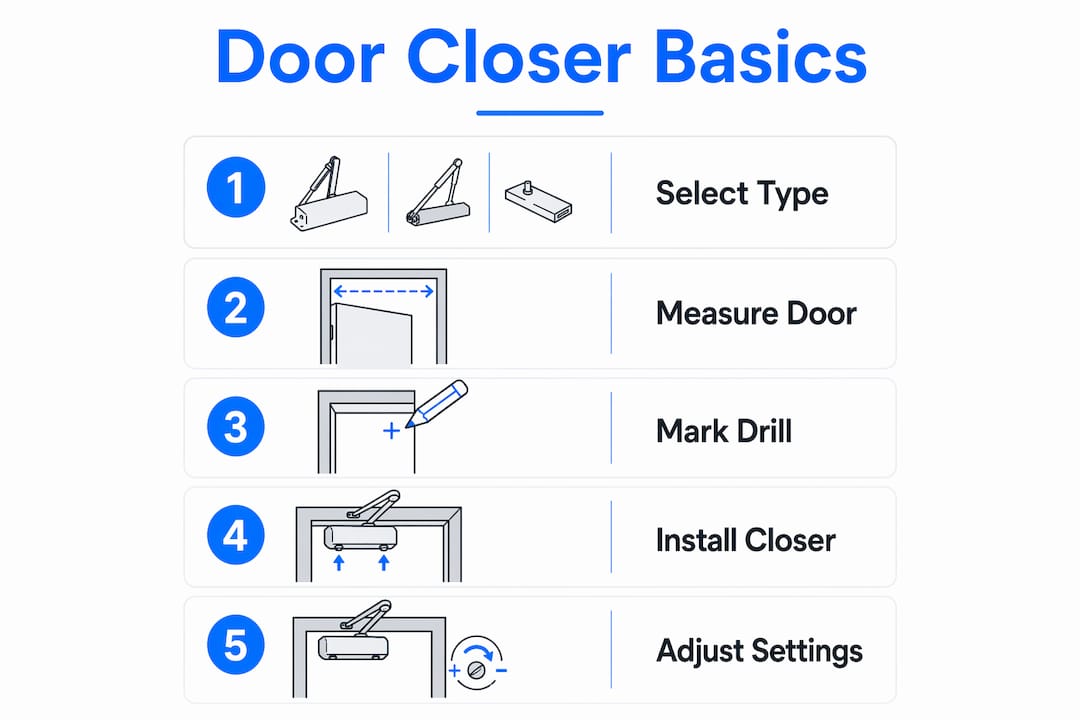
Installation accuracy determines whether a closer performs correctly or fails early. The most common mistake is misaligning the mounting template. Deviating by as little as 1/8 inch from the manufacturer’s template can cause arm binding, improper latching, and premature wear on the piston and seals.
Before mounting, confirm these factors:
- Door weight and width. Heavier and wider doors require a higher-power closer. Most manufacturers publish sizing charts based on door dimensions.
- Handing. Closers are configured for left-hand or right-hand doors. Installing the wrong configuration forces the arm into an unnatural angle.
- Mount position. Regular arm, top jamb, and parallel arm are the three standard mount positions. Parallel arm mounting is common when the closer must clear a door stop or narrow frame.
- Code requirements. Fire-rated door assemblies require closers listed by UL (Underwriters Laboratories) for use with that specific door and frame combination.
Pro Tip: Always use the paper template included with the closer to mark hole positions before drilling. Tape it to the door, confirm alignment with a level, and drill only after double-checking every measurement.
After mounting, adjust the sweep speed, latch speed, and backcheck valves with a small flathead screwdriver. Test the door through at least 10 full cycles before considering the installation complete.
Maintenance is straightforward but often neglected. Watch for these warning signs:
- The door no longer latches fully on its own.
- The arm moves unevenly or jerks during closing.
- Hydraulic oil appears around the closer body.
Oil leakage around the closer body signals seal failure. Once seals fail, hydraulic pressure cannot be restored, and the unit requires full replacement. No amount of valve adjustment fixes a leaking closer.
For fire-rated door assemblies, professional installation is the correct choice. A misinstalled closer on a fire door can void the door’s UL listing and create a code violation. The ADA-compliant door hardware requirements add another layer of precision that professional installers handle as part of standard practice.
Key Takeaways
A door closer is a required safety device on fire-rated doors and a practical security upgrade for any commercial or residential opening, with performance determined by grade, mechanism type, and installation accuracy.
| Point | Details |
|---|---|
| Grade determines durability | Grade 1 handles 2,000,000 cycles; match the grade to your traffic volume. |
| Hydraulic valves control performance | Sweep, latch, and backcheck valves each serve a distinct function and require individual adjustment. |
| Fire doors require closers by code | Closers on fire-rated doors prevent smoke and fire spread and must be UL-listed for the assembly. |
| ADA sets closing force limits | Interior doors must open with no more than 5 lbs of force and close in at least 5 seconds. |
| Oil leakage means replacement | A leaking hydraulic closer cannot be repaired and must be replaced to restore safe function. |
Why most people underestimate the door closer
People treat door closers as an afterthought. They pick whatever is cheapest or whatever fits the existing holes in the door. That approach works until it doesn’t, and when it fails on a fire door, the consequences go beyond inconvenience.
The detail I see overlooked most often is the relationship between closer grade and actual traffic. A Grade 3 closer installed on a school corridor door will fail within a year. The math is simple: 500,000 cycles sounds like a lot until you count how many students pass through that door each day. Grade 1 is the only sensible choice for any door that sees consistent daily use.
The second thing people miss is the backcheck valve. Most building owners assume it controls closing speed. It does not. It limits how hard the door can be pushed open. Ignoring it means the arm takes repeated impact loads that shorten its life considerably.
For anyone managing a commercial property, I’d also point to the fire-rated door guide as a starting point before selecting any closer. The closer is only one component of a compliant fire door assembly. Getting the assembly right from the start avoids costly retrofits later.
— Esteban
Ufiredoors: professional door closer installation in New York
Ufiredoors has spent over 20 years supplying, installing, and maintaining fire-rated steel doors and commercial door hardware across New York. Every installation follows UL-approved specifications and meets local building codes, including ADA and fire safety requirements.
If you need a door closer installed on a new or existing door assembly, Ufiredoors handles the full process, from hardware selection to final adjustment and code verification. The team also fabricates and installs fire-rated steel doors and steel stiffened doors built locally with fast lead times. Contact Ufiredoors for a free site estimate and get the right hardware installed correctly the first time.
FAQ
What is a door closer used for?
A door closer automatically returns a door to the closed and latched position after it has been opened. It is required on fire-rated doors and used on commercial and residential doors to improve security, accessibility, and hardware longevity.
How do I know which door closer grade I need?
Match the grade to your traffic volume. Grade 1 (2,000,000 cycles) suits high-traffic commercial doors. Grade 2 (1,000,000 cycles) works for moderate use. Grade 3 (500,000 cycles) is appropriate for light residential applications.
Can I install a door closer myself?
Surface-mounted closers on standard doors can be installed by a careful DIYer using the manufacturer’s template. Fire-rated door assemblies require professional installation to preserve the door’s UL listing and meet building code requirements.
How do I adjust a door closer?
Use a small flathead screwdriver to turn the sweep speed, latch speed, and backcheck valves on the closer body. Turn clockwise to slow the door and counterclockwise to speed it up. Always test through multiple cycles after each adjustment.
When should a door closer be replaced?
Replace a door closer when it leaks hydraulic oil, fails to latch the door consistently, or shows jerky movement during closing. Oil leakage indicates seal failure, which cannot be repaired. A closer that no longer latches the door reliably is a security and fire safety risk.