
Door fabrication is the specialized process of designing and manufacturing doors to meet specific structural, aesthetic, and regulatory requirements. Unlike off-the-shelf products, fabricated doors are built to precise project specifications, covering everything from fire ratings to custom dimensions. For construction professionals and property managers, understanding this process is the difference between a compliant installation and a costly field correction. Ufiredoors, a New York-based manufacturer with over 20 years of experience, builds UL-approved steel doors through this exact process for commercial, residential, and industrial properties.
What is door fabrication and why does it matter?
Door fabrication is the controlled manufacturing process that transforms raw materials into finished doors built to exact project specifications. The industry term for this broader discipline is door manufacturing, though fabrication specifically refers to the hands-on production sequence from design through final inspection. Every fabricated door must satisfy three requirements simultaneously: structural performance, visual specification, and code compliance.
The process matters most when a building’s safety depends on it. Fire-rated doors, for example, must meet UL certification standards that govern not just the door leaf but also the frame, hardware, and installation method. A door that passes design review but fails at the fabrication stage can void its fire rating entirely. That outcome creates liability for the property manager and rework costs for the contractor.
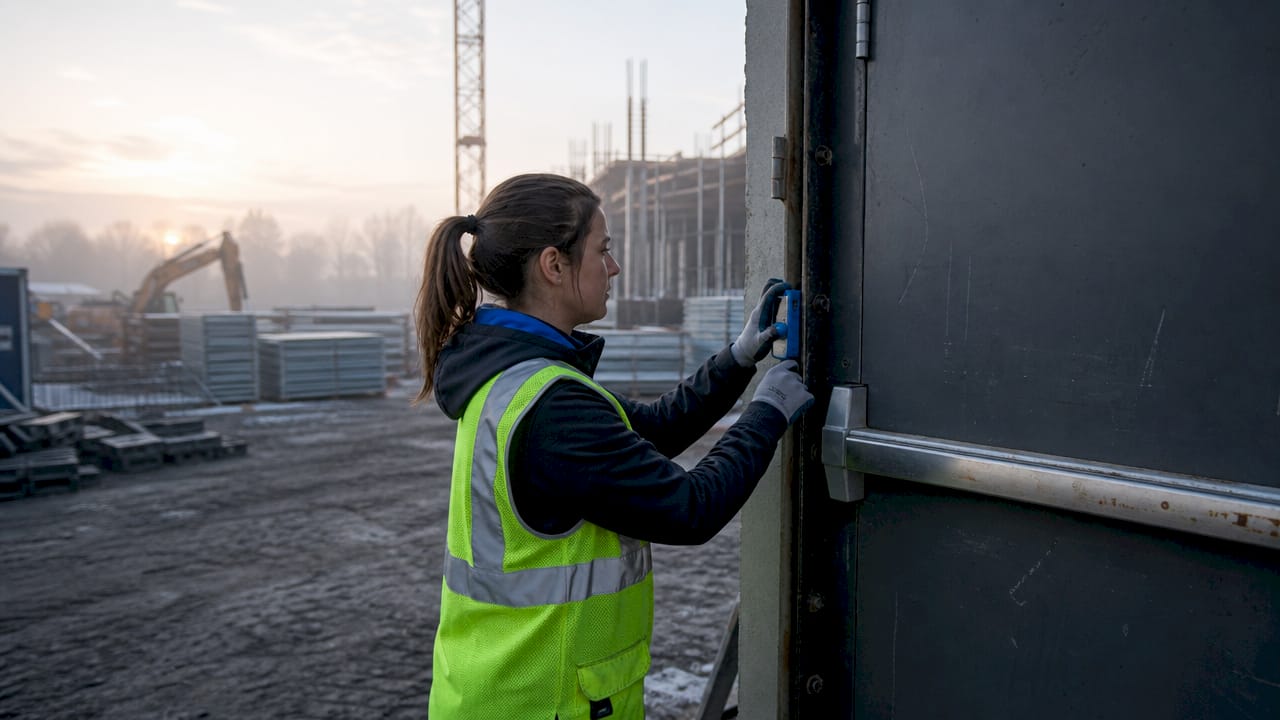
Custom door fabrication also addresses what standard catalog products cannot. Unusual opening sizes, non-standard fire ratings, acoustic requirements, and specific hardware configurations all require fabrication from the ground up. The fabrication process is where those requirements get locked in permanently.
What are the key stages in the door fabrication process?
Door fabrication typically follows a 5-stage process: technical design and CAD development, precision cutting and shaping, component assembly, finishing, and hardware integration with final quality inspection. Each stage feeds directly into the next, so an error in stage one compounds through every stage that follows.
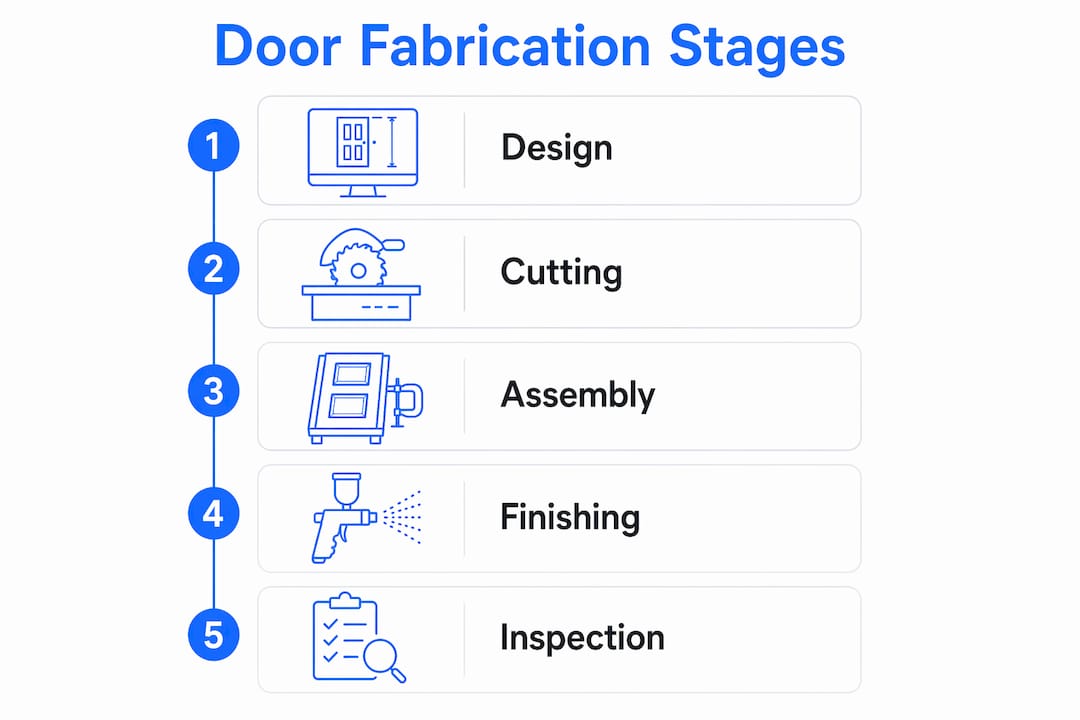
Stage 1: Technical design and CAD development
CAD design is where the door comes to life on paper before a single piece of metal or wood is cut. Industry experts treat the CAD phase as the most consequential step in the entire process. Rushed or inaccurate drawings significantly increase on-site problems and expenses. Every hardware cutout, hinge location, and frame dimension must be verified at this stage.
Stage 2: Precision cutting and shaping
CNC machining and laser cutting convert raw material sheets into door components with tight dimensional tolerances. This stage determines whether hardware preps land in the correct position and whether the door leaf fits the specified frame. Precise machining during fabrication directly affects ease of installation and compliance with fire and security codes.
Stage 3: Component assembly
Assembly joins the cut components into a complete door unit. For steel doors, this means welding. For wood doors, it means lamination and clamping. The method used here determines the door’s structural integrity for its entire service life.
Stage 4: Finishing
Finishing protects the door and prepares it for its end environment. Powder coating transforms steel doors with durable finishes that meet both architectural specifications and fire code requirements. Wood doors receive sealants, primers, or veneers depending on the application.
Stage 5: Hardware integration and quality inspection
Hardware is installed or prepped during fabrication, not as an afterthought on the job site. The final inspection verifies dimensional accuracy, finish quality, hardware placement, and compliance documentation before the door ships.
| Stage | Steel doors | Wood doors | Composite doors |
|---|---|---|---|
| Design | CAD with hardware preps | CAD with grain and moisture specs | CAD with core density specs |
| Cutting | CNC/laser cutting | Panel saw and router | CNC cutting |
| Assembly | MIG/TIG welding | Lamination and clamping | Bonding with engineered core |
| Finishing | Powder coating | Veneer, primer, or paint | Laminate or paint |
| Inspection | UL compliance check | Warp and moisture check | Structural integrity check |
Pro Tip: Request the CAD drawings and hardware prep schedule from your fabricator before production begins. Reviewing them early catches specification errors before they become field problems.
How do different materials impact door fabrication methods and quality?
Material choice drives every fabrication decision that follows. Steel, wood, and composite doors each require distinct processes, and the quality of the finished product depends on how well those processes are executed.
Steel door fabrication
Steel fabrication centers on welding, grinding, and coating. The welding joins the door skin to the internal frame, and the quality of that weld determines the door’s structural performance. Proper weld grinding and finishing removes visible seams that compromise aesthetics and may indicate structural weaknesses. This step is especially critical for UL-listed doors, where surface integrity is part of the certification. Ufiredoors builds its commercial hollow metal doors using this exact process, with UL-approved materials throughout.
Key quality indicators in steel fabrication:
- Weld seams ground flush with no visible gaps or pitting
- Hardware preps cut to exact specification with no field modification required
- Powder coat applied at consistent thickness with no runs or bare spots
- Door leaf square within tolerance, verified before shipping
Wood door fabrication
Wood fabrication introduces a variable that steel does not have: moisture. Wood doors require kiln drying to 8–12% moisture content before lamination begins. Failure to hit that range causes warping, telegraphing through the veneer surface, and binding in the frame after installation. These failures often appear weeks or months after installation, making the root cause hard to trace back to fabrication.
Assembly technique matters as much as moisture control. Balanced clamping during wood door assembly prevents stress imbalances that lead to bowing and uneven jamb shadow lines. Uneven clamp pressure is invisible in the finished door but shows up as a gap problem within the first heating season.
Pro Tip: When specifying wood doors for exterior or high-humidity applications, ask your fabricator for the kiln drying report. A moisture content reading outside the 8–12% range is a rejection criterion, not a negotiation point.
Composite and engineered core doors
Composite doors use engineered cores bonded between face sheets. The fabrication challenge is achieving consistent core density across the full door panel. Low-density voids create soft spots that affect both security performance and acoustic ratings. Bonding pressure and cure time must be controlled precisely to avoid delamination at the edges.
What role does door fabrication play in building safety and compliance?
Fabrication quality is the primary determinant of whether a door meets its rated performance in the field. A fire-rated door is only as good as the fabrication process that produced it.
UL certification governs the entire assembly, not just the door leaf. Hardware placement, frame dimensions, and even the type of adhesive used in composite cores can affect whether a door retains its UL listing after installation. CAD verification during fabrication ensures hardware prep accuracy and prevents the kind of field corrections that void fire ratings. Contractors following UL-approved installation steps depend on receiving a door that was fabricated to the same standard.
Compliance considerations that fabrication must address:
- Fire rating: door leaf, frame, and hardware must all carry matching UL ratings
- Acoustic performance: core density and seal design are set during fabrication, not installation
- Security classification: steel gauge, lock prep location, and reinforcement are fabrication decisions
- ADA compliance: hardware height and operating force requirements must be designed into the door
Quality inspection before shipment is the last line of defense. A door that leaves the factory with a mislocated hinge prep or an out-of-square leaf creates a compliance problem the installer cannot fix without voiding the rating.
What are common challenges and best practices in custom door fabrication?
Custom fabrication introduces complexity that standard production does not. The most common failure points are predictable and preventable.
Rushed CAD design is the leading cause of costly field corrections. When hardware locations are not verified against the actual hardware specification, preps land in the wrong position. Fixing a mislocated lock prep on a fire-rated door in the field often means replacing the door entirely.
Best practices for avoiding fabrication errors:
- Verify technical drawings against the hardware schedule before approving production
- Confirm frame dimensions match the rough opening dimensions in the field, not just the drawings
- Require a pre-production review meeting for any door with non-standard specifications
- Request a physical sample or mock-up for large orders before full production runs
Craftsmanship in manual steps like weld grinding and lamination pressure control determines door longevity beyond what the machine can guarantee. A fabricator with skilled tradespeople produces a consistently better product than one relying entirely on automated equipment. Ask to see the quality control process, not just the equipment list.
Pro Tip: For projects with multiple door openings, number each door to its specific opening in the fabrication drawings. This prevents field substitution errors that create compliance gaps.
How to select a door fabricator and evaluate fabrication quality?
The right fabricator has the equipment, the certifications, and the people to deliver a compliant product on schedule. Evaluating those three factors before awarding a contract saves significant rework cost.
Capabilities to verify before committing:
- CAD design capability with hardware schedule integration
- CNC or laser cutting equipment for dimensional accuracy
- Certified welding staff for steel doors or controlled lamination processes for wood
- UL listing or the ability to fabricate to UL specifications
- Documented quality control process with inspection records
Project management matters as much as production capability. A fabricator who cannot provide a clear production schedule or respond to specification questions quickly will create problems during a time-sensitive construction phase. Ask for references from projects with similar scope and timeline requirements.
Documentation to request before production:
- Approved shop drawings with hardware locations dimensioned
- Material certifications for steel gauge or wood species
- UL listing documentation for fire-rated assemblies
- Inspection checklist used at final quality review
Ufiredoors provides free site estimates for steel stiffened door projects, with production timelines as short as 3–5 days for standard configurations.
Key takeaways
Door fabrication is a five-stage manufacturing process where design accuracy, material control, and craftsmanship each determine whether the finished door meets its rated performance and compliance requirements.
| Point | Details |
|---|---|
| CAD design is the highest-risk stage | Errors in technical drawings compound through every production stage and create costly field corrections. |
| Material choice drives the process | Steel, wood, and composite doors each require distinct fabrication methods that affect durability and compliance. |
| Moisture control is non-negotiable for wood | Kiln drying to 8–12% moisture content prevents warping, telegraphing, and post-installation binding. |
| UL compliance is a fabrication responsibility | Hardware placement, frame dimensions, and core materials must all meet UL specifications before the door ships. |
| Craftsmanship determines longevity | Manual steps like weld grinding and balanced clamping affect door performance in ways automated equipment cannot guarantee. |
What I’ve learned from watching fabrication shortcuts play out on real projects
After working closely with construction teams and property managers across New York for years, the pattern I see most often is this: the fabrication phase gets compressed to protect the installation schedule. The drawings get approved too fast, the hardware schedule does not get cross-checked, and the door arrives on site with a lock prep that does not match the specified hardware. The installer improvises. The fire rating gets voided. Nobody finds out until the building inspection.
The uncomfortable truth about door fabrication is that the most important work is invisible. You cannot see whether a weld was ground properly by looking at a powder-coated door. You cannot tell whether the wood core was kiln-dried to the right moisture content by knocking on the face. The only way to know is to work with a fabricator who documents those steps and stands behind the result.
I have also seen the opposite: property managers who treat fabrication as a commodity and chase the lowest price, then spend three times the savings on emergency replacements within two years. The door that costs less to fabricate almost always costs more to own.
My recommendation is to treat the CAD review as a project milestone, not a formality. Bring your hardware supplier into that review. Confirm the frame dimensions against the field measurements. That one meeting eliminates the majority of fabrication-related field problems I have seen across hundreds of projects.
— Esteban
Ufiredoors: built-in New York, built to code
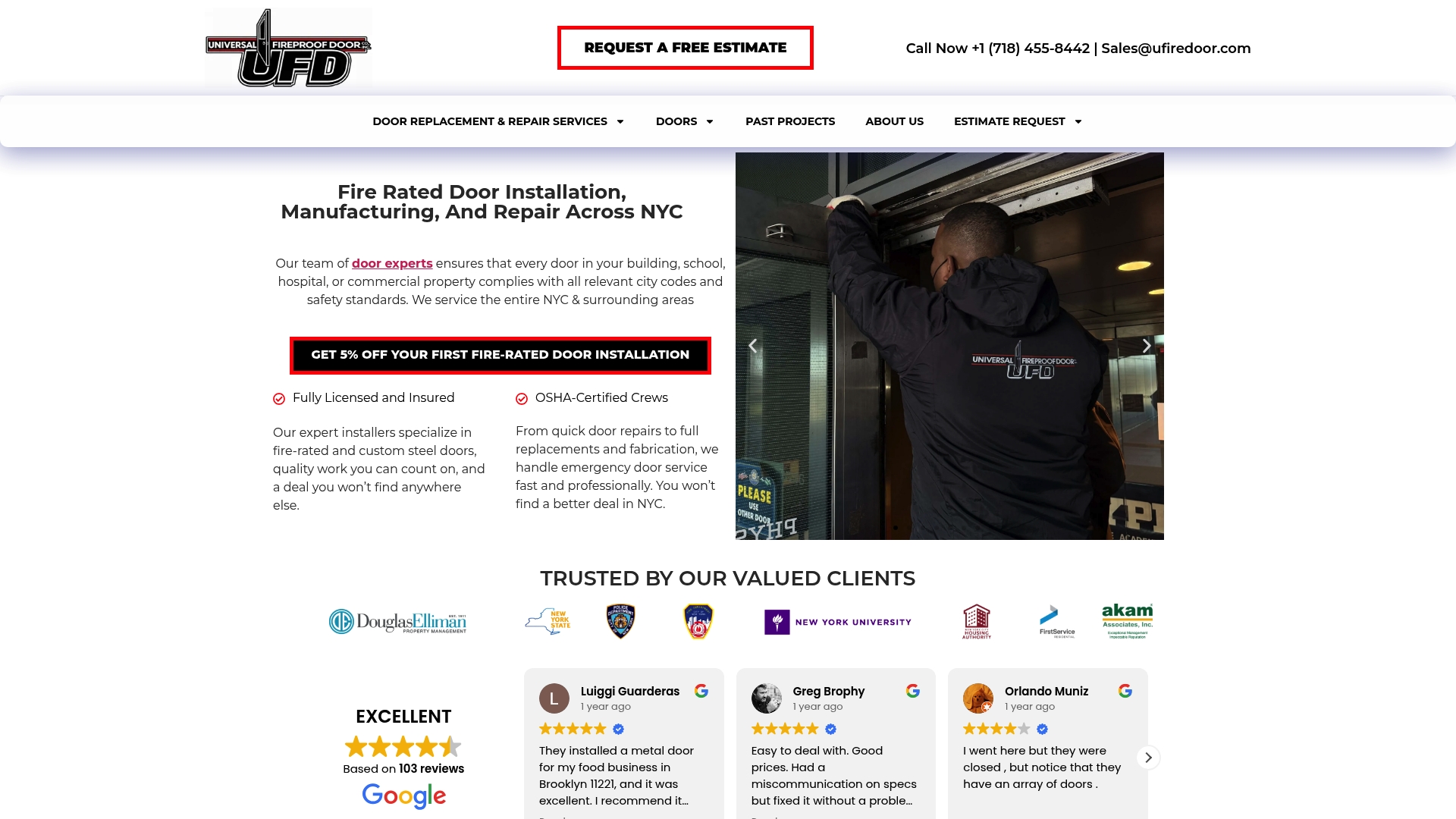
Ufiredoors manufactures fire-rated steel doors, frames, and commercial hardware from its New York facility, with production timelines as short as 3–5 days for standard configurations. Every door is built using UL-approved materials and goes through a documented quality inspection before it ships. For construction professionals and property managers who need a fabricator that can match tight project schedules without cutting corners on compliance, Ufiredoors offers free site estimates for steel stiffened door projects. The team also handles installation, repair, and emergency service for existing door assemblies. Contact Ufiredoors directly to discuss your project specifications and get a production timeline.
FAQ
What is door fabrication in simple terms?
Door fabrication is the process of manufacturing a door from raw materials to finished product, following a sequence of design, cutting, assembly, finishing, and hardware integration steps. The process produces doors built to specific dimensions, materials, and compliance standards.
How long does the door fabrication process take?
Production timelines vary by material, complexity, and fabricator capacity. Ufiredoors produces standard steel door configurations in 3–5 days; custom or large-volume orders require longer lead times.
What materials are used in door fabrication?
Steel, wood, and composite engineered cores are the three primary door fabrication materials. Steel is the standard for fire-rated and security applications; wood suits interior and aesthetic applications; composite cores balance performance and weight.
How does fabrication affect a door’s fire rating?
Fire ratings depend on the entire door assembly, including the leaf, frame, hardware, and installation method. Errors during fabrication, such as mislocated hardware preps or incorrect core materials, can void a door’s UL listing before it is ever installed.
What should I verify before approving a fabrication order?
Verify the CAD drawings against the hardware schedule, confirm frame dimensions match field measurements, and request UL listing documentation for any fire-rated assembly. These three checks prevent the majority of fabrication-related field problems.