
Door frame material is the single most consequential structural variable in any door system, determining long-term security, operational stability, and resistance to environmental damage. Property managers and contractors who treat frames as an afterthought routinely face warped doors, failed hinges, and costly callbacks within a few years of installation. Solid wood pine frames last 30–50+ years, while MDF frames can fail in as few as 5 years under normal use. The gap between those outcomes starts with the material spec, not the door itself. Brands like Therma-Tru and standards like AAMA 2605 exist precisely because the industry has learned this lesson the hard way.
Why door frame material matters more than most specs
Door frames are load-bearing structural components, not decorative trim. They carry hinge loads, resist racking forces, and seal the gap between the door and the rough opening. Poor frame selection causes door misalignment, air leaks, and security failures that no amount of door quality can compensate for. The frame is the foundation. Get it wrong, and everything built on top of it degrades faster.
The importance of door frame material shows up most clearly in lifecycle cost. A frame that costs 30% more upfront but lasts three times as long is the obvious financial choice. Yet project bids routinely cut frame quality to hit a number, then absorb repair costs that exceed the original savings within five years.
What are the most common door frame materials?
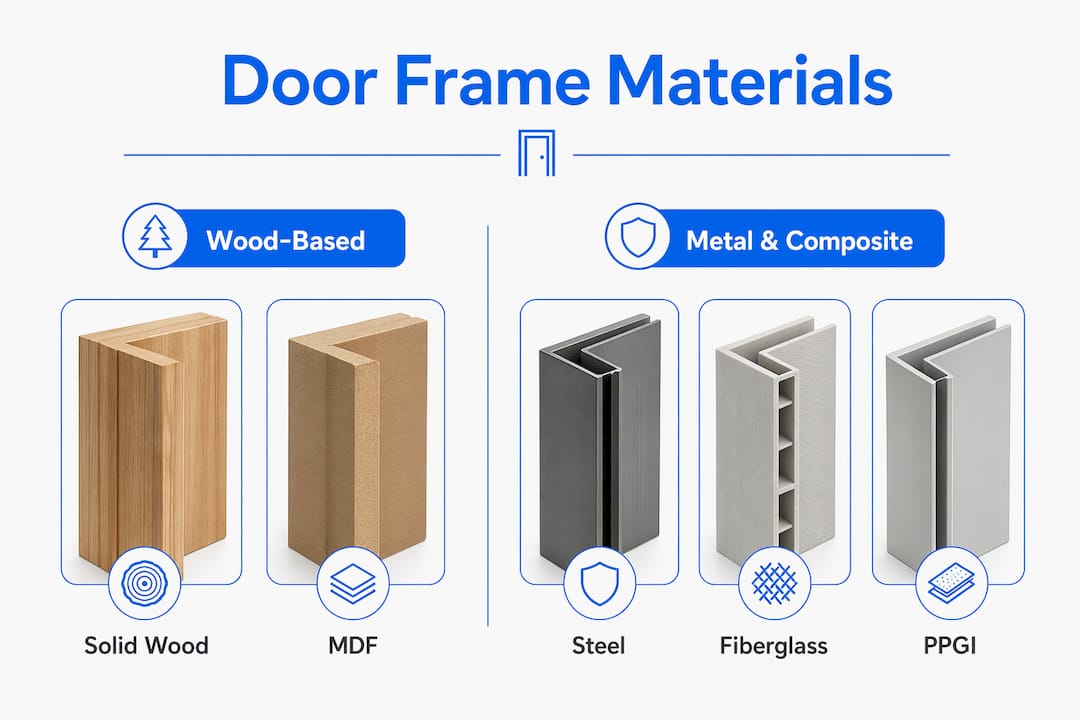
The five primary door frame material types used in commercial and residential construction are solid wood, MDF, steel, fiberglass, and composite. Each has a distinct performance profile.
| Material | Lifespan | Moisture Resistance | Best Use Case | Relative Cost |
|---|---|---|---|---|
| Solid Wood (Pine) | 30–50+ years | Moderate | Interior, dry climates | Medium |
| MDF | 5–11 years | Poor | Interior, low-traffic only | Low |
| Steel | 30–50+ years | High (with coating) | Commercial, high-security | Medium-High |
| Fiberglass | 25–40 years | Excellent | Coastal, humid climates | High |
| Composite | 20–40 years | Very Good | Mixed-use, exterior | Medium-High |
Solid wood pine delivers roughly 2,700 lbs of hinge-screw resistance, compared to 900–1,350 lbs for MDF. That difference directly affects how long a door stays plumb and operational. Solid wood also shows 3–4x greater bending strength than MDF, which matters in high-traffic corridors where doors take repeated lateral stress.
MDF is the budget choice that often becomes the expensive choice. Its isotropic fiber structure concentrates stress at hinge screw points, leading to compression creep and sagging doors within a decade. MDF may require 3–6 replacements over 30 years versus one pine frame that outlasts the building’s first renovation cycle.
Steel frames are the standard for commercial door applications where traffic volume, security requirements, and code compliance converge. They resist forced entry, hold hardware securely over decades, and pair naturally with fire-rated door assemblies.
Fiberglass excels in moisture-heavy environments. Its thermal expansion rate matches glass, and it offers 8–10x greater strength than vinyl. Composite frames, including finger-jointed wood with waterproof composite bottoms, solve the specific problem of floor-level moisture absorption that destroys traditional wood and MDF frames from the ground up.
Pro Tip: Specify finger-jointed composite frames for any exterior door in a climate with seasonal humidity swings. The waterproof base prevents the floor-level swelling that causes most wood frame failures.
How do environmental conditions affect frame material choice?
Climate is the most underweighted variable in frame material selection. A frame that performs well in Phoenix will fail in Miami within five years if the wrong material is specified.
Humidity above 75–85% accelerates wood swelling, MDF delamination, and paint failure. Coastal environments add UV degradation and salt corrosion on top of moisture stress. Coastal UV exposure runs 15–20% higher than inland levels, which shortens the service life of any frame without a rated protective finish.
For humid and coastal projects, the two strongest material choices are fiberglass and PPGI (pre-painted galvanized iron). PPGI frames are rust-proof, termite-resistant, and maintenance-free with a service life of 30–50 years. That makes them a direct competitor to wood in humid climates, with a significant maintenance advantage. Fiberglass matches that durability profile while also providing thermal performance benefits.
Aluminum frames are viable in coastal conditions only when finished to AAMA 2605 standards. That specification requires factory-applied coatings using 6063 T6 aluminum alloys that resist salt corrosion and UV degradation. Without that finish grade, aluminum frames in coastal environments corrode at joints and fastener points within a few years.
Wood and MDF frames in wet climates require frequent repainting, sealing, and eventual replacement. For property managers tracking maintenance budgets, that recurring cost is a liability. Hardwoods remain preferred aesthetically in dry climates, but humid and high-traffic environments favor composite or PPGI frames for durability and minimal upkeep.
Pro Tip: Always specify the climate zone and expected humidity range in your frame material schedule. A single spec sheet that covers all locations on a multi-site project is a common source of premature frame failures.
What are the structural and security implications of frame material?
Security is where frame material choice becomes a life-safety decision, not just a performance preference. Door security is only as strong as its weakest component, and in most forced-entry failures, the frame gives before the door does.
The structural failure sequence in a compromised door system typically follows this pattern:
- Hinge screws lose grip in the frame material, causing the door to sag and misalign.
- Misalignment creates gaps at the latch and deadbolt strike, reducing lock engagement depth.
- Reduced lock engagement allows forced entry with minimal force, even against a high-quality door.
- Frame replacement is required before the door can be secured again.
Steel and reinforced timber frames provide significantly higher forced-entry resistance than uPVC or MDF alternatives. For commercial buildings, schools, and multi-family residential properties, steel frames are the baseline specification, not an upgrade. The steel door frame installation guide from Ufiredoors covers the specific anchoring and welding standards that determine whether a steel frame performs to its rated capacity.
“A strong door frame reinforcement is critical to security; even high-quality steel doors provide limited protection if the frame lacks equivalent strength and integrity.” — An Expert’s Guide to Door Materials
MDF frames fail through compression creep at hinge points. The isotropic fiber structure cannot redistribute stress the way wood grain does, so the material deforms permanently around fasteners. This is not a gradual performance decline. It is a structural failure mode that accelerates once it starts. For any application where door alignment and security matter, MDF is not a compliant choice regardless of its upfront cost advantage.
For fire-rated door assemblies, the frame material must match the door’s fire rating. A UL-listed fire door installed in a non-rated frame voids the assembly’s certification. This is a code compliance issue, not just a performance concern.
How to balance cost, durability, and compliance in frame selection
The practical decision framework for frame material comes down to four variables: traffic volume, climate exposure, security requirements, and lifecycle cost tolerance.
- High-traffic commercial: Steel frames are the standard. They hold hardware longer, resist forced entry, and comply with most commercial building codes without supplemental reinforcement.
- Humid or coastal exterior: Fiberglass or PPGI. Both outperform wood and MDF in moisture resistance and require minimal maintenance over their service life.
- Interior low-traffic, dry climate: Solid wood pine or composite. MDF is acceptable only in genuinely low-moisture, low-use applications where replacement cost is budgeted.
- Fire-rated assemblies: Steel frames with UL-listed hardware. No substitution is code-compliant.
Composite and factory-finished frames reduce maintenance callbacks and support warranty compliance. Factory finishes applied under controlled conditions outperform field-applied paint in adhesion, UV resistance, and moisture sealing. For contractors managing warranty liability, specifying factory-finished frames is a direct risk reduction strategy.
Building code compliance adds another layer to the selection process. ISO standards in construction tie material performance to safety outcomes, and inspectors increasingly scrutinize frame specifications in commercial projects. Documenting material choices with manufacturer data sheets and compliance certifications protects contractors during inspections and litigation.
Pro Tip: Request lifecycle cost data from frame suppliers, not just unit pricing. A supplier who cannot provide maintenance interval estimates and expected replacement timelines is not a reliable specification partner.
The frame decision gets made too late
I have reviewed enough commercial door specifications to recognize a consistent pattern. The frame material gets decided at the end of the procurement process, after the door style, hardware, and finish are locked in. That sequence is backwards, and it costs money.
The frame determines what hardware can be used, what fire rating the assembly can achieve, and how long the door will function without adjustment. Specifying the door first and the frame second means you are often retrofitting a frame to a door, rather than building a system. I have seen projects where a correctly specified steel door was installed in an MDF frame to save $80 per opening. Within three years, those openings needed full frame replacement, at a cost that exceeded the original door budget for the entire floor.
The other mistake I see regularly is treating all steel frames as equivalent. Gauge, anchoring method, and coating specification vary significantly between manufacturers. A 16-gauge steel frame anchored with expansion bolts into a concrete masonry unit performs very differently from a 20-gauge frame shot into drywall. Both are “steel frames” on a spec sheet. Only one performs to the security and durability standard the project requires.
My recommendation: lock in the frame material specification before finalizing the door selection. Build the system from the outside in, starting with the structural component that everything else depends on.
— Esteban
How Ufiredoors delivers frame solutions built for commercial projects
Ufiredoors manufactures and installs steel stiffened door frames built to UL-approved standards at their New York facility, with lead times that keep commercial projects on schedule. Every frame is fabricated locally, inspected for gauge and finish compliance, and installed by crews who understand the code requirements for commercial, industrial, and residential applications. Ufiredoors offers free site estimates, so contractors and property managers can get accurate material and installation specifications before committing to a project budget. For fire-rated assemblies, their fire-rated steel doors and matching frames are built as complete systems, eliminating the compliance gap that voids UL listings. Contact Ufiredoors to schedule your site estimate and get frames specified correctly from the start.
FAQ
What is the longest-lasting door frame material?
Solid wood pine and steel frames both offer 30–50+ year service lives when properly maintained. PPGI frames match that lifespan in humid and coastal environments with minimal upkeep required.
Why do MDF door frames fail so quickly?
MDF fails through compression creep at hinge screw points. Its isotropic fiber structure cannot redistribute stress, causing permanent deformation around fasteners and door sagging within 5–11 years.
Does door frame material affect fire rating compliance?
Yes. A fire-rated door assembly requires a frame that matches the door’s UL listing. Installing a rated door in a non-rated frame voids the assembly’s certification and fails code inspection.
What frame material is best for coastal or humid climates?
Fiberglass and PPGI frames are the top choices for high-humidity and coastal environments. Both resist moisture, UV exposure, and corrosion far better than wood, MDF, or uncoated aluminum.
How does frame material affect door security?
Frame material determines hinge-screw retention and resistance to forced entry. Steel frames provide the highest security performance. MDF and uPVC frames are the most vulnerable to forced-entry failure because they lose fastener grip over time.