
Regular door maintenance is the single most effective way to prevent costly emergency repairs, extend door lifespan, and keep your building safe and code compliant. Property owners and managers who skip routine upkeep pay for it later, often with emergency service calls, failed inspections, or liability claims. The industry term for this practice is preventive door maintenance, and it covers everything from lubricating hinges and replacing weatherstripping to documenting annual fire door inspections under NFPA 80. A standard maintenance visit takes 30–60 minutes per door every 3–6 months. That small investment protects doors that, when properly maintained, can last 30–50 years.
Why regular door maintenance is a safety requirement, not just upkeep
Neglected doors are a direct safety hazard. A misaligned door that drags, a closer that fails to latch, or a panic bar that sticks under pressure can trap occupants during an emergency. These are not hypothetical risks. They are the exact failure points that building inspectors and fire marshals flag during audits.
Fire-rated doors carry the highest stakes. These assemblies are engineered to contain fire and smoke for a rated period, typically 20, 45, 90, or 180 minutes. A gap in the door frame, a missing intumescent seal, or a broken self-closer destroys that rating entirely. Fire-rated door assemblies require annual inspections documented per NFPA 80. That is a legal requirement, not a recommendation.

Beyond fire doors, commercial panic hardware and door closers are safety-critical components that degrade under heavy use. Commercial door closers last 10–15 years under normal use, but only 5–7 years in high-traffic environments. That lifespan drops further when routine lubrication and adjustment are skipped.
Key safety risks from deferred door maintenance include:
- Misaligned doors that fail to latch, leaving spaces unsecured
- Failing door closers that allow fire doors to remain open
- Broken panic hardware that blocks egress during emergencies
- Damaged frames that compromise the structural integrity of the door assembly
- Worn intumescent seals that allow smoke infiltration through fire-rated gaps
Pro Tip: Schedule fire door inspections at the same time each year, and keep a physical or digital log on site. Fire marshals in New York and most other jurisdictions expect to see documentation, not just a verbal confirmation that the doors work.
Does routine upkeep actually save money?
The short answer is yes, and the gap between maintenance costs and emergency repair costs is significant. Preventive maintenance shifts facility spending from unpredictable emergency costs to predictable budgeted expenses. That shift matters for property managers who need to plan annual operating budgets.
A simple hinge adjustment costs a fraction of what a multi-point lock replacement runs after the door frame warps from years of misalignment. Minor misalignment issues that go unaddressed lead directly to premature lock and hardware failure. The repair bill grows with every month the problem is ignored.
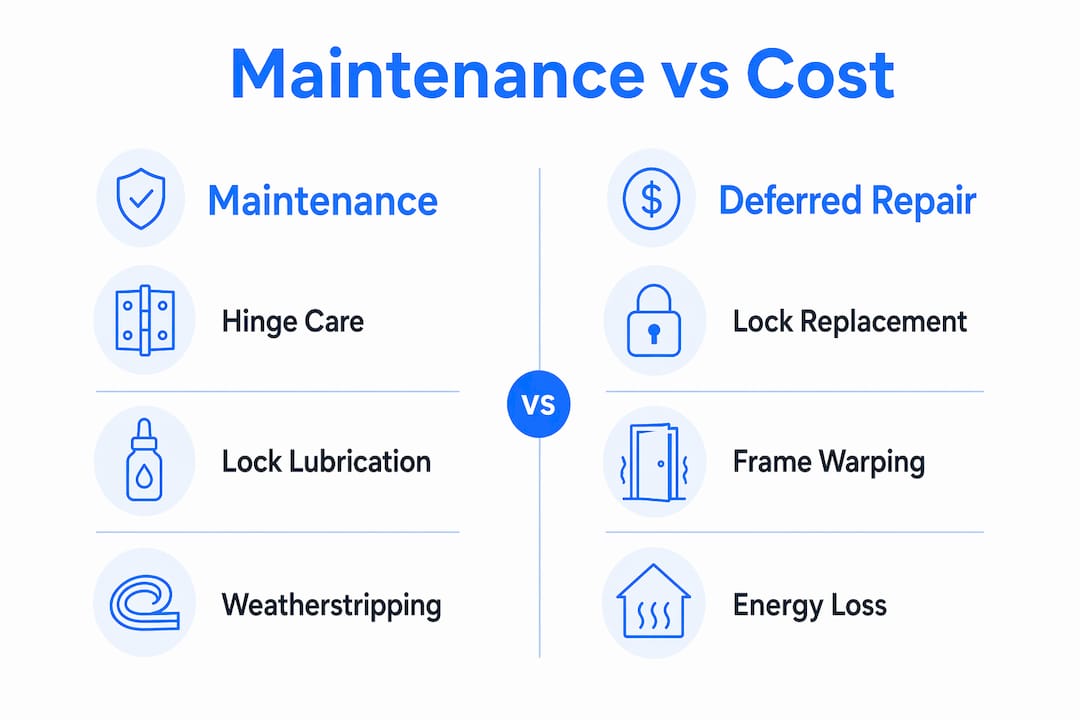
Weatherstripping is another area where deferred maintenance creates compounding costs. Neglected weatherstripping forces door closers to work harder against air pressure imbalances, shortening their lifespan. At the same time, the air leaks it allows raise HVAC costs in ways that are often blamed on the HVAC system itself, not the doors.
| Maintenance task | Typical cost | Deferred repair cost |
|---|---|---|
| Hinge lubrication and adjustment | Low | High (frame damage, lock replacement) |
| Weatherstripping replacement | Low to moderate | Moderate to high (closer failure, energy loss) |
| Door closer adjustment | Low | High (full closer replacement) |
| Annual fire door inspection | Moderate | Very high (fines, liability, full assembly replacement) |
| Frame realignment | Moderate | Very high (door replacement) |
Well-maintained doors last 30–50 years. Neglected doors can reach irreparable wear within 5–10 years. That difference in lifespan represents tens of thousands of dollars per door across a commercial property portfolio.
Pro Tip: Build door maintenance into your annual operating budget as a line item. A predictable $X per door per year is always cheaper than an unplanned emergency call at $X per incident.
What goes on a door maintenance checklist?
A practical door maintenance checklist organizes tasks by frequency. Not everything needs attention every quarter. Knowing what to check when prevents both over-servicing and neglect.
Quarterly tasks:
- Inspect door surfaces for dents, scratches, or corrosion
- Check weatherstripping for compression set, tears, or gaps
- Test door latching and locking under normal use
- Verify door closer speed and latching force
- Wipe down hardware with a dry cloth to remove grit and debris
Biannual tasks:
- Lubricate hinges, pivots, and door closer arms with PTFE spray or a manufacturer-recommended dry lubricant
- Inspect and tighten all visible fasteners on hinges, strikes, and closers
- Check door alignment against the frame on all four sides
- Test panic hardware and exit devices for smooth operation
- Inspect threshold seals and door bottoms for wear
Annual tasks:
- Perform a full fire door inspection per NFPA 80 and document findings
- Adjust or replace door closers showing signs of hydraulic fluid loss
- Replace weatherstripping that has lost its seal
- Inspect frames for rust, cracks, or separation from the wall
- Review the full commercial door hardware assembly for any components approaching end of life
One of the most common mistakes property managers make is using WD-40 on locks and hinges. WD-40 attracts dirt and grit, accelerating wear on lock pins and hinge bearings. PTFE spray or a dry lubricant recommended by the hardware manufacturer is the correct choice. It leaves no oily residue and does not collect debris.
Pro Tip: Signs that a door needs professional attention rather than routine maintenance include a door that binds in the frame after adjustment, a closer that leaks hydraulic fluid, or a fire door with visible gaps around the frame perimeter. Do not attempt to patch these issues with temporary fixes.
How does compliance work for fire-rated and commercial doors?
Regulatory compliance for commercial doors centers on NFPA 80, the National Fire Protection Association standard that governs fire door assemblies. Under NFPA 80, annual inspections are mandatory and must be documented. That documentation serves as proof of compliance during fire marshal inspections and insurance audits.
The documentation requirement is specific. Each inspection record must include the date, the inspector’s name, the door location, and the findings. Physical binders work, but digital maintenance management systems are increasingly common in larger properties. Either format is acceptable as long as records are accessible on demand.
Non-compliance carries real consequences:
- Fines from the local fire marshal or building department
- Increased insurance premiums or denied claims after a fire event
- Liability exposure if a non-compliant fire door fails during an emergency
- Failed certificate of occupancy renewals in jurisdictions with active enforcement
- Mandatory shutdown orders for buildings with repeated violations
Property managers who integrate fire door compliance tracking into their maintenance calendar avoid most of these risks. The key is treating the annual inspection as a fixed operational event, not a task that gets scheduled when someone remembers it.
Beyond NFPA 80, local building codes in cities like New York add additional requirements for commercial properties. New York City’s Local Law 26 and related fire safety regulations require documented fire safety plans that include door hardware and egress path maintenance. Properties that fall behind on documentation face enforcement actions that go beyond a simple fine.
Key Takeaways
Regular door maintenance protects property owners from emergency repair costs, safety failures, and compliance violations by converting unpredictable expenses into scheduled, budgeted tasks.
| Point | Details |
|---|---|
| Maintenance prevents costly repairs | Routine upkeep costs far less than emergency hardware or frame replacement. |
| Fire doors require annual inspections | NFPA 80 mandates documented annual inspections for all fire-rated door assemblies. |
| Doors last 30–50 years when maintained | Neglected doors can fail irreparably within 5–10 years, multiplying replacement costs. |
| Use PTFE lubricants, not WD-40 | Dry lubricants protect lock pins and hinges without attracting grit and debris. |
| Documentation protects against liability | Inspection records are required for fire marshal audits and insurance compliance. |
What I’ve learned after years of watching doors fail
The most expensive door repairs I’ve seen were all preventable. A property manager in a mid-size commercial building ignored a dragging door for two years. By the time the frame was repaired, the cost was five times what a simple hinge adjustment would have run. That story repeats itself constantly in this industry.
The mistake I see most often is treating door maintenance as a cosmetic concern. Owners notice a scuff or a slow closer and think it’s a minor annoyance. What they’re actually seeing is the early signal of a mechanical failure. A door closer that’s slowing down is losing hydraulic pressure. A door that drags is putting stress on the frame every single time it opens. These are mechanical systems, and they fail the same way any mechanical system fails: gradually, then suddenly.
The lubricant issue is also more serious than most people realize. I’ve inspected doors where someone used WD-40 on every moving part for years. The lock cylinders were packed with grit. The hinge bearings were worn down to metal on metal. The fix required full hardware replacement on doors that should have had another decade of service life.
My practical advice for property managers: build a simple spreadsheet with every door in your building, its last inspection date, and its next scheduled service. Review it quarterly. Assign one person to own it. That single habit eliminates most of the emergency calls. Pair it with a relationship with a qualified door service provider who knows fire-rated assemblies, and you’ve converted a liability into a managed asset.
— Esteban
Ufiredoors provides professional door maintenance and fire door services
Property managers who want compliance, safety, and long-term door performance without the guesswork of DIY maintenance have a clear option: work with a specialist who builds and services the doors they install.
Ufiredoors is a New York-based manufacturer and installer of fire-rated steel doors with over 20 years of experience serving commercial, residential, and industrial properties. Every door is built locally using UL-approved materials and installed to full code compliance. Ufiredoors also provides emergency repair services and ongoing maintenance programs, so your doors stay compliant and operational year-round. For property managers who need a reliable partner for inspections, repairs, and new installations, Ufiredoors delivers steel door solutions with fast lead times and documented service records.
FAQ
Why does regular door maintenance matter for commercial buildings?
Regular door maintenance prevents safety failures, extends component lifespan, and keeps buildings compliant with NFPA 80 and local fire codes. Deferred maintenance leads to emergency repairs that cost significantly more than scheduled upkeep.
How often should commercial doors be inspected?
Fire-rated doors require a documented annual inspection under NFPA 80. General commercial doors benefit from quarterly visual checks and biannual lubrication and hardware adjustments.
What lubricant should I use on door hinges and locks?
Use PTFE spray or a manufacturer-recommended dry lubricant. WD-40 attracts dirt and grit that accelerates wear on lock pins and hinge bearings, shortening hardware life.
What happens if fire door inspections are not documented?
Non-compliance with NFPA 80 documentation requirements can result in fines, increased insurance liability, and failed fire marshal inspections. Documentation must include the date, inspector name, door location, and findings.
How long do commercial doors last with proper maintenance?
Well-maintained doors last 30–50 years. Neglected doors can reach irreparable wear within 5–10 years, making routine upkeep one of the highest-return investments in a property’s maintenance budget.