
When you’re managing a commercial property, overseeing a construction project, or developing a building in the Northeast, the question of why use local door suppliers comes up fast, and the wrong answer costs you time, money, and code violations. National suppliers sound convenient until a shipment arrives two weeks late, a frame doesn’t match the slab spec, or no one on-site knows whether the hardware meets New York’s fire egress requirements. Local sourcing, specifically working with regional door vendors who know your climate, your codes, and your schedule, changes that equation completely.
Table of Contents
- Key takeaways
- Why use local door suppliers for complete door systems
- Proximity means faster delivery and fewer surprises
- Regional expertise in code compliance and installation
- Reducing rework through coordinated door packages
- Sustainability and community impact of sourcing locally
- My take on why local always wins in the Northeast
- How Ufiredoors serves Northeast contractors and property managers
- FAQ
Key takeaways
| Point | Details |
|---|---|
| One-stop door sourcing | Local suppliers provide slabs, frames, hardware, and accessories together, cutting coordination time significantly. |
| Faster regional delivery | Proximity to Northeast distribution centers reduces lead times and keeps urgent projects on schedule. |
| Built-in code knowledge | Regional vendors understand local building codes and climate conditions, reducing compliance risk. |
| Fewer field adjustments | Pre-coordinated door packages with shop drawings and test fits prevent costly on-site rework. |
| Community and sustainability | Shorter supply chains lower emissions and support Northeast manufacturing networks. |
Why use local door suppliers for complete door systems
The standard industry term for what local vendors provide is a “complete door system,” meaning the slab, frame, hinges, lockset, closer, and all associated hardware arrive as a coordinated package from one source. This is distinct from piecemeal procurement, where you buy components from three or four separate suppliers and hope everything aligns on delivery day.
That hope rarely pays off. Mismatched mortise preps, frames ordered in the wrong profile, and hardware that technically fits but creates binding issues are all common outcomes of fragmented sourcing. Local suppliers eliminate this by handling the complete door-system work from start to finish, reducing the vendor coordination that eats into your project timeline.
The benefits of working with a single local source go beyond logistics. A regional supplier’s sales team knows which frame profile works with which slab thickness, which closers meet ADA compliance in New York City, and which finishes hold up in coastal New England salt air. You get real answers from people who install these products in the same conditions you’re working in, not a national call center reading spec sheets.
Here’s what a complete door system from a local supplier typically includes:
- Hollow metal or steel door slab in the required fire rating
- Welded or knocked-down frame sized to the specific wall thickness
- Hardware schedule with matched hinge prep, lockset, and closer specs
- Finish and paint coordination to match existing building aesthetics
- Submittal documentation for building permit and code review
Pro Tip: Request a hardware schedule in writing before ordering. Confirm that mortise and multipoint lock preps are verified via factory test fits before the slab ships. This single step eliminates the most common source of field rework on commercial door projects.
Proximity means faster delivery and fewer surprises
Speed matters in construction. A delayed door holds up an entire floor’s certificate of occupancy. A botched replacement order for an emergency exit means a building violation that compounds daily. Local suppliers reduce that exposure because their inventory is closer to your site and their trucks are already running regional routes.
This isn’t theoretical. Local supply channels measurably reduce delivery friction for urgent orders, particularly in dense urban markets like New York City where national carriers face access restrictions and delivery window constraints. A local supplier that runs its own delivery can get a replacement door to a Brooklyn site in 24 hours. A national supplier shipping from a Midwest warehouse cannot.
Regional distribution networks built for the Northeast market add another layer of reliability. Suppliers with established roots in the region carry inventory that reflects local demand, which means fire-rated steel doors in standard New York City specs, heavy-duty frames for masonry construction, and hardware compliant with Local Law requirements. Northeast-focused distribution is specifically engineered to address regional weather, architecture, and construction cycles.
Seasonal scheduling is another factor contractors often underestimate. Northeast winters compress outdoor construction timelines, and spring creates a rush of projects competing for the same materials. Local partners with regional networks are better positioned to handle seasonal constraints and urgent change orders because they’ve built their inventory and staffing models around exactly these patterns. A national supplier’s fulfillment center in Georgia has no reason to prioritize your February emergency in Manhattan.
Inventory-backed sourcing also reduces schedule risk on ongoing projects. If you’re a property manager overseeing a multi-phase renovation across several buildings, a local supplier can hold allocated stock for your project and release it on your schedule rather than theirs.
Regional expertise in code compliance and installation
Northeast building codes are not simple. New York City alone operates under the NYC Construction Codes, which layer on top of state and federal requirements with specific provisions for fire-rated assemblies, egress hardware, and accessibility. Massachusetts, Connecticut, and New Jersey each carry their own amendments to base codes. A supplier who works exclusively in this region knows these distinctions without having to look them up.

Local installers adapt both materials and methods to regional climate conditions, and that adaptation directly affects durability and long-term maintenance costs. A door installed in coastal Rhode Island faces salt air, freeze-thaw cycling, and high humidity. The correct approach to weatherstripping, threshold sealing, and finish selection in that environment differs from what works in a climate-controlled office tower in Midtown Manhattan.
Local suppliers who also handle installation bring several specific advantages:
- Knowledge of which AHJ (Authority Having Jurisdiction) inspectors prioritize which code elements during final walkthrough
- Familiarity with common structural conditions in regional building stock, including older masonry and mixed-construction multifamily buildings
- Established relationships with local hardware suppliers who stock the specific product lines approved for fire-rated assemblies in each jurisdiction
- Post-installation warranty support with local claim handling, which simplifies repairs and reduces downtime
Reputation is also a meaningful factor in local markets. A supplier who operates in your region knows that a poor installation will follow them through your network of contractors, property managers, and developers. That accountability produces better work.
Pro Tip: When reviewing bids, ask suppliers directly whether they’ve installed doors in buildings of similar age and construction type in your area. A supplier with experience in pre-war New York City masonry buildings will anticipate frame conditions that a newer company won’t.
Reducing rework through coordinated door packages
Rework is the silent budget killer in commercial construction. A door that arrives without the correct hinge prep requires a field modification that delays the schedule, creates a warranty gray area, and adds labor cost that no one budgeted. Complete door packages with aligned components eliminate this by ensuring that slabs, frames, hardware, and finish preparations are specified and verified together before anything ships.
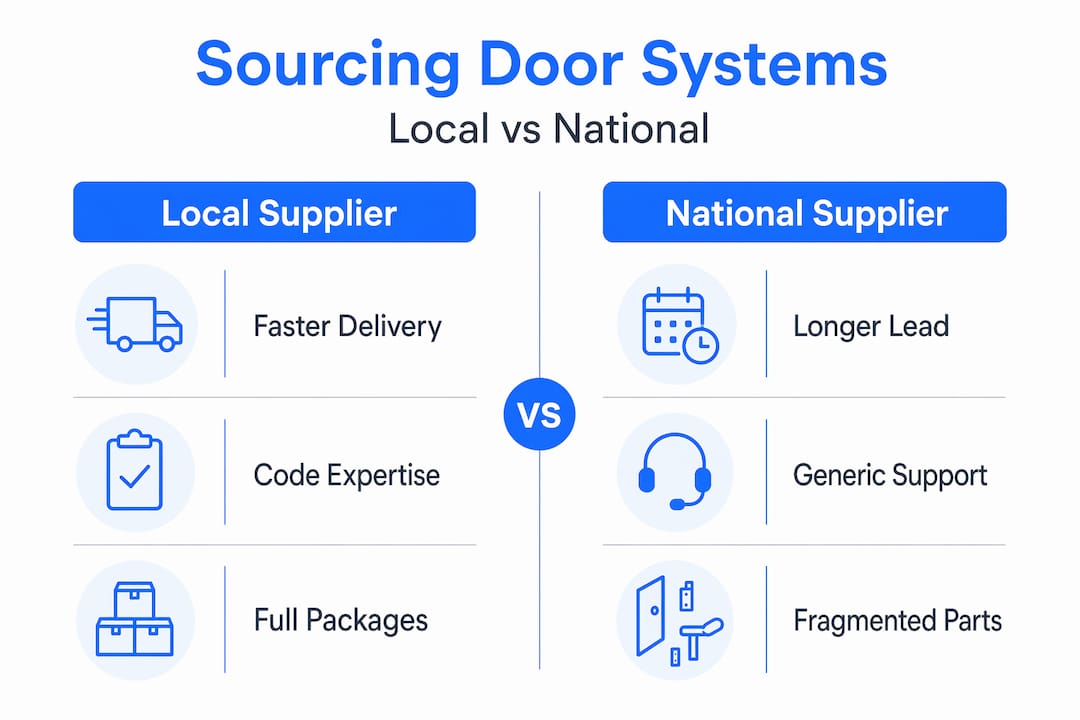
The table below shows what separates a coordinated local package from standard piecemeal procurement.
| Factor | Coordinated local package | Piecemeal national sourcing |
|---|---|---|
| Component matching | Verified by supplier before ship | Buyer’s responsibility to cross-check |
| Lead time clarity | Written, confirmed at quote stage | Variable across multiple vendors |
| Shop drawings | Included with submittal package | Often not provided |
| Mortise prep accuracy | Confirmed via bench test fits | Field verification only |
| Code documentation | Supplier provides labels and certs | Buyer assembles from multiple sources |
| Warranty coverage | Single-source accountability | Fragmented by component |
The documentation side of this matters for code compliance as much as for installation quality. Fire-rated assemblies require labeled components, and those labels must match the listed assembly. When components come from multiple suppliers, verifying that the full assembly maintains its UL listing falls on the contractor. When components come from a local supplier who specializes in fire-rated systems, that verification is part of the service.
Sustainability and community impact of sourcing locally
Choosing local vendors isn’t just a logistical decision. It carries real sustainability consequences that matter more every year as building projects face pressure to reduce embodied carbon and supply chain emissions.
Shorter transport distances mean lower emissions per door delivered. Contractors who source locally also promote regional manufacturing and strengthen community business networks, which creates a compounding local economic benefit over time.
For Northeast projects, the sustainability case for local sourcing includes:
- Significantly reduced freight miles compared to national distribution from out-of-region warehouses
- Support for Northeast manufacturing jobs and trade apprenticeship programs
- Reduced packaging waste from shorter, more controlled supply chains
- Stronger alignment with green building certifications that reward regional material sourcing
Property managers and developers working on LEED or WELL certified projects should note that regional material sourcing can contribute directly to certification point thresholds, making local procurement a decision with both ethical and financial return.
My take on why local always wins in the Northeast
I’ve worked in and around commercial door supply and installation in New York for long enough to have watched the full cycle of a national supplier relationship play out more than once. It always starts the same way: lower unit prices, slick catalog, and a sales rep who’s never set foot in the building they’re quoting.
What I’ve seen repeatedly is that the savings evaporate the moment something goes wrong. And in the Northeast, something always goes wrong at some point. A frame ships short, a closer isn’t rated for the jurisdiction, or a delivery misses the window by three days and holds up a certificate of occupancy. At that point, you’re calling a 1-800 number and explaining your problem to someone who has never heard of the NYC Building Code.
The deeper advantage of working with local suppliers that most people miss isn’t speed or price. It’s accountability. A local vendor lives in the same professional ecosystem you do. They know your general contractor, they’ve worked in your building type before, and they understand that one bad job in this market travels fast. That context changes how they treat every order.
My honest advice: stop treating door procurement like commodity purchasing. The fire-rated assemblies going into your buildings carry real life-safety consequences. The vendor supplying them should be someone you can reach on a Tuesday morning when a hinge fails and a tenant can’t secure their unit.
— Esteban
How Ufiredoors serves Northeast contractors and property managers
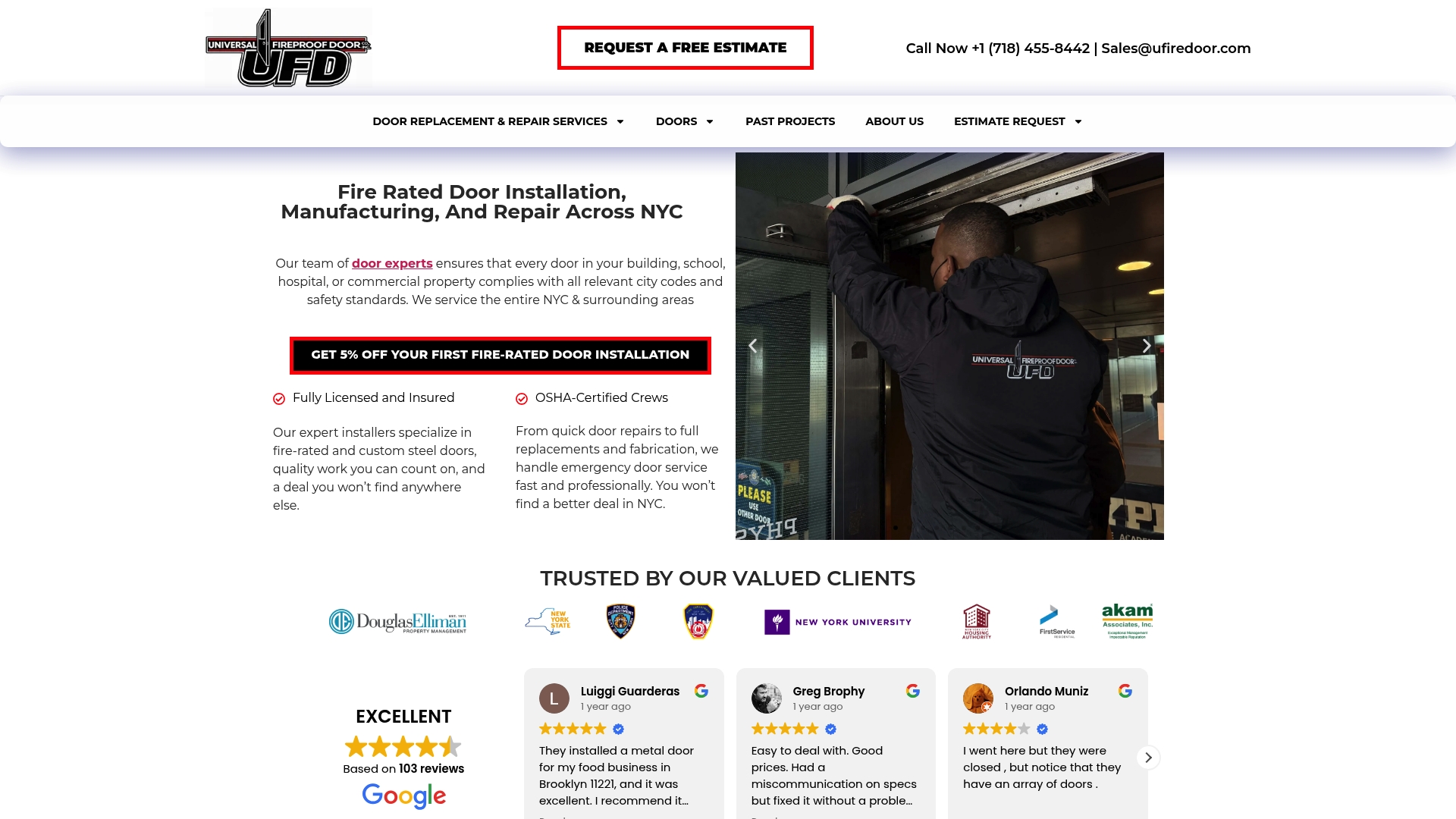
Ufiredoors brings over 20 years of New York-based manufacturing and installation experience to every project. As a local supplier and installer of fire-rated steel doors built with UL-approved materials, Ufiredoors delivers complete door systems, not just components, to property managers, contractors, and developers across the Northeast. Every package includes matching frames, hardware schedules, and full code documentation.
Fast lead times matter on real projects, and Ufiredoors backs that with in-house fabrication capable of steel door builds completed in three to five days. Emergency repair services are also available for urgent replacement situations that can’t wait. From front entrance systems to roof access doors and commercial storefront assemblies, every solution is sourced, built, and installed by a team that knows New York codes inside and out.
Schedule a free site estimate and get a written quote that includes your full hardware schedule, lead time confirmation, and code documentation.
FAQ
What makes local door suppliers better for compliance?
Local suppliers understand the specific building code requirements for your jurisdiction, including state and city-level amendments that national suppliers may not track. They also provide the submittal documentation and labeled components required for fire-rated assembly inspections.
How much faster can local suppliers deliver compared to national ones?
Delivery timelines vary, but local suppliers with regional inventory can typically fulfill urgent orders within 24 to 48 hours. National suppliers shipping from out-of-region warehouses often require one to two weeks for standard orders and longer for custom specs.
What is a complete door system and why does it matter?
A complete door system includes the slab, frame, hinges, lockset, closer, and all hardware specified and verified together before shipping. Sourcing these as a coordinated package prevents the component mismatches that cause field rework and schedule delays.
Can local suppliers handle fire-rated door requirements in New York?
Yes. Established local suppliers in New York specialize in fire-rated steel door assemblies built with UL-approved materials and documented to meet NYC Building Code egress and fire separation requirements.
How do I evaluate a local door supplier before committing?
Ask for references from projects in comparable building types, request a sample hardware schedule with your quote, and confirm they provide shop drawings and written lead times. Suppliers who offer factory test fits before shipping demonstrate the kind of quality control that prevents on-site problems.