
An access control door is defined as a physical entry point managed by an electronic security system that verifies credentials before granting or denying access. These systems replace traditional mechanical keys with card readers, biometric scanners, PIN pads, or mobile credentials. The result is a door that logs every entry attempt, revokes access instantly, and enforces who can enter which space and when. For any organization managing multiple entry points or sensitive areas, understanding how these systems work is the first step toward building real security.
What is an access control door system and how does it work?
An access control system is an integrated electronic security framework that replaces keys with credential verification, decision logic, and automated lock release. That definition matters because it shifts the focus from the door itself to the entire system behind it.

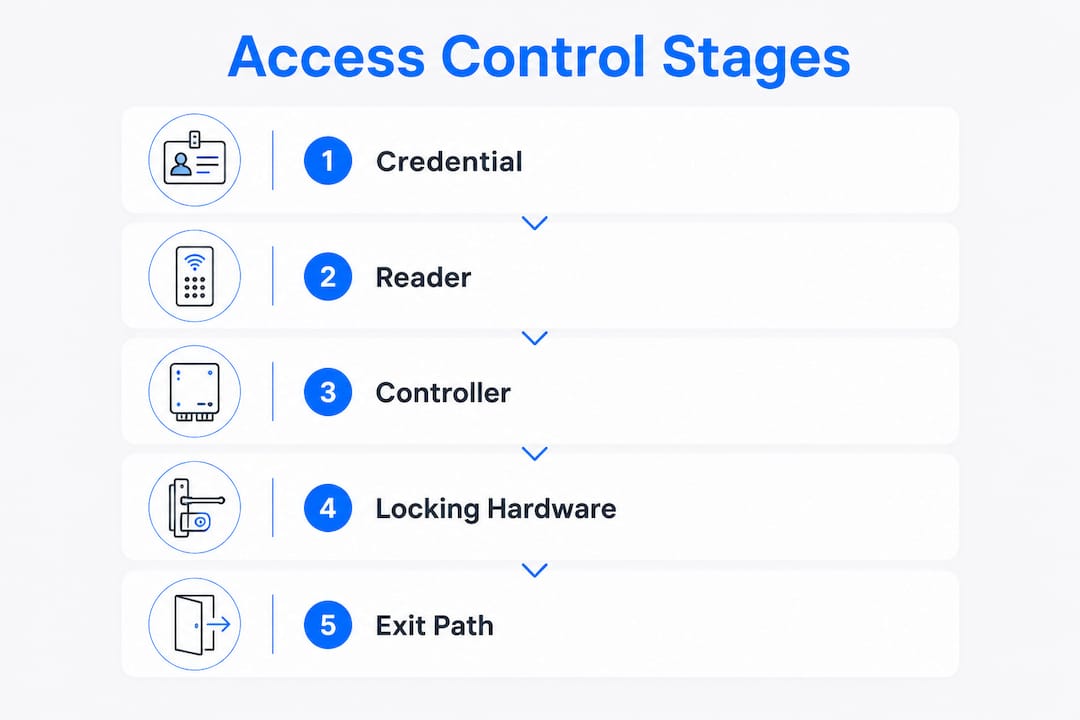
The process follows a clear sequence. A person presents a credential at a reader mounted on or near the door. The reader sends that credential data to a controller, which checks it against a stored access policy. If the credential matches an authorized profile, the controller signals the locking hardware to release. The door opens, and the event is logged with a timestamp and user identity.
Every component in that chain carries equal weight:
- Credential: The identity token. Common formats include proximity cards, key fobs, PIN codes, mobile apps, and biometric data such as fingerprints or facial recognition.
- Reader: The device that captures credential data. Readers range from basic card swipe units to multi-factor readers combining card and PIN.
- Controller: The decision engine. It holds access rules, communicates with readers, and triggers lock release.
- Locking hardware: Electric strikes, magnetic locks, or electrified mortise locks hold the door secure until the controller authorizes release.
- Power supply: A dedicated power source with battery backup keeps the system active during outages.
- Exit hardware: Motion sensors, push bars, or request-to-exit buttons allow safe egress without a credential.
Electronic access control allows instant access revocation and detailed logs, replacing traditional lock and key systems that carry significant security gaps. A lost key requires a lock change. A lost card requires one click in the software to deactivate it.
Pro Tip: Always specify a battery backup unit rated for at least four hours of operation. Power outages are a common attack vector, and a system that fails open during a blackout defeats its own purpose.
What physical security measures complement access control doors?
Electronic access control is only as strong as the door it protects. A sophisticated card reader mounted on a hollow-core door with a weak frame offers almost no real protection. Physical door security measures are the foundation that electronic systems build on.
Reinforcing doors with Grade 1 deadbolts, structural screws in strike plates, and extended strike plates drastically increases forced entry resistance. Strike plates should extend 8–12 inches along the door frame to distribute impact across a wider area. A standard strike plate held by half-inch screws into soft wood fails in seconds under a kick. Replacing those screws with 3-inch fasteners anchored directly into wall studs changes the physics of forced entry entirely.
Door frames and hinges deserve equal attention. Hinge reinforcement is vital for outward-swinging doors, which require security hinges with non-removable pins to prevent door removal by an attacker who simply taps out the hinge pins. This is the detail most organizations overlook when budgeting for access control upgrades.
The table below compares common physical security measures by threat type and effectiveness:
| Physical measure | Threat addressed | Effectiveness |
|---|---|---|
| Extended strike plate (8–12 in.) | Door kick-in | High |
| 3-inch frame screws into studs | Frame separation | High |
| Security hinges with fixed pins | Hinge-side removal | High |
| Multipoint locking mechanism | Pry attacks | High |
| Reinforced door slab (steel core) | Panel breach | High |
Certified doorsets provide the clearest benchmark for physical security. PAS 24:2022+A1:2024 certified doorsets resist defined attack tests, significantly raising the difficulty of forced entry and supporting compliance with building regulations. The standard covers the entire doorset as a tested combination, meaning the door slab, frame, multipoint lock, cylinder, and installation method must all meet the specification together.
Pro Tip: Specify a TS 007 three-star rated cylinder when selecting hardware for a certified doorset. This rating confirms resistance against lock snapping, picking, and drilling, which are the three most common cylinder attacks.
What are the different types of access control doors and features available?
Access control door systems vary widely in scale, technology, and integration depth. Choosing the right type depends on the number of doors, the sensitivity of the spaces, and the organization’s IT infrastructure.
Standalone systems control a single door without network connectivity. They store access rules locally on the controller and require manual updates when credentials change. These suit small offices, storage rooms, or residential applications where simplicity matters more than centralized management.
Networked systems connect multiple doors to a central software platform. Administrators can update access policies, pull audit logs, and receive alerts from any browser or mobile device. Large commercial buildings, hospitals, schools, and warehouses rely on networked systems because managing dozens of doors individually is not practical.
Authentication methods fall into three categories:
- Token-based: Cards, fobs, and mobile credentials. Fast and convenient, but tokens can be lost or shared.
- Knowledge-based: PIN codes. Low cost, but PINs can be observed or shared.
- Biometric: Fingerprint, iris, or facial recognition. Highest identity assurance, but higher hardware cost and privacy considerations.
Locking hardware also varies by application. Electric strikes release the latch when powered, making them common in doors that must fail secure during outages. Magnetic locks hold the door closed with electromagnetic force and release when power cuts, making them suitable for emergency egress doors where fail-safe operation is required by fire code.
Integration with building systems adds another layer of value. Access control platforms can connect with video surveillance, visitor management software, elevator controls, and HVAC systems. A visitor badge issued at reception can automatically grant access to specific floors for a defined time window. That kind of door access management reduces administrative overhead while tightening security.
How can organizations implement and maintain access control door security?
Effective implementation starts before any hardware is ordered. A clear plan covering every entry point, the credential type, the power supply path, and the exit hardware prevents costly rework during installation.
- Map every access point. List all doors that need control, including service entrances, stairwells, and loading docks. Organizations routinely secure front entrances while leaving side doors unmonitored.
- Select certified components. Substituting components in certified doors can void certification and insurance. Use full tested combinations from the start, not mix-and-match hardware.
- Plan the exit path. Every controlled door needs a compliant egress solution. Request-to-exit sensors, push bars, and emergency release hardware must meet local fire and life safety codes.
- Use professional installation. A professional installation ensures that readers are mounted at the correct height, cables are protected from tampering, and locking hardware is aligned for reliable operation. Poor installation is the most common cause of system failures in the first year.
- Establish a credential management policy. Define who approves access requests, how quickly credentials are deactivated when an employee leaves, and how often access logs are reviewed.
- Schedule regular maintenance. Test lock release times, inspect door closers, check battery backup levels, and update firmware on controllers at least twice per year.
Smart locks improve convenience but do not increase forced-entry resistance unless the physical door hardware is upgraded alongside them. This is the most common mistake organizations make: they install an electronic credential system on a door that a determined person could breach in under a minute with physical force.
For properties in dense urban environments, combining electronic access control with reinforced steel doors and certified hardware creates a layered defense that addresses both opportunistic and targeted threats. Ufiredoors provides door security guidance specifically for urban commercial and residential properties where both threat density and compliance requirements are high.
Key Takeaways
An access control door system is only as effective as its weakest component, whether that is the credential, the controller, the locking hardware, or the physical door itself.
| Point | Details |
|---|---|
| System completeness matters | Every component from credential to exit hardware must function correctly or security is compromised. |
| Physical reinforcement is non-negotiable | Electronic readers on weak doors offer minimal protection; reinforce frames, hinges, and strike plates first. |
| Certification covers the full doorset | PAS 24:2022+A1:2024 applies to the entire combination; substituting one component voids compliance. |
| Credential management is ongoing | Access policies must be updated immediately when personnel change to prevent unauthorized entry. |
| Professional installation prevents failures | Correct mounting, cable protection, and hardware alignment are the most common points of failure in new systems. |
Why electronic access control is only half the answer
I have seen this play out more times than I can count. An organization invests in a well-specified card reader system, installs it on every front door, and then considers the security problem solved. Six months later, someone walks through a side entrance that was never addressed, or a door fails because the frame was never reinforced and a single hard kick separated it from the wall.
The uncomfortable truth about access control is that the electronic layer gets all the attention because it is visible and measurable. You can pull a report showing every entry event. You can see the credential database. What you cannot see as easily is whether the door slab is solid steel or hollow core, whether the strike plate screws reach the studs, or whether the hinge pins can be tapped out in thirty seconds.
Mixing components in certified doors risks voiding certification and insurance, and that is a lesson that usually arrives after a claim is denied. The standard does not care that you used a high-quality cylinder from a reputable brand if it was not part of the tested combination. Compliance is binary.
My recommendation is to treat the door as a system, not a collection of parts. Start with the physical door and frame. Confirm the slab material, the frame anchoring, and the hinge specification before selecting any electronic hardware. Then layer the credential system on top of a door that can actually resist attack. That sequence produces security. The reverse produces the appearance of security.
— Esteban
Ufiredoors: steel door solutions built for access control integration
Ufiredoors manufactures and installs fire-rated steel doors and frames built to support access control systems in commercial, residential, and industrial properties across New York. Every door is fabricated locally using UL-approved materials, which means the physical foundation of your security system meets verified standards before any electronic hardware is added. Ufiredoors offers steel stiffened door options with free site estimates, so you can confirm the right specification for your property before committing to a build. With over 20 years of experience and fast lead times, Ufiredoors delivers complete door solutions from fabrication through installation and ongoing maintenance. If your access control upgrade starts with the door, it starts in the right place.
FAQ
What is an access control door?
An access control door is a physical entry point managed by an electronic system that verifies credentials such as cards, PINs, or biometrics before granting entry. The system logs every access event and allows administrators to revoke credentials instantly.
What are the main components of an access control system?
A complete access control system includes a credential, reader, controller, power supply, locking hardware, and exit path hardware. Failure in any one component compromises the security of the entire door.
Does electronic access control replace the need for a strong physical door?
Electronic access control does not replace physical door security. Smart locks and card readers do not increase forced-entry resistance unless the door slab, frame, hinges, and strike plate are also reinforced.
What does PAS 24 certification mean for a door?
PAS 24:2022+A1:2024 is a British standard that certifies a complete doorset, including the slab, frame, lock, and cylinder, against defined attack tests. Substituting any component in the tested combination voids the certification.
How often should access control door systems be maintained?
Access control systems should be tested and inspected at least twice per year. Maintenance checks should cover lock release timing, battery backup levels, door closer function, and controller firmware updates.